Dug-Up Seminary Hills–Telangkhedi Road Turns ‘Accident-in-Waiting’ Spot: No Barricades, No Lights, Ambulance Forced to Turn Back


Published: May 11, 2026 | Category: Nagpur Local | Dharampeth zone | Seminary Hills Telangkhedi road | By: Nagpur Updates Desk
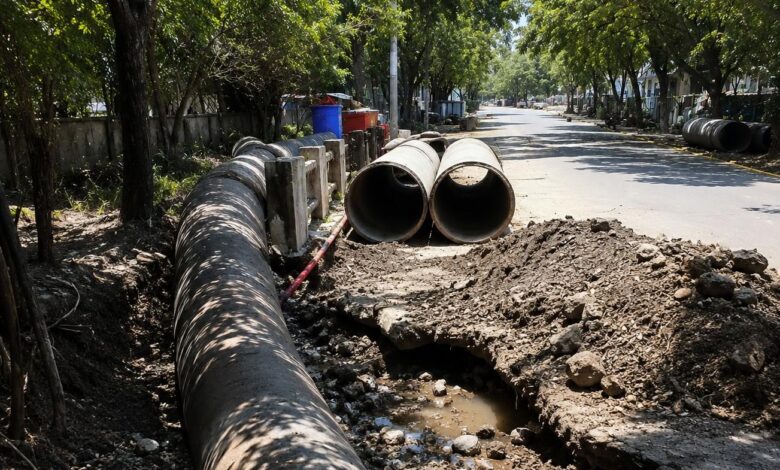
A dangerous and deeply irresponsible situation has been allowed to develop on one of Nagpur’s regularly used roads — the stretch connecting Seminary Hills to Telangkhedi — where a deep trench dug for pipeline work has effectively split the road, left motorists navigating through a hazardous obstacle course, and in one alarming incident, forced an ambulance to turn back from a potentially time-critical emergency response.
The dug-up stretch, located near the Mother Dairy plant and the NCC Group headquarters, has been excavated for the laying of a water pipeline. What should have been a routine civic infrastructure works site — one that is properly barricaded, clearly signposted, and well-lit — has instead become a textbook example of how not to manage road excavation in a busy urban area. The result is a stretch of road that residents and commuters are now openly calling an “accident waiting to happen”.
The Ground Reality: A Trench That Has Split the Road
A visit to the site reveals the severity of the situation. The trench, dug across the width of the road, has physically divided the carriageway — leaving barely enough space for even a single two-wheeler to squeeze through on one side. Four-wheelers face an even more desperate situation: they are simply unable to navigate through the narrow gap left by the excavation and are being forced to execute U-turns at the site, creating significant traffic congestion and confusion on an otherwise busy road.
The barricading that has been put in place is woefully inadequate. Authorities have placed partial barricades on only one side of the trench — allowing a narrow passage for two-wheelers approaching from that direction — while the opposite side, approaching from the CP Club, remains completely exposed. There are no proper warning signs, no reflective markers, no safety lights, and no channelising devices to guide motorists safely through or around the excavation.

After sunset, the situation deteriorates from dangerous to potentially deadly. The area already suffers from non-functional streetlights, plunging the road into near-total darkness during evening and night hours. Combined with the absence of reflectors or warning lights at the trench site, the excavated stretch becomes virtually invisible to approaching motorists until they are right upon it — leaving no room for reaction, especially for two-wheeler riders travelling at even moderate speeds.
The Ambulance Incident: A Wake-Up Call That Must Not Be Ignored
Among the multiple alarming incidents reported at this site, one stands out with particular urgency — the case of an ambulance that was forced to turn back because it could not navigate through the dug-up road.
The ambulance driver described the incident with chilling clarity: “Had it been an emergency, we would have lost crucial time changing the route.”
This single statement encapsulates everything that is wrong with how this excavation has been managed. Roads in residential and mixed-use urban areas serve as critical corridors for emergency vehicles. An ambulance delayed by even a few minutes on its way to a medical emergency can mean the difference between life and death for a patient. The fact that a pipeline excavation — a planned, pre-approved infrastructure activity — has been conducted in a manner that forces ambulances to turn back is not just a civic failure. It is a potentially life-threatening administrative negligence that demands immediate and unequivocal correction.
Residents Speak Out: Anger, Fear and Demand for Action
Locals and regular commuters who use the Seminary Hills–Telangkhedi road daily have expressed deep anger over the complete absence of safety planning at the excavation site.
Deepak Korgaonkar, a resident of the area, put it bluntly: “There are no warning boards or lights. At night, the trench is almost invisible. Someone is bound to fall into it.”
Another commuter echoed the frustration: “This road is frequently used, and yet the work has been left incomplete and unsafe. Shockingly, no proper precautions have been taken.”
The anger among residents is entirely justified. Under established NMC guidelines and standard public works safety protocols, any contractor digging up a public road is required to:
- Erect proper barricading on all sides of the excavation — not just one
- Install reflective markers and warning signage at adequate distances from the trench in both directions
- Provide lighting at the excavation site during night hours
- Ensure that adequate passage width is maintained for emergency vehicles at all times
- Display the contractor’s contact details and the work completion timeline at the site
None of these basic requirements appear to have been complied with at the Seminary Hills–Telangkhedi site.
The Missing Elements: A Safety Checklist That Was Ignored
A systematic look at what is missing at this excavation site reveals just how comprehensively the basic safety protocols have been disregarded:
No proper barricading: Only one side has partial barricades. The CP Club approach side is completely exposed — leaving motorists coming from that direction with no warning until they are directly in front of the trench.
No warning signage: There are no advance warning boards on either approach to the excavation site informing motorists that road work is in progress ahead and that they should slow down and proceed with caution.
No reflectors: The absence of reflective markers means that vehicle headlights — the only source of illumination on this darkened stretch after sunset — do not provide adequate advance warning of the obstruction ahead.
Non-functional streetlights: The pre-existing failure of streetlights on this stretch — a separate civic infrastructure failure — has compounded the danger created by the excavation. Two civic failures converging at the same spot create a danger greater than the sum of their parts.
No emergency vehicle corridor: As the ambulance incident demonstrates, no arrangement has been made to ensure that emergency vehicles can pass through the area without being forced to divert.
Dharampeth Zone Official Acknowledges, Promises Action
When TOI reached out to the relevant civic authority, Rajkumar Meshram, Assistant Commissioner of the Dharampeth Zone, acknowledged the issue and promised prompt corrective action.
Meshram said: “The road has been dug up for pipeline work. We were not informed about the lack of barricading and signage on one side. I will immediately deploy officials to the spot to ensure necessary safety measures are implemented.”
While the acknowledgement is welcome, residents are rightly sceptical about whether the promised action will be swift and sufficient. The Assistant Commissioner’s statement that he was “not informed” about the inadequate barricading raises its own questions — if the civic administration is not actively monitoring active road excavation sites within its jurisdiction for compliance with safety protocols, what mechanism exists to prevent similar situations from occurring across the city?
A Systemic Problem: Nagpur’s Road Digging Culture
The Seminary Hills–Telangkhedi incident is not an isolated one. Nagpur has a well-documented problem with road excavations being conducted without adequate safety measures — a reality that has been highlighted repeatedly over the years, from waterlogged craters on Kamptee Road to open trenches outside school gates.
Just as the city’s civic administration has been struggling to address poor public infrastructure at the Nagpur Passport Office in Sadiqabad and the ongoing delay in the Bhande Plot–Dighori flyover, the management of road excavation sites reflects a broader pattern of civic works being executed without adequate regard for the safety and convenience of the public they are supposed to serve.
The root of the problem lies in a combination of factors: contractors cutting corners on safety measures to reduce costs, inadequate supervision by civic officials, the absence of real-time monitoring mechanisms for active excavation sites, and insufficient penalties for contractors who fail to comply with safety norms.
What Needs to Happen — Immediately
The situation at Seminary Hills–Telangkhedi demands urgent corrective action on multiple fronts:
Immediate steps:
- Full barricading on both sides of the trench, including the CP Club approach
- Installation of reflective markers and warning signboards at least 50 metres from the excavation in both directions
- Temporary lighting at the excavation site to ensure visibility after dark
- Repair of the non-functional streetlights on this stretch as an emergency measure
- Ensuring a minimum passage width for emergency vehicles at all times during the excavation
Longer-term measures:
- Mandatory safety audits of all active road excavation sites in Nagpur by civic officials
- Strict penalty enforcement against contractors who fail to comply with barricading and signage requirements
- A centralised dashboard tracking all active road digs in the city — accessible to the public and updated in real time
The residents of Seminary Hills and the regular commuters on the Telangkhedi road deserve a basic guarantee of safety on a public road. That guarantee has been comprehensively broken by the current state of this excavation site. The Dharampeth Zone administration must act — not tomorrow, not next week, but today.
Nagpur Updates will continue to monitor this situation and report on whether the promised safety measures are actually implemented at the Seminary Hills–Telangkhedi excavation site.
Tags: Seminary Hills Nagpur, Telangkhedi Road, Road Safety Nagpur, NMC Nagpur, Pipeline Work, Nagpur Civic Issues, Dharampeth Zone, Nagpur Local News, Road Accident Nagpur