


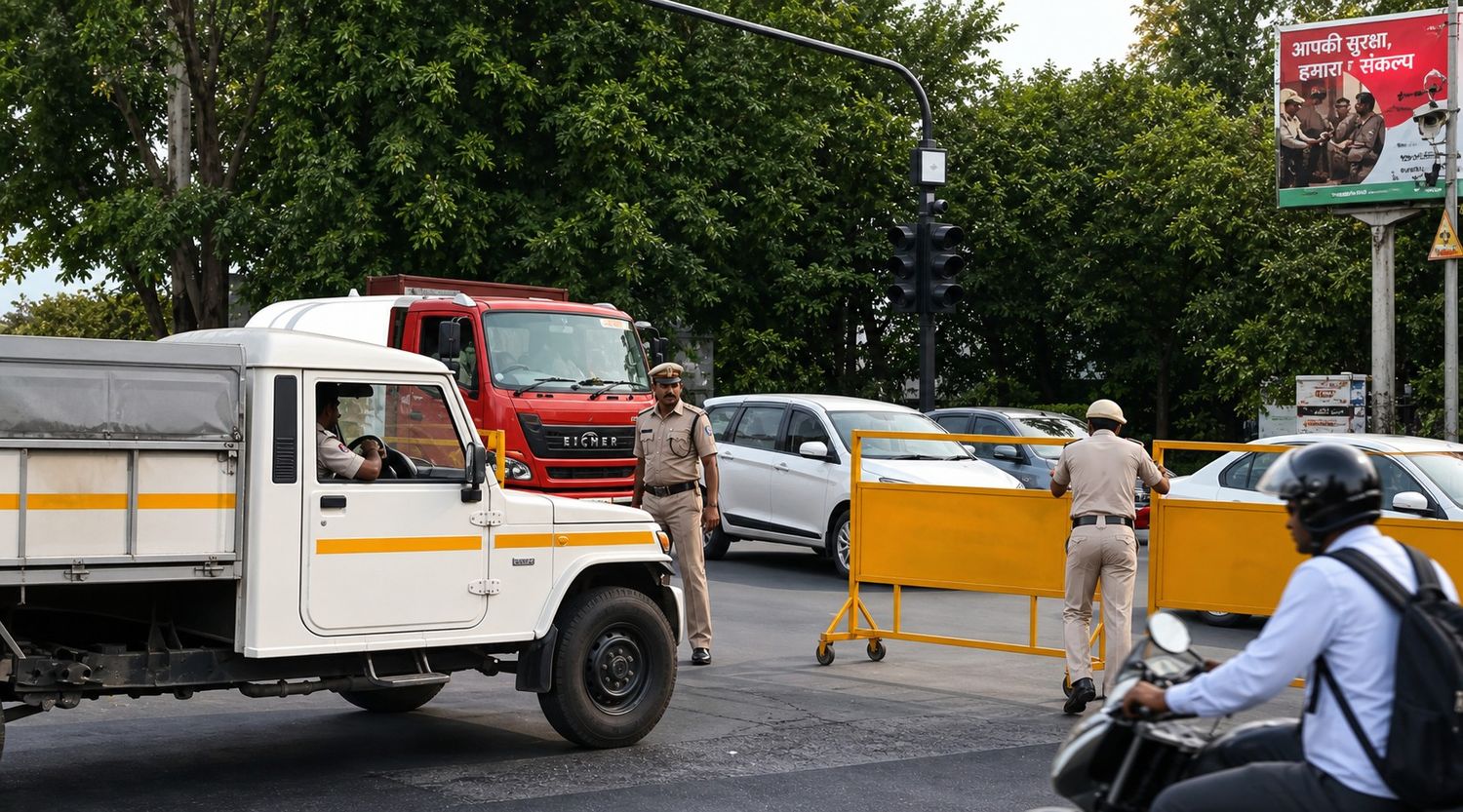
Nagpur, May 5, 2026. Nagpur Traffic Police : If you drive on Wardha Road during the evening rush hour, you already know what has happened. The brief period of relative relief that commuters experienced over the past year and a half — when traffic between Morris College T-Point and Ajni Square had been significantly improved through lane management and turn restrictions — is over. The U-turn facility at Ajni Square has been removed. The intersection is a bottleneck again. And the daily crawl that once took 30 minutes for a distance that should take five is back.
For the thousands of Nagpur commuters who use Wardha Road daily — one of the city’s most critical arterial corridors, connecting the airport, MIHAN, Wardha district, and the southern residential belt to the city centre — this is not just frustrating. It is the latest episode in a years-long story of a traffic problem that has been partially solved, politically complicated, reversed, and partially solved again — without ever being permanently fixed.
The Wardha Road Problem: Four Years of Crawling
To understand why the removal of the Ajni Square U-turn matters so much, you need to understand the scale of the problem that existed before the traffic experiments of 2024.
Traffic on Wardha Road has faced severe jams since the opening of the new Ajni Road at Kriplani Square. For the past four years, motorists have crawled from Rahate Colony T-Point to Ajni Square, particularly during evening rush hours when two traffic signals — at Rahate Colony Square and Kriplani Square — created bottlenecks. Commuters often found themselves waiting for 2–3 green lights just to move a short distance.
In recent months before the 2024 experiment, vehicles plying on the Shaheed Govari Flyover were taking almost 30 minutes for four-wheelers to cross the distance from Morris College T-Point to Ajni Square during peak hours.
Thirty minutes. For a distance of roughly 2.5 kilometres. That is a speed of approximately 5 kilometres per hour — barely faster than walking. Every evening, Monday to Saturday, thousands of vehicles — office workers heading home, goods vehicles, schoolchildren in auto-rickshaws, airport-bound passengers — were subjected to this crawl with no alternative.
This was not a new problem. It had been building for four years. Nagpur Traffic Police had received complaints consistently. Citizens had raised it in public forums, on social media, and through formal civic channels. And for four years, nothing had decisively changed.
September 2024: The Experiment That Worked
In September 2024, then-DCP Traffic Archit Chandak decided to try something different. From September 23 to 28, commuters were prohibited from making a right turn from Ajni Chowk to Morris College T-Point — a five-day trial of a No Right Turn policy on the corridor.
The results were immediate and dramatic. The route now took just five minutes to cover — down from the previous 30 minutes — thanks to the changes implemented by Nagpur Traffic Police.
The trial revealed that about 80% of traffic on this route moves straight, with only 20% requiring right or U-turns. This single data point explains everything. The bottleneck at Rahate Colony Square and Kriplani Square was being caused by a minority of vehicles — those needing to turn right — blocking the majority of traffic that simply needed to go straight. Removing the right turns allowed the 80% to flow freely, eliminating the queue-within-a-queue that had been creating the 30-minute crawl for years. nagpurupdates
Citizens responded with rare enthusiasm for a traffic enforcement measure. Many citizens requested its continuation to address traffic bottlenecks. The public, it turned out, was entirely willing to accept the inconvenience of not being able to turn right — because the benefit of a 25-minute reduction in daily commute time vastly outweighed that inconvenience. nagpurupdates
September 30, 2024: The Experiment Ends — And the Questions Begin
Then, on September 30, 2024 — just two days after the five-day trial ended — the traffic police decided to restore the old system. The traffic police invited suggestions from citizens regarding the traffic experiment. nagpurupdates
However, there were murmurs in administrative circles about pressure from certain quarters to prevent the City Police from continuing the experiment. nagpurupdates
This is the line that Nagpur’s commuting public has never forgotten — and never forgiven. An experiment that reduced a 30-minute crawl to 5 minutes, that had public support, that was backed by data showing 80% of traffic goes straight — was quietly discontinued. No official explanation was given for why a demonstrably successful traffic management measure could not be made permanent. The “murmurs about pressure from certain quarters” were widely interpreted as referring to pressure from commercial establishments, auto-rickshaw unions, or area-specific interest groups whose business or operations were inconvenienced by the turn restrictions.
October 2024: A Partial Return Under New Rules
Following public backlash, right turns were prohibited at key intersections, including Rahate Colony Square and Kriplani Square, between 6:30 PM and 8:30 PM from Monday to Saturday. Signal timings at Rahate Square and Krupalani Square were set to blinker mode, and right turns were closed at both squares during peak hours.
The “No Right Turn” policy during peak hours from 5:30 PM to 8:30 PM resulted in a reduction in travel time from 20–25 minutes to just 5–6 minutes between Morris College T-Point and Ajni Square.
This was a partial restoration — limited to peak hours only, rather than the full-day restriction of the original trial. But it provided meaningful relief during the hours when the bottleneck was most severe. Commuters adapted. The route became manageable again during evenings. The U-turn at Ajni Square, under the revised October 2024 rules, was accessible via specific diversions — traffic from the Ajni Flyover and Congress Nagar T-Point areas was routed via a U-turn through the Central Jail Cutting to reach Dikshabhoomi or Lokmat Square.
May 2026: The U-Turn Is Gone — And the Bottleneck Is Back
This brings us to the current situation. The Times of India’s May 2026 report — the article that prompted this investigation — confirms that the U-turn facility at Ajni Square has now been removed entirely. The intersection has reverted to bottleneck status. Commuters who had experienced improvement are back to the frustrating reality of extended waits at Rahate Colony Square and Kriplani Square.
The removal of the U-turn is not a traffic management improvement. It is a regression. The specific diversion route that allowed vehicles needing to reach Dikshabhoomi, Lokmat Square, and other destinations on the far side of the Wardha Road corridor has been eliminated — forcing those vehicles back into the main Ajni Square intersection, adding conflicting movements to what was already a challenging junction.
The result is predictable and has already been confirmed by commuters: the evening peak-hour bottleneck on Wardha Road is back at its worst.
Why Does This Keep Happening? The Structural Problem
The Wardha Road–Ajni Square story is not really a traffic management story. It is a governance story. And it illustrates a pattern that repeats itself across Nagpur’s infrastructure and civic management: a problem is identified, a solution is found that works, the solution is reversed under pressure, a partial version of the solution is restored, and eventually that too is undone — leaving the city roughly where it started, having spent significant administrative energy going in circles.
The fundamental issue at Ajni Square has been known since before 2024. The intersection handles a volume of traffic that exceeds its designed capacity — particularly since the opening of the new Ajni Road at Kriplani Square added a new traffic stream to an already congested node. The long-term solution is not traffic signal timing adjustments or turn restrictions — these are management tools that improve flow within the existing infrastructure. The long-term solution is infrastructure: an underpass, a flyover, or a grade-separated interchange at Ajni Square that physically separates conflicting traffic movements.
Such a solution has been discussed in various planning documents and civic forums over the years but has not been executed. Until it is, Wardha Road’s commuters are dependent on traffic management measures that are vulnerable to political pressure, administrative changes, and the shifting priorities of whoever currently holds the DCP Traffic position.
The Data Case for a Permanent Solution
The data from the September 2024 trial makes the case for permanent action irrefutably. A single, simple traffic management change — restricting right turns between two intersections — reduced travel time on a 2.5-kilometre stretch from 30 minutes to 5 minutes. That is an 83% reduction in travel time. Applied across the thousands of vehicles that use this corridor daily, the economic value of that time saving — in fuel, productivity, and quality of life — is enormous.
If a simple turn restriction produces this result, an infrastructure solution — a grade-separated interchange that permanently eliminates conflicting movements at Ajni Square — would produce comparable or better results on a permanent basis, without requiring constant enforcement or being vulnerable to political pressure.
The cost of building such infrastructure needs to be weighed against the daily economic cost that tens of thousands of Nagpur commuters bear because this bottleneck has not been resolved. When you calculate the cumulative loss of productivity, fuel, and time across a city of over 2.5 million people over four years — it almost certainly exceeds the cost of building a proper intersection solution.
What Commuters on Wardha Road Can Do Right Now
For Nagpur residents who use the Wardha Road corridor daily, here is the practical situation as of May 2026:
The U-turn at Ajni Square is not available. Vehicles that previously used this U-turn to reach Dikshabhoomi, Lokmat Square, and Congress Nagar areas from the Wardha Road side will need to find alternative routes. The most commonly used alternatives include going via Sonegaon, using the Manish Nagar Flyover approach from Nari T-Point, or using the Outer Ring Road for longer journeys.
During evening peak hours — roughly 5:30 PM to 8:30 PM — avoid the Wardha Road corridor between Morris College T-Point and Ajni Square if you have a viable alternative route. The Shaheed Govari Flyover, while also congested, may provide marginally better flow than the ground-level signalised route.
Citizens who want to formally demand a permanent infrastructure solution at Ajni Square can write to the Nagpur Traffic Police at the DCP Traffic office, to NMC’s traffic and roads department, and to their elected ward representatives. The September 2024 data — which demonstrated a 30-minute to 5-minute improvement — is the strongest possible case for action, and it is already on the public record.
Nagpur Updates Will Track This Story
The Wardha Road–Ajni Square bottleneck is one of the most consequential daily quality-of-life issues for a significant portion of Nagpur’s population. Nagpur Updates will continue to track developments on this corridor — including any new traffic management measures by Nagpur Traffic Police and any infrastructure proposals from NMC or the state government.

