


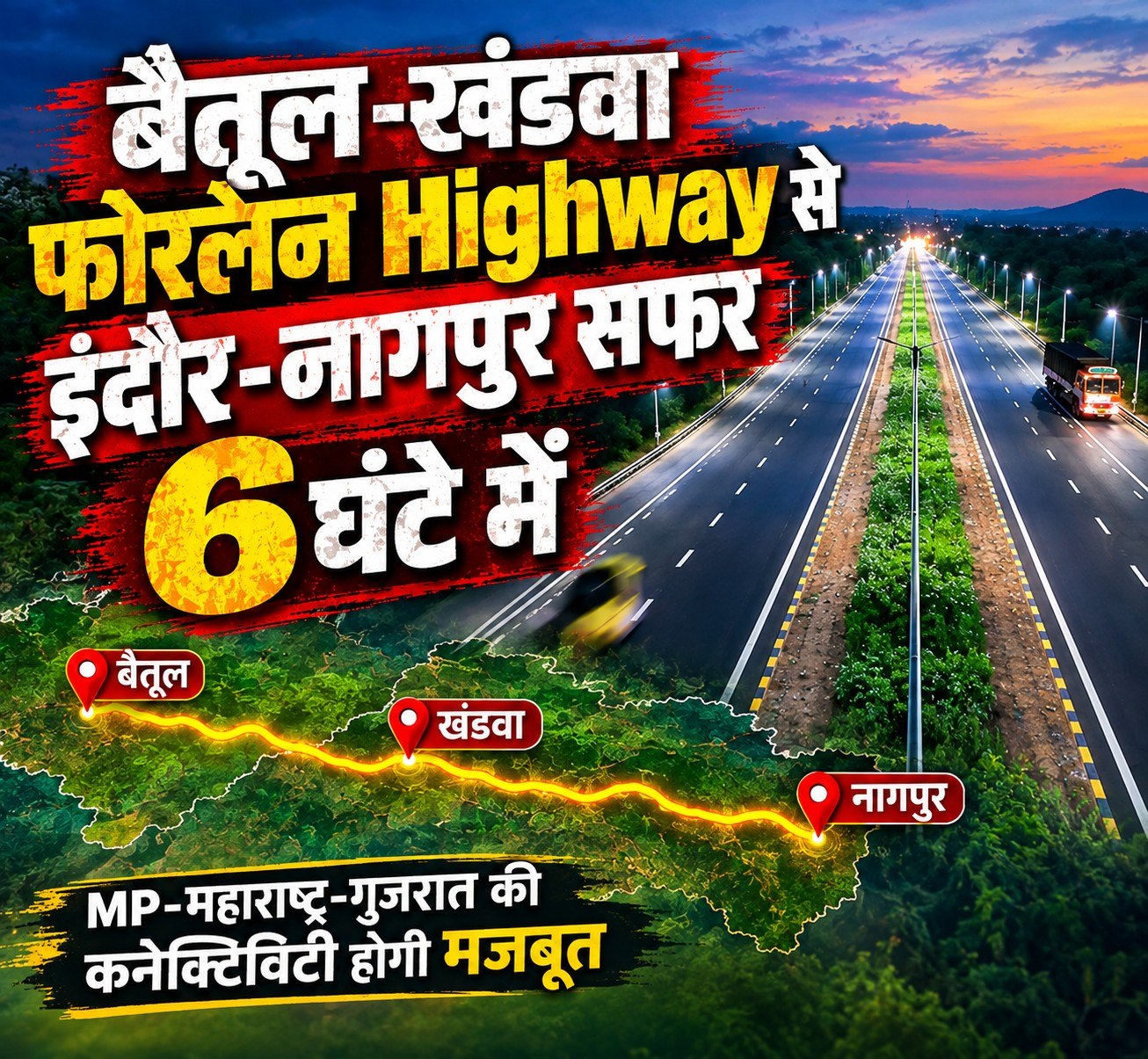
One of the most frustrating journeys in central India is about to become dramatically easier. The Central Government has approved the long-awaited Betul-Khandwa four-lane highway project. Furthermore, once this highway is complete, the travel time between Indore and Nagpur will reduce from the current 13 to 14 hours to just 6 hours. As a result, two of central India’s most important cities will be connected faster than ever before.
This is a massive win for travellers, traders and businesses across Madhya Pradesh and Maharashtra. Moreover, the Rs 1,104.61 crore NHAI project will transform connectivity between the Malwa-Nimar region and Vidarbha. Therefore, the Betul-Khandwa highway is not just a road — it is an economic and social lifeline for the entire central Indian corridor.
Why the Current Journey Takes 14 Hours — The Problem
Anyone who has driven between Indore and Nagpur knows the pain of this route. Furthermore, the current road conditions make the journey far longer than the distance should require.
The route passes through Betul and Khandwa — two of Madhya Pradesh’s most strategically located towns. However, the existing roads are largely two-lane highways. Moreover, the ghat sections between Indore and Khandwa include sharp curves, narrow carriageways and hazardous stretches that force vehicles to slow to a crawl. As a result, a journey that covers approximately 500 kilometres ends up taking 13 to 14 hours for most travellers.
For truck drivers carrying agricultural produce or industrial goods between the two regions, this slow journey translates directly into higher logistics costs. Furthermore, for passengers, a 14-hour road journey is exhausting enough to push many travellers toward more expensive flight options. Therefore, the demand for a faster road link between Indore and Nagpur has been building for decades.
What the Betul-Khandwa Four Lane Highway Includes
The approved project is a comprehensive four-lane highway development. Furthermore, NHAI is the executing agency and the project investment is Rs 1,104.61 crore. As a result, this is one of the most significant highway investments on the Madhya Pradesh-Maharashtra corridor in recent years.
The project includes the development of the Indore-Khandwa corridor under NH-347BG. Furthermore, a key section of this corridor — the 33.4 kilometre Tejajinagar to Balwada stretch — is already 85 to 87 per cent complete with a December 2026 target for opening. The contractor for this section is Megha Engineering and Infrastructure Limited.
A critical feature of this project is the construction of three tunnels through the ghat section between Indore and Khandwa. Furthermore, these tunnels will eliminate the sharp curves and hazardous stretches that currently slow traffic to dangerous speeds in this mountainous section. As a result, travel through the ghats will become both faster and significantly safer.
Moreover, the project includes 24 bridges and a 1.8 kilometre Road Over Bridge. Therefore, the engineering scope of this highway reflects the complexity of the terrain it is crossing.
The Betul Section — Connecting the Full Corridor
The Betul-Khandwa portion of the corridor connects the already-approved and partially complete Indore-Harda-Betul four-lane highway project on NH-47. Furthermore, work on the Indore-Harda-Betul stretch has already begun and vehicles are plying on completed sections.
Together, the Indore-Harda-Betul section and the new Betul-Khandwa section form a continuous four-lane corridor from Indore all the way to Khandwa. Moreover, from Khandwa, the route connects to existing Maharashtra highway networks heading toward Nagpur via Amravati.
As a result, when all sections of this corridor are complete and operational, a traveller leaving Indore can drive on four-lane, high-speed road infrastructure almost continuously until they reach Nagpur. Furthermore, the elimination of the current two-lane bottlenecks and dangerous ghat sections is what produces the dramatic reduction from 14 hours to 6 hours.
Why This Matters for Nagpur — The Strategic Angle
Nagpur’s geographical position as the central point of India makes it a natural beneficiary of every major highway improvement in surrounding states. Furthermore, better road connectivity between Nagpur and Indore has been a long-standing demand from the business communities of both cities.
Indore is Madhya Pradesh’s commercial capital and one of India’s fastest-growing tier-2 cities. Moreover, it is a major centre for textile, pharmaceutical and food processing industries. Nagpur, on the other hand, is the gateway to Vidarbha’s agricultural production and the logistics hub of central India through MIHAN.
The current 14-hour journey between these two cities is a significant barrier to trade. Furthermore, trucks carrying goods between the two cities lose almost a full day in transit each way. As a result, businesses prefer other supply routes or rely on more expensive logistics options.
A 6-hour road connection transforms this equation. Moreover, it makes day-trip business travel between Indore and Nagpur feasible for the first time. As a result, commercial activity between the two cities — and between their surrounding regions — is expected to grow significantly once the corridor is fully operational.
Religious Tourism — Mahakal, Omkareshwar and Vidarbha Connected
Beyond commercial connectivity, the Betul-Khandwa four-lane highway carries significant religious tourism implications. Furthermore, NHAI has specifically highlighted the enhancement of connectivity to major pilgrimage destinations as a key benefit of this project.
Omkareshwar — one of the 12 sacred Jyotirlingas of Lord Shiva — is located near Khandwa on the banks of the Narmada River. Furthermore, Ujjain — home to Mahakaleshwar, another of the 12 Jyotirlingas — is already connected to Indore by a six-lane highway project. As a result, once the Betul-Khandwa corridor is complete, a Nagpur resident wanting to visit both Mahakaleshwar in Ujjain and Omkareshwar in Khandwa can do so in a single comfortable day trip — something that is simply not practical with current road conditions.
Moreover, Burhanpur — an important historical city with Mughal heritage — and Jalgaon — a major agricultural centre connected to Nagpur — also benefit from improved connectivity on this corridor.
The Broader Highway Network Around Nagpur — The Bigger Picture
The Betul-Khandwa highway approval is the latest in a series of major highway investments that are transforming Nagpur’s road connectivity in all directions. Furthermore, Nagpur is already connected to Mumbai via the Samruddhi Mahamarg expressway. Moreover, the Nagpur-Bhandara-Gondia expressway is under planning. The Indora-Dighori flyover — as Nagpur Updates reported recently — is opening on September 15 within the city.
Together, these investments are building a highway network that positions Nagpur as the true road connectivity hub of central India. Furthermore, with the Betul-Khandwa corridor connecting Nagpur to Indore in 6 hours, and the Samruddhi Mahamarg connecting Nagpur to Mumbai in under 8 hours, Nagpur will be within a single working day’s drive of all of India’s major central and western cities.
As a result, the economic arguments for investing in Nagpur — manufacturing, logistics, MIHAN, GMR airport cargo — become even stronger with every highway project that reduces travel time to and from the city.
When Will the Full Corridor Be Ready
The Tejajinagar-Balwada section targeting December 2026 is the most advanced portion of the corridor. Furthermore, the remaining Betul section approvals are fresh and construction will take additional time. As a result, the full 6-hour Indore-Nagpur journey will not be available immediately — it will come in stages as different sections of the corridor are completed.
However, even partial completion of the four-lane sections will produce measurable travel time reductions along the corridor. Moreover, each section that opens adds to the cumulative improvement in journey time.
Nagpur Updates will track the progress of this project and report on the December 2026 opening of the Tejajinagar-Balwada section, which is the first milestone on the path to the full 6-hour Indore-Nagpur corridor.

