


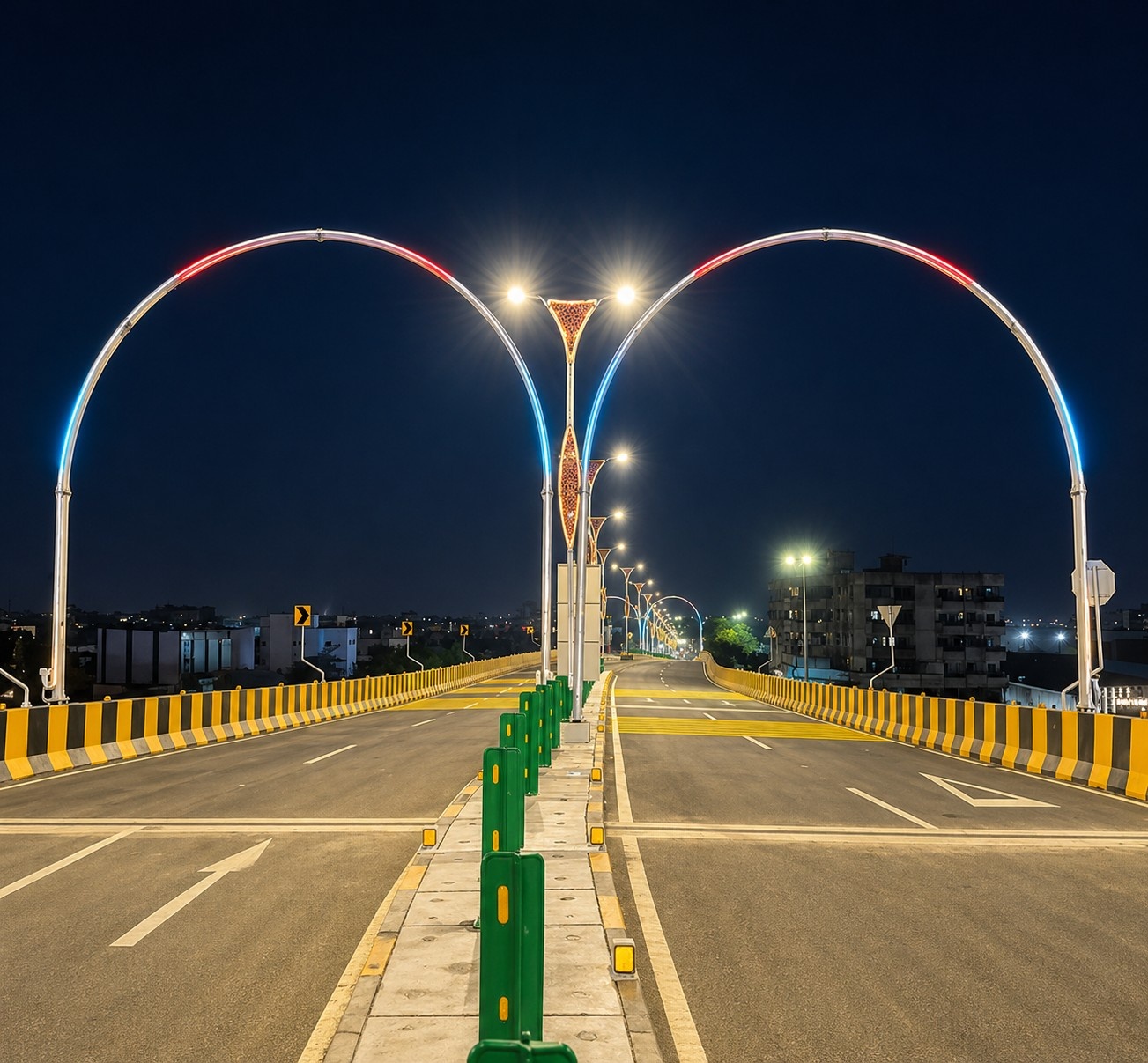
Nagpur, May 1, 2026. Dipti Signal flyover : Drive past the Dipti Signal area in Wardhaman Nagar on any given morning and you will see two things simultaneously: a brand-new, fully built, four-lane Road Over Bridge gleaming in the sun — lights installed, surface complete, structurally cleared — and, a few metres away, the same long, choking traffic jam that has plagued this corridor for years.
The flyover is finished. The jam is not.
The reason is one that Nagpur residents have seen before and never stopped being frustrated by: the bridge cannot be opened until a senior political leader arrives to cut a ribbon, shake hands for the cameras, and formally inaugurate it. Until that ceremony happens — on a date that has not been confirmed — the barricades stay up, the commuters wait, and a multi-crore piece of public infrastructure built with taxpayer money sits idle.
What the Dipti Signal ROB Is — and Why It Was Built
The Road Over Bridge (ROB) at Dipti Signal is located at Railway Crossing No. 73 on the stretch between Itwari and Dighori — historically one of the most congested and accident-prone bottlenecks in East Nagpur. The bridge connects Bhagwan Sambhavnath Chowk to Dipti Signal Road in the Wardhaman Nagar area, providing an elevated crossing over the railway line that eliminates the need for vehicles to stop at a level crossing gate.
Level crossings — where road traffic must stop and wait every time a train passes — are among the most significant sources of urban traffic delay and accident risk in Indian cities. Nagpur has many such crossings, and the one at Dipti Signal has been particularly notorious. Trains on the Itwari-Dighori line pass frequently, and every closure of the crossing gate sends a ripple of congestion through surrounding roads in Satranjipura, Wardhaman Nagar, and the Small Factory Area that can take 15 to 20 minutes to clear.
The ROB was built specifically to eliminate this problem — permanently. With the bridge in place, vehicles cross over the railway line without any interruption, regardless of train movements below. The level crossing gate becomes irrelevant. The ripple congestion disappears.
That is the promise the bridge holds. It is a promise currently being withheld while officials wait for a VIP.
Who Built It — and the Scale of the Project
The Dipti Signal ROB was constructed by the Maharashtra Rail Infrastructure Development Corporation Limited (MRIDC) — commonly known as MahaRail — under the Central Road Infrastructure Fund (CRIF). This funding mechanism reflects a partnership between central government infrastructure finance and state-level execution, with MRIDC serving as the implementing agency.
The bridge is a four-lane structure — two lanes in each direction — giving it the capacity to handle the substantial traffic volumes that characterise this corridor. The project was assigned to the contractor M/s Ansari Erectors for the girder launching phase, with MRIDC overseeing overall construction supervision.
Construction involved significant disruption to the surrounding road network. Traffic diversions were in place for extended periods — including during night-hour girder launching operations in early 2025 — as residents and commuters endured months of inconvenience specifically on the understanding that the finished bridge would make their daily journeys permanently easier.
MahaRail has confirmed that the structure has now been completed and is ready for inauguration. The agency’s announcement described it as a significant victory for Nagpur’s infrastructure and cited the project as an achievement under Chief Minister Devendra Fadnavis’s vision to make Maharashtra “Rail Fatak Mukt” — free of dangerous level crossings.
The project was executed under the managing direction of Rajesh Kumar Jaiswal, Managing Director of MRIDC.
The Problem: “Ready” Is Not the Same as “Open”
Here is where Nagpur residents — and the citizens of virtually every Indian city with similar experiences — find themselves at a familiar breaking point.
The Dipti Signal ROB has cleared all technical inspections. It is structurally safe for traffic movement, confirmed by NMC and MRIDC sources. The lighting poles are installed and functional. The surface is complete. There is nothing technically preventing vehicles from using the bridge today.
Except the barricades. And the ribbon that has not yet been cut.
Sources within the civic administration have acknowledged that the delay is not technical — it is political and ceremonial. The bridge’s formal inauguration requires the attendance of senior political leadership. Coordinating the schedules of ministers, confirming a suitable date, arranging the inauguration event — all of this takes time. And until that coordination produces a confirmed date, the barricades remain in place and the bridge remains closed.
Residents and daily commuters in the area have made their feelings clear. A local trader from Wardhaman Nagar put it bluntly: the flyover is ready for use, the lighting poles are up, yet it remains closed because someone is waiting for a ribbon-cutting ceremony. He described it as a complete mockery of taxpayers’ money.
That sentiment is widely shared. On social media, residents of Satranjipura, Wardhaman Nagar, and the Small Factory Area have been vocal about their frustration. The underlying question is one that no official has been willing to answer directly: if the bridge is safe, who does it protect to keep it closed?
The Human Cost of Waiting
To understand why the delay matters beyond symbolic frustration, consider what the Dipti Signal crossing currently puts residents through every single day.
Vehicles heading from Wardhaman Nagar and the Small Factory Area toward Satranjipura or vice versa must navigate the level crossing — where every train passage closes the gate and adds minutes to every journey. During peak hours, when trains pass frequently and gate closure times overlap with morning and evening commute traffic, the resulting jams force vehicles into narrow internal lanes of the surrounding residential and commercial areas.
Trucks and commercial vehicles serving the Small Factory Area — which is, as the name suggests, an active industrial zone — are particularly affected. Delays in freight movement translate directly into economic costs for businesses in the area. The bridge was partly justified on the grounds of improving freight connectivity to this industrial cluster.
For the residents who live in the lanes that absorb diverted traffic during crossing closures — the families whose streets become unofficial bypass routes — every day the bridge stays closed is another day of noise, congestion, and road wear in front of their homes.
These are not abstract inconveniences. They are daily lived realities for thousands of Nagpur residents who were told, when the construction started and the disruption began, that the end result would make their lives better. The end result is built. Their lives have not yet changed.
A Pattern Nagpur Knows Too Well
The Dipti Signal ROB is not the first completed infrastructure project in Nagpur to sit idle while waiting for a VIP inauguration — and it will not be the last unless the culture that produces this situation is directly challenged.
In November 2025, a separate Nagpur flyover connecting Satranjipura to the Small Factory Area in Wardhaman Nagar — a different project — was similarly reported as complete, barricaded, and awaiting political inauguration while commuters fumed. Residents at that time described it in identical terms: structurally safe, technically cleared, lights installed, and not open because of a ribbon-cutting delay.
The pattern is consistent enough across Maharashtra and indeed across India’s urban infrastructure landscape to be considered systemic rather than accidental. When the opening of public infrastructure becomes a political event — an opportunity for a minister or senior leader to associate themselves with a popular achievement — the timing of that opening is determined not by when the infrastructure is ready but by when the political moment is convenient.
This creates a perverse incentive structure. Citizens bear the inconvenience of construction for months or years. The project is completed with their tax money. And then, instead of immediately accessing what they paid for, they wait additional weeks or months while political schedules are coordinated. The infrastructure is held as a prop for a future photo opportunity.
Civic activists in Nagpur have consistently argued that this practice should be challenged through a simple rule: if infrastructure is technically cleared and structurally safe, it must be opened immediately for public use. A ceremonial inauguration can follow on whatever date politicians prefer. But the public benefit — the reason the infrastructure was built in the first place — should not wait for the ceremony.
What Nagpur’s Commuters Are Asking For
The demand from residents around the Dipti Signal ROB is straightforward and reasonable. Open the bridge immediately for traffic. Allow vehicles to use it now, based on the technical clearance that has already been issued. Schedule the formal inauguration ceremony separately, on whatever date is convenient for the political leadership, and hold it as a standalone event that does not require the bridge to be closed between now and then.
This is not a radical demand. It is the minimum that citizens who funded the project through their taxes are entitled to expect. The bridge was not built for a ceremony. It was built for them.
Several commuters and transport associations in the area have urged the civic administration to take exactly this position — open for use now, inaugurate formally later. It is a solution that serves everyone: citizens get immediate access to infrastructure they have waited years for, and political leaders still get their inauguration moment on a date of their choosing.
Whether the administration will act on this pragmatic approach before a confirmed inauguration date is announced remains to be seen.
Where This Sits in Nagpur’s Broader Infrastructure Story
The Dipti Signal ROB is one piece of a larger infrastructure transformation underway in East Nagpur. The Indora-Dighori flyover project — a massive 7-kilometre elevated corridor divided across two flyovers, two Road Over Bridges, two Road Under Bridges, and an elevated rotary — is also progressing in this part of the city, with Phase II targeting a June 2026 opening.
Together, these projects represent a generational investment in connectivity for an area of Nagpur that has historically been underserved by the city’s infrastructure compared to the Civil Lines, Dharampeth, and South Nagpur corridors. East Nagpur — the Wardhaman Nagar, Satranjipura, Kamptee Road belt — is home to dense residential populations, active industrial clusters, and significant daily freight and commuter traffic that has been strangled for decades by inadequate road infrastructure and level crossings.
When the Dipti Signal ROB opens — whenever that happens — it will be a meaningful improvement for this part of the city. When the Indora-Dighori flyover project is fully complete, East Nagpur’s connectivity will be transformed in ways that residents of the area have waited years to see.
The frustration over the inauguration delay does not diminish the significance of these projects. It simply underscores a principle that civic society in Nagpur needs to assert more forcefully: public infrastructure is not a gift from politicians. It is a delivery on a commitment made to citizens. And deliveries should not wait for ceremonies.

