


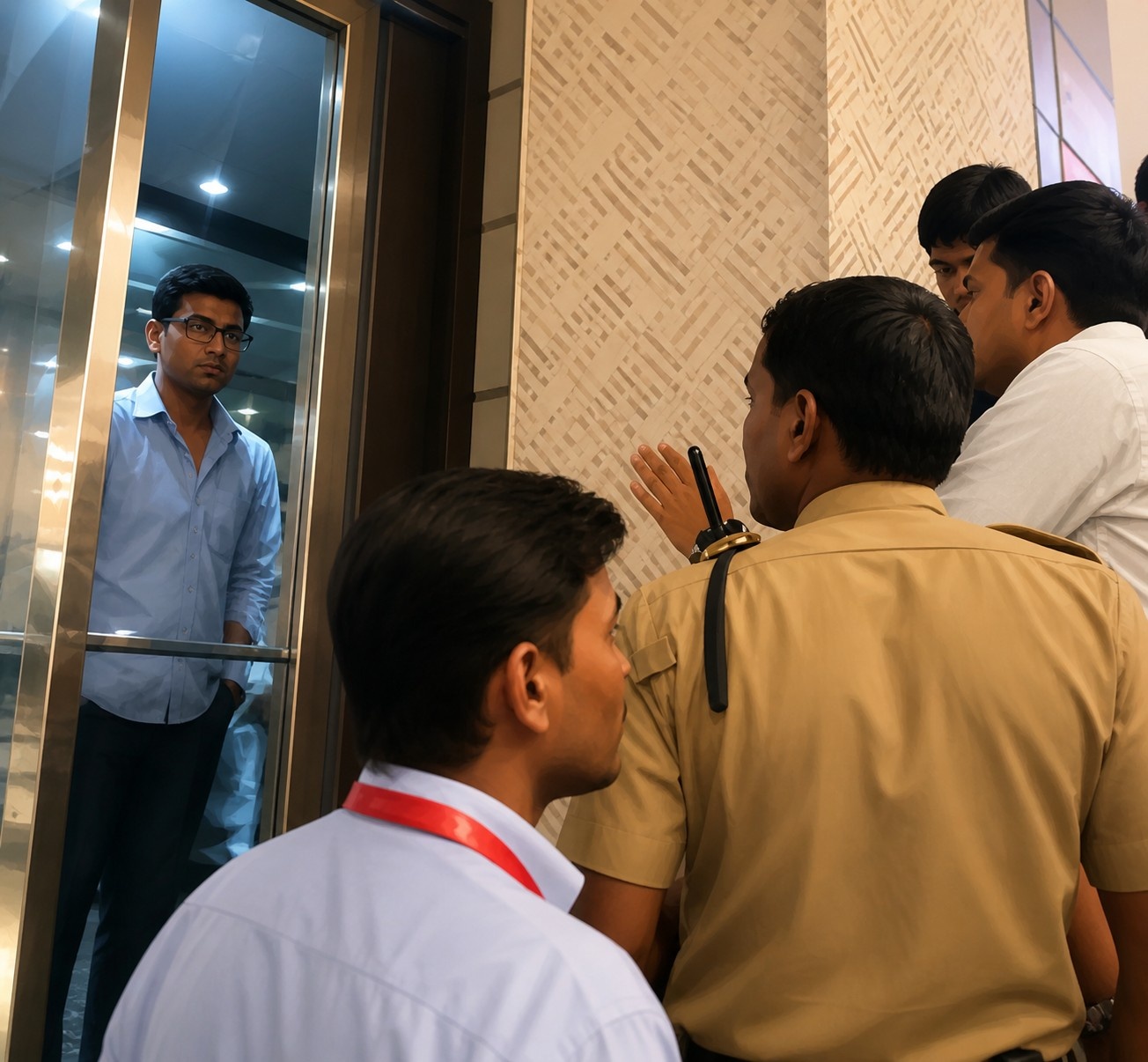
Nagpur, May 2, 2026. What should have been a routine visit to one of Sitabuldi’s busiest shopping destinations turned into a frightening ordeal for five to six people on Saturday when the elevator at Fortune Mall in Sitabuldi suddenly broke down — trapping them inside with no immediate escape and no adequate response from the mall’s administration.
The incident, which occurred on May 2, 2026, quickly escalated from a mechanical failure into a safety crisis. As time passed and the elevator remained stuck, those trapped inside began experiencing difficulty breathing and a suffocating sensation from the enclosed, poorly ventilated space. Panic spread — both inside the elevator and among visitors and bystanders watching helplessly from outside.
What made the situation significantly worse was what did not happen in the critical minutes after the elevator stopped: the mall administration did not respond with urgency.
What Happened — Minute by Minute
The elevator at Fortune Mall, located in the heart of Sitabuldi — one of Nagpur’s most active commercial districts — malfunctioned and came to an abrupt halt with five to six people inside. The exact floor at which the elevator stopped has not been officially confirmed.
The trapped individuals — whose identities have not been publicly disclosed — immediately began calling for help. They contacted mall administration through whatever means were available to them, requesting urgent assistance. According to witnesses at the scene, these calls for help were made repeatedly. And for a period of time, no concrete action followed.
As minutes passed inside the enclosed elevator, the air quality deteriorated. Those trapped began experiencing breathing difficulty and a sensation of suffocation — a common and serious risk when multiple people are confined in an unventilated elevator cabin for an extended period. Their condition, by all accounts, was deteriorating.
Outside the elevator, other visitors and bystanders who became aware of the situation grew increasingly agitated. They could see that people were in distress inside, that the administration was not responding with adequate urgency, and that the situation was worsening. Their anger — loudly and clearly expressed — finally pushed the mall management to act.
The decision was made to break the elevator’s glass panel to create an opening through which the trapped individuals could be safely extracted. Once the glass was broken, all five to six people were brought out safely. Fortunately, no fatalities or serious injuries occurred. Everyone was rescued.
But the question that has followed this incident is one that the rescued individuals, the bystanders, and Nagpur’s wider public are all asking: why did it take public outcry to get the mall administration to act?
The Administration’s Failure — Why It Matters
A malfunctioning elevator is not an unusual event. Mechanical failures happen in buildings across the world. What distinguishes a responsibly managed building from a negligently managed one is how quickly and effectively the emergency response kicks in when something goes wrong.
Standard elevator safety protocols, as prescribed under the Maharashtra Lifts, Escalators and Moving Walks Act and the National Building Code of India, require buildings to have emergency response procedures in place for exactly this type of situation. These procedures include maintaining direct communication between the elevator cabin and building security or management, deploying trained personnel to respond to elevator failures within minutes, having emergency equipment readily available, and — if passengers are in distress — escalating immediately to fire and rescue services if internal response is insufficient.
At Fortune Mall on Saturday, by all available accounts, these protocols were either not in place, not followed, or not followed with adequate urgency. Repeated calls for help from the trapped individuals went unanswered for a significant period. The administration did not act until outside pressure — from angry bystanders — forced them to do so.
This is not a minor procedural gap. In an elevator malfunction involving people in respiratory distress, every minute without rescue is a potential medical emergency. If any of the trapped individuals had had an underlying respiratory condition, a heart condition, or had been particularly vulnerable, the delay could have had fatal consequences.
The Law on Elevator Safety in Maharashtra
Maharashtra has a dedicated regulatory framework for elevators and escalators — the Maharashtra Lifts, Escalators and Moving Walks Act, 1939, which has been updated over the years and whose implementation is overseen by the Labour Department. Under this framework:
Every elevator in a commercial building must be inspected and certified as safe for operation by a licensed inspector at regular intervals — typically annually. The certificate of inspection must be displayed inside or near the elevator.
Building owners and management are responsible for ensuring that elevators are maintained by licensed and competent mechanics, that defects are reported and repaired promptly, and that adequate emergency procedures are in place.
In cases where an elevator failure results in injury or entrapment due to negligence in maintenance or emergency response, the building management can be held liable under both the Maharashtra Lifts Act and relevant provisions of the Bharatiya Nyaya Sanhita (BNS).
Residents and visitors who are aware of elevator safety violations in any Nagpur building — including expired inspection certificates, non-functional emergency alarms, or inadequate maintenance — can file a complaint with the Labour Department, Maharashtra Government, or with NMC’s building inspection division.
Fortune Mall and Sitabuldi’s Commercial Density — Why This Incident Carries Wider Significance
Fortune Mall is located in Sitabuldi — arguably the single most commercially dense area in Nagpur. The Sitabuldi corridor, which runs from the Variety Square intersection toward the main market area, is home to some of Nagpur’s busiest retail establishments, offices, and public spaces. On any given day, thousands of people pass through the buildings and malls in this area.
Fortune Mall itself draws a significant volume of visitors — shoppers, families, office workers, and tourists exploring Nagpur’s commercial heart. The elevator is not a peripheral amenity for such a building. It is a critical piece of accessibility infrastructure, particularly for elderly visitors, people with disabilities, and those carrying shopping or heavy items.
When an elevator in a high-traffic commercial building fails and the management’s emergency response is inadequate, the risk is not limited to the handful of people who happen to be inside at the moment of failure. It is a signal about the broader safety culture of the building — and by extension, about how seriously the city’s commercial establishments are taking their responsibilities toward the public.
What Should Have Happened — And What Fortune Mall Must Explain
Mall management owes the public — and specifically the five to six people who were trapped on Saturday — a clear and detailed explanation of what happened, why the response was delayed, and what corrective measures are now being put in place.
Specifically, Fortune Mall should answer the following questions: Was the elevator in valid, current inspection certification at the time of the failure? When was the elevator last serviced, and by whom? What is the mall’s standard emergency procedure for elevator failures, and was it followed? What caused the elevator to malfunction? And what steps have been taken since Saturday to ensure this does not happen again?
Beyond Fortune Mall specifically, this incident is a reminder that NMC and the Labour Department need to conduct urgent inspection audits of elevators across commercial buildings in Sitabuldi and the wider Nagpur commercial area. A spot check of elevator inspection certificates across the city’s major malls, multiplexes, and commercial complexes would almost certainly reveal a concerning picture of overdue inspections and deferred maintenance.
What Nagpur Visitors Should Know — Your Rights in an Elevator Emergency
If you are ever trapped in a malfunctioning elevator anywhere in Nagpur, here is what you should know:
Stay calm and conserve air. Panicking increases breathing rate and depletes the available oxygen faster. The structural safety of an elevator cabin is extremely robust — falling is extraordinarily rare. You are far safer staying inside than attempting to force the doors open.
Use the emergency alarm button inside the elevator — every certified elevator must have one by law. This should connect to building security or management directly. If there is an intercom, use it.
Call 101 — the Nagpur Fire Brigade — if the building management is not responding. The Fire Brigade is trained for exactly this type of rescue and is equipped with tools to open elevator doors safely from the outside. Do not wait until you are in severe distress to make this call.
Call 100 — Nagpur Police — if you believe the building management is negligently ignoring a life safety emergency.
Do not attempt to force open elevator doors yourself. The gap between a stuck elevator and the floor of the shaft is unpredictable, and falls from elevator shafts are among the most serious types of building accidents.

