


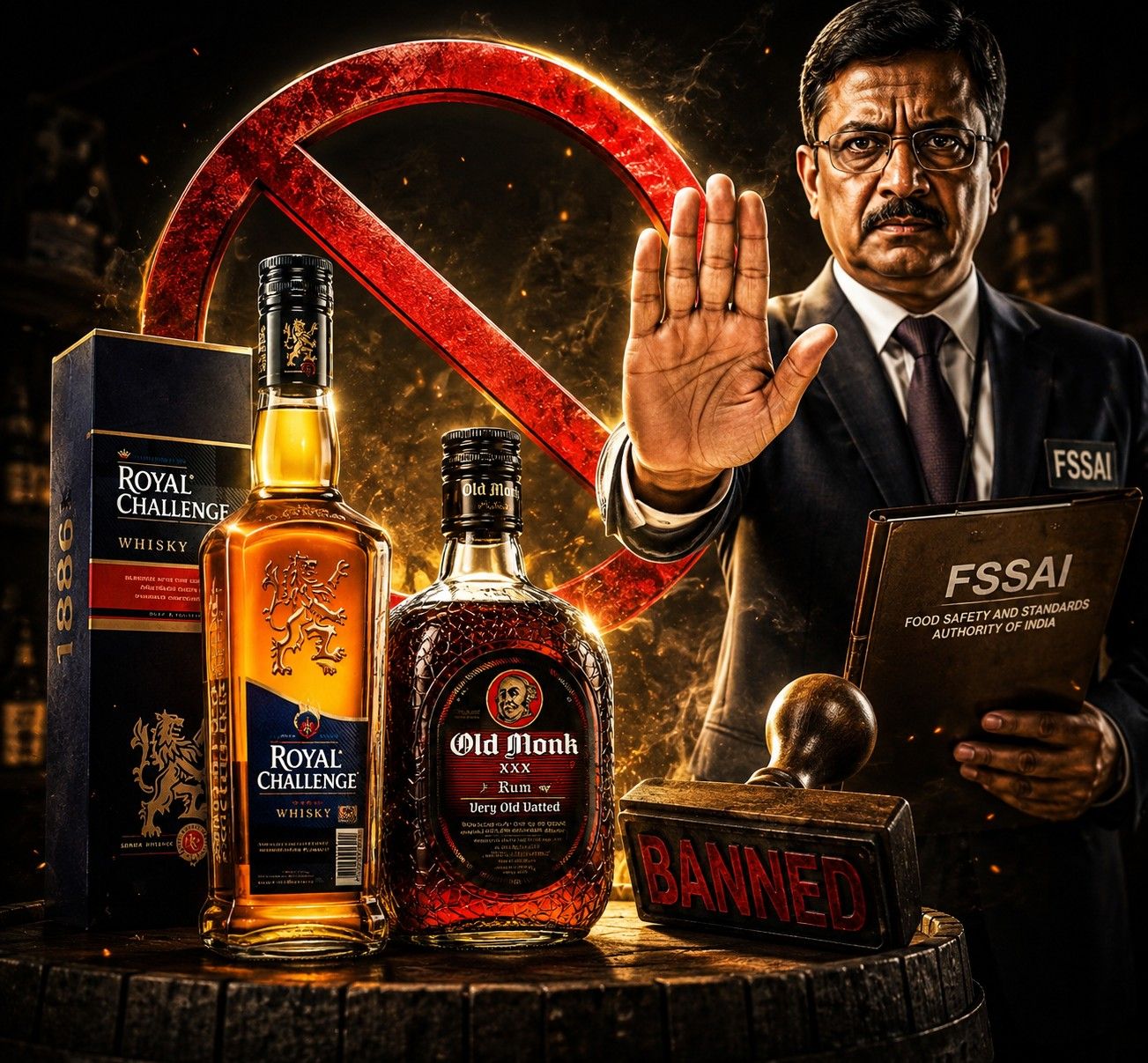
FSSAI bans Royal Challenge Old Monk: FSSAI has prohibited the sale of several popular whisky and rum brands, including Old Monk, Antiquity Blue and Royal Challenge, citing the use of artificial flavouring that does not meet prescribed standards. Furthermore, the ban also covers Bagpiper and McDowell’s variants from the same manufacturers.
This is one of the biggest enforcement actions in India’s domestic liquor market in recent years. Moreover, the banned brands are among the most popular affordable spirits sold across Nagpur’s retail stores, bars and restaurants. As a result, Nagpur consumers need to understand exactly what happened, which products are affected and what their rights are.
Which Brands Are Banned and Who Makes Them
The affected products come from three major manufacturers — Diageo India’s United Spirits, Inbrew Beverages and Mohan Rocky Springwater.
From Diageo India’s United Spirits, the banned products include Antiquity Blue Whisky and Royal Challenge Whisky variants produced at specific facilities. Furthermore, McDowell’s variants are also part of the enforcement action.
From Inbrew Beverages, certain Old Monk Rum variants have been banned. Old Monk is one of India’s most iconic rum brands with a loyal following among budget-conscious consumers across Nagpur and Vidarbha.
From Mohan Rocky Springwater, Bagpiper variants are included in the prohibition orders. Bagpiper is one of the country’s largest-selling whisky brands by volume.
However, it is important to note that the ban covers specific variants produced at specific facilities — not necessarily every product these companies make. Therefore, consumers should check the specific product and batch details as more information is released.
Why Did FSSAI Take This Action — The Core Problem
The regulator alleged that these companies used artificial or nature-identical flavoring to mimic the taste and aroma of spirits instead of relying on natural ingredients and proper ageing processes.
Under the Food Safety and Standards (Alcoholic Beverages) Regulations, 2018, adding artificial or nature-identical flavourings that imitate a spirit’s natural taste is prohibited.
The issue is straightforward. Making genuine whisky requires malted barley or grain, distillation and proper ageing in barrels. Making genuine rum requires molasses-based fermentation and distillation. These processes are time-consuming and costly.
As flavouring can be used to mask neutral spirits, the regulator said this might lead companies to skip proper maturation. They added that this also eliminates the need for companies to use ingredients traditionally involved in making spirits, such as molasses, malt and grapes.
In simpler terms, some manufacturers were allegedly taking neutral alcohol and adding artificial rum or whisky flavour to it. They were then selling this as genuine rum or whisky. Moreover, they were doing this without telling consumers. As a result, consumers were paying for a product they believed was the real thing — when it was not.
What FSSAI Says Is Allowed and What Is Not
FSSAI says that general additives like vanilla or coffee flavours are allowed, but adding the profile of the exact alcohol drink lacks justification since a neutral alcohol base is already used.
Therefore, a rum brand can add vanilla flavour. However, it cannot add artificial rum flavour to a product it calls rum. Furthermore, if any flavouring is used, the product must be clearly labelled as “Rum-flavoured Spirit” or “Whisky-flavoured Spirit” — not simply “Rum” or “Whisky.”
“There is no internationally recognised manufacturing practice whereby rum flavour is added to rum or whisky flavour is added to whisky,” FSSAI stated.
What About Products Already on Nagpur Store Shelves
This is the most practical question for Nagpur consumers. The FSSAI action is a prohibition of sale — meaning retailers should not be selling these specific banned variants.
However, clearing products already in distribution channels takes time. Furthermore, Maharashtra’s state excise system adds another layer to implementation. As a result, some products may still be visible in shops in the short term.
Nagpur consumers who want to check whether a specific bottle is affected should look for the manufacturer name, facility location and batch details on the label. In addition, FSSAI will publish updated product lists as enforcement progresses. Nagpur Updates will track and report these updates as they are released.
The Bigger Picture — What This Means for India’s Liquor Market
The ban touches a large chunk of India’s domestic liquor market, particularly the segment that caters to budget-conscious drinkers who choose Indian-made spirits over pricier imported whisky, rum and Scotch.
Industry analysts note that because imported spirits volumes in India grew at a CAGR of 16 per cent between 2019 and 2024, this action against Indian-made Foreign Liquor (IMFL) may add stress to the domestic segment.
Moreover, FSSAI’s enforcement extends beyond just these three manufacturers. FSSAI issued notices to multiple alcohol manufacturers including Diageo, Mohan Rocky Springwater, INBREW Beverages and Associated Alcohol and Breweries. Six other companies have also been issued notices.
Furthermore, FSSAI also conducted inspections and sample collections at Mandexi Distilleries and Breweries in Goa and issued notices to six other manufacturers in Maharashtra. Therefore, this is not an isolated case. It is a broad industry-wide crackdown on flavouring violations in Indian spirits.
If you have recently purchased any of the banned variants and the product is still unused, you have consumer rights. First, return the product to the retailer and request a full refund. Most retailers will comply given the FSSAI ban order.
Second, if a retailer refuses, file a complaint with the Maharashtra FDA’s Nagpur office. The FDA has jurisdiction over food and beverage retail in Nagpur. Furthermore, you can also file a consumer complaint with the District Consumer Disputes Redressal Commission in Nagpur for any financial loss suffered.
Third, for bars and restaurants that served these products, the consumer protection framework also applies. Moreover, if you believe you were sold a mislabelled product, you can report it through the FSSAI Food Safety Connect app, which we covered in our earlier article on FSSAI’s consumer complaint system.
What the Companies Have Said
The affected companies have not issued comprehensive public statements accepting the FSSAI findings at the time of this report. Diageo India, which owns the United Spirits brands including Royal Challenge and Antiquity Blue, is one of India’s largest spirits companies and is expected to respond formally through legal and regulatory channels.
Moreover, Mohan Rocky Springwater — the maker of Old Monk — has a deeply loyal consumer base that has followed the brand for generations. Old Monk’s reputation as an honest, value-for-money rum makes this ban particularly surprising for its fans.
Nagpur Updates will report on any statements or legal challenges from the manufacturers as they emerge.

