


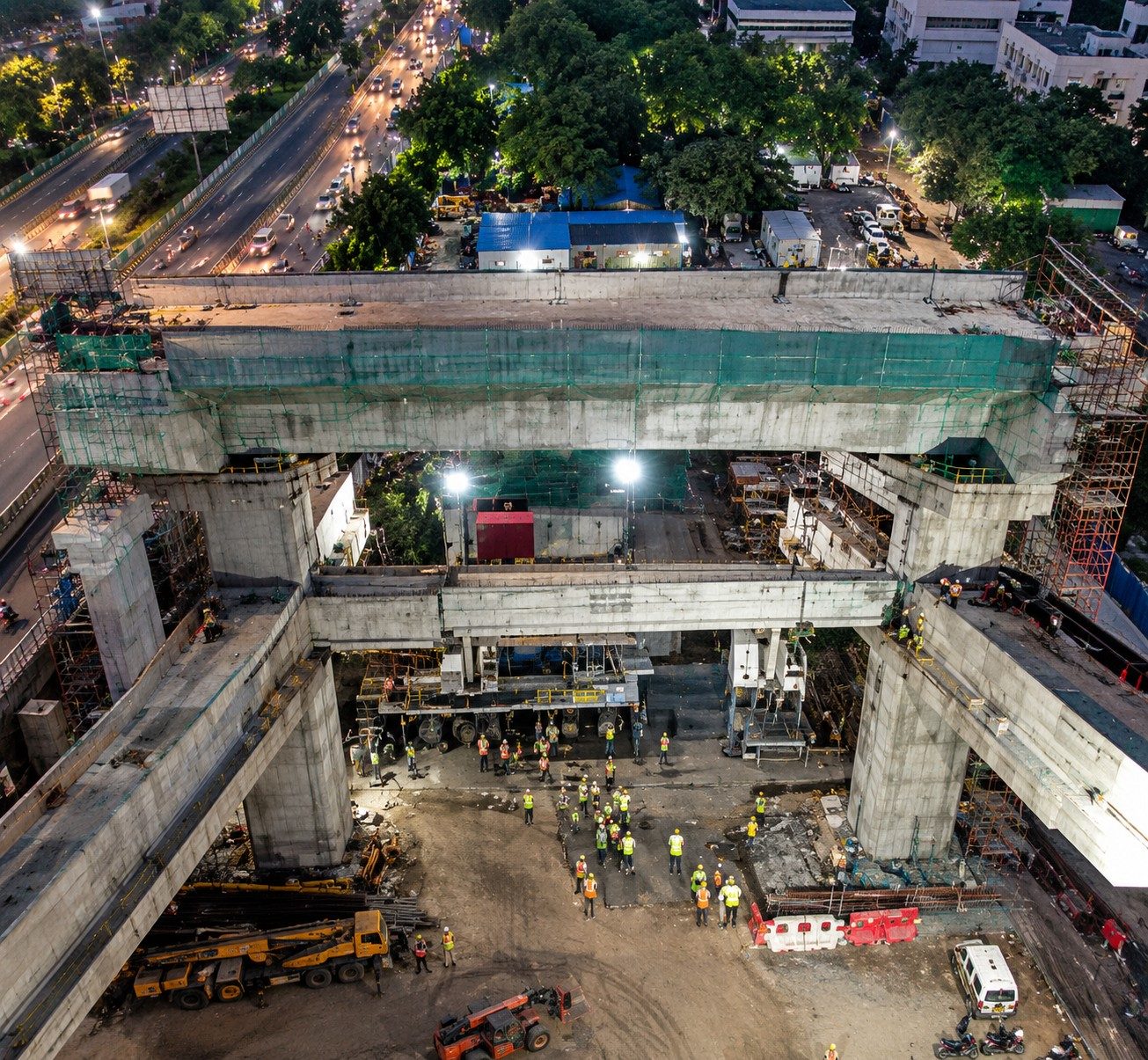
Nagpur Metro’s Phase 2 expansion has crossed a significant construction milestone. MahaMetro has commenced the erection of the first I-girder at Hingna Mount View station on the Lokmanya Nagar to Hingna corridor. Furthermore, this marks the beginning of girder erection across the entire 6.4-kilometre stretch that will add seven new elevated stations to Nagpur’s metro network. As a result, the corridor connecting Lokmanya Nagar with Hingna is now visibly rising above ground — and the August 2027 target for the first 4-kilometre stretch to become operational is firmly in progress.
Station construction on this corridor began in March 2025. Moreover, MahaMetro is now simultaneously carrying out girder erection, slab construction and structural works at multiple stations to maintain the overall project schedule. Therefore, Hingna Mount View is the first station to reach the girder erection stage — and the others are expected to follow in sequence.
What Is an I-Girder and Why Does It Matter
Many readers may be unfamiliar with what an I-girder is and why its erection is a milestone worth noting. Furthermore, understanding the engineering helps explain why this moment is significant for the corridor’s construction progress.
An I-girder is a horizontal structural beam — named for its I-shaped cross-section when viewed from the end. Furthermore, these beams form the floor structure of the metro station at each level — the concourse level and the platform level. Each span of the station structure requires 15 I-girders. Moreover, each complete station needs 60 I-girders in total — 36 at the concourse level and 24 at the platform level.
The concourse level is where passengers will access ticket counters, lifts, escalators, toilets and infant-care facilities. Furthermore, it serves as the transfer level between the station entry and exit areas and the platforms above. The platform level is where trains will stop and passengers will board and alight. Therefore, the I-girders are literally the physical foundation of every functional space inside the station.
Before I-girders can be erected, the supporting columns and pier caps must be complete. Furthermore, the fact that girder erection has begun at Hingna Mount View station confirms that the substructure work at this station has reached the required level of completion. As a result, the station is now moving from the underground-visible foundation stage to the visibly rising above-ground structure stage — the point at which construction becomes tangible and exciting for daily commuters passing the site.
The Engineering Scale — Cranes, Weights and Timelines
The engineering scale involved in I-girder erection at Nagpur Metro Phase 2 stations is impressive. Furthermore, each girder is a substantial piece of steel and concrete — not something that can be moved with ordinary equipment.
Concourse-level girders weigh between 27 and 45 tonnes each. Moreover, platform-level girders are heavier — weighing between 37 and 45 tonnes. Therefore, the total weight of girders at each station — 60 girders averaging approximately 35 tonnes each — amounts to over 2,000 tonnes of structural steel and concrete per station.
The logistics of moving these girders are equally demanding. Furthermore, the finished girders are transported from their fabrication site to the erection location on heavy-duty trailers along designated routes. This route planning is necessary because heavy-duty trailer movement on urban roads requires specific clearances — particularly under existing bridges and overpasses. As a result, MahaMetro plans the delivery routes for each station individually.
For the actual erection, two types of cranes are used. The central three concourse-level girders of each span — the most centrally positioned and therefore the most difficult to manoeuvre — are positioned using two 80-tonne-capacity cranes working in tandem. Moreover, the remaining girders are installed using a 500-tonne-capacity crane — one of the largest mobile cranes in the construction toolkit. Therefore, girder erection day at a metro station is one of the most visually dramatic moments in the construction process.
MahaMetro officials have confirmed that girder erection, slab construction and other structural works at both levels are expected to be completed within approximately 45 days at each station. Furthermore, with seven stations on the corridor and work happening simultaneously at multiple stations, the overall structural completion of the corridor can progress efficiently.
The Seven Stations on the Lokmanya Nagar-Hingna Corridor
The 6.4-kilometre Lokmanya Nagar to Hingna corridor — known as Reach-3A in MahaMetro’s Phase 2 planning — will have seven elevated stations. Furthermore, Hingna Mount View is the station where girder erection has now begun — making it the most advanced in construction terms among the seven.
The corridor connects Lokmanya Nagar — an area in western Nagpur — with Hingna — the industrial and developing zone that also hosts the Hingna Metro Depot, which Nagpur Updates has reported on in the context of the solar panel installation between live tracks. Moreover, the corridor passes through the rapidly developing western growth corridor of Nagpur. As a result, when operational, it will serve the growing residential and industrial population in this zone.
Entry and exit works are currently underway at all seven stations. Furthermore, this simultaneous work across the corridor is what allows MahaMetro to maintain the ambitious August 2027 operational target for the first 4-kilometre stretch.
The August 2027 Target — What It Means for Western Nagpur
The first 4-kilometre stretch of Reach-3A is scheduled to become operational by August 2027. Furthermore, this target is now backed by visible construction progress — with station substructures complete and girder erection underway at the lead station.
For residents of the western Nagpur zone — the Lokmanya Nagar, Pratap Nagar and Hingna areas — August 2027 is the date when their daily commute changes. Furthermore, access to the metro network from this part of the city will reduce dependence on personal vehicles and autorickshaws for movement to central Nagpur and other metro-connected zones.
Moreover, the Hingna industrial area benefits specifically from metro connectivity in terms of worker mobility. Furthermore, factory workers, logistics staff and industrial employees who commute from other parts of Nagpur to Hingna will have a more reliable, affordable transit option. As a result, the corridor serves both residential commuter demand and industrial workforce mobility in a complementary way.
How Phase 2 Is Transforming Nagpur Metro’s Network
The Lokmanya Nagar-Hingna corridor is one of multiple Phase 2 extensions that MahaMetro is building simultaneously. Furthermore, Phase 2 also includes extensions toward Kanhan in the north, Butibori MIDC in the south and other directions.
As Nagpur Updates has reported in the context of the proposed Phase 3 planning — with the underground Sadar section and driverless metro on the Koradi corridor — Nagpur Metro is thinking well beyond its current network even as Phase 2 construction continues. Moreover, the consistent pace of construction across multiple corridors simultaneously demonstrates that MahaMetro has developed the organisational capacity to manage large, multi-site metro expansion effectively.
The Hingna Mount View I-girder erection is one milestone among many that Nagpur’s metro expansion is producing. Furthermore, each milestone brings the day closer when Nagpur residents in areas currently unserved by the metro will have access to the same rapid transit network that has already transformed daily mobility in the corridors that Phase 1 serves.
Nagpur Updates will track construction progress on the Lokmanya Nagar-Hingna corridor and report on significant milestones as each of the seven stations advances through its construction stages toward the August 2027 target.

