


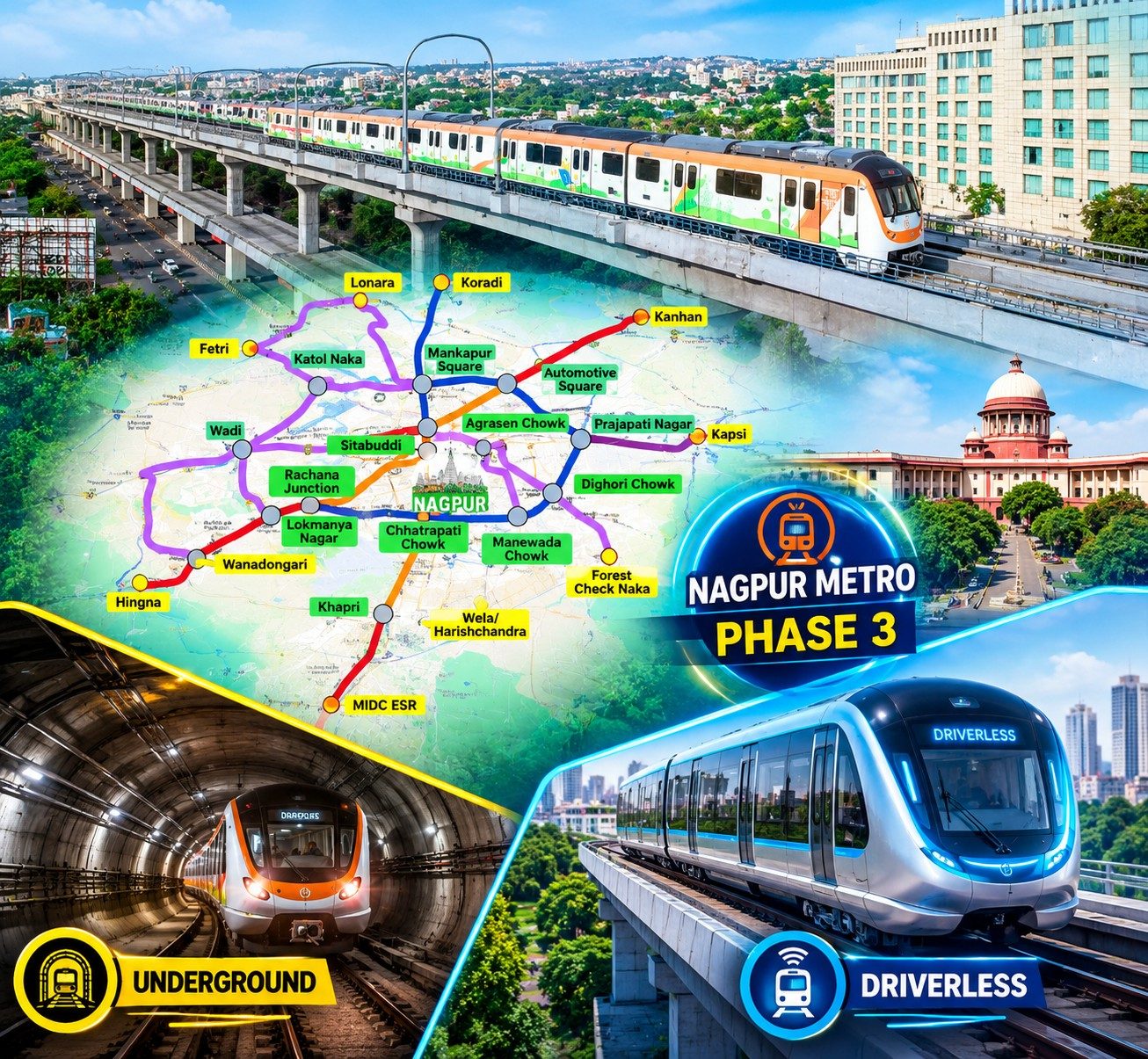
Nagpur Metro is planning its most ambitious expansion yet. Phase 3 of Nagpur Metro proposes a 11.5-kilometre corridor connecting Kasturchand Park to Koradi. Furthermore, two groundbreaking new features are being considered for this corridor — an underground metro track through the Sadar area and a driverless metro train on the Koradi route. As a result, Nagpur Metro Phase 3 could introduce technologies that do not exist anywhere on the current network.
However, both proposals are currently at the study stage. Moreover, the final decision will only be taken after the Detailed Project Report — DPR — is complete. Maha Metro has assigned this DPR work to RITES Ltd. Furthermore, the study is expected to be completed by approximately April 2027.
Why Underground at Sadar — The Technical Challenge
The Sadar area is one of Nagpur’s busiest and most complex urban zones. Furthermore, it already has an existing flyover and a dense road network. As a result, adding a new elevated metro track through Sadar without affecting the existing infrastructure would be extremely difficult.
This is the core reason why an underground alignment is being considered for the Sadar section. Furthermore, going underground eliminates the conflict with the existing flyover and road network entirely. The proposed underground alignment would begin from the existing Kasturchand Park Metro Station and connect to an elevated section further along the corridor.
Moreover, a new underground metro station is also being proposed as part of this section. As a result, the Sadar area would get a metro station that serves the dense residential and commercial population of this zone — something the current elevated alignment cannot provide without significant disruption.
What Is the Kasturchand Park to Koradi Corridor
The proposed Phase 3 corridor covers 11.5 kilometres between Kasturchand Park and Koradi. Furthermore, this corridor would connect the existing Orange Line of Nagpur Metro to the Koradi area — home to the famous Mahalaxmi Jagdamba Temple and a rapidly developing industrial and residential zone north of Nagpur.
Kasturchand Park is a well-known landmark in central Nagpur — a large public garden near the NMC headquarters and the Civil Lines area. Moreover, it already has a metro station on the existing network. Therefore, Phase 3 would extend metro connectivity from this central point northward through Sadar and onward to Koradi — creating a new north-south axis for the city’s metro network.
The Koradi end of the corridor is particularly significant. Furthermore, as Nagpur Updates has reported extensively, Koradi is undergoing major development — including the Rs 100 crore Kamptee District Sports Complex, the Mahalaxmi Jagdamba Sansthan land lease approval, the theme park and tourist centre approvals, and the planned 162-foot Hanuman idol. As a result, metro connectivity to Koradi would directly serve this rapidly developing zone and dramatically improve access to the temple for devotees.
Driverless Metro on the Koradi Route — What It Means
The second major innovation proposed for Phase 3 is the introduction of driverless metro technology on the Koradi route. Furthermore, this would be a first for Nagpur Metro — the existing Orange Line and Aqua Line both operate with human drivers.
Driverless metro — also known as Unattended Train Operation or UTO — is the most advanced level of metro automation. Furthermore, it means trains operate entirely under computer control. There are no drivers in the train cab. Trains accelerate, brake, open doors, close doors and move between stations automatically — all managed by a centralised control system.
Several Indian metro systems are already moving toward this technology. Moreover, the Mumbai Metro Line 3 was designed with driverless capability. Delhi Metro’s Phase 4 also incorporates driverless operations on some lines. As a result, Nagpur adopting this technology on Phase 3 would place it among the most technologically advanced metro systems in India.
The benefits of driverless metro are significant. Furthermore, trains can run more frequently — because computer systems can manage tighter headways than human drivers. Operating costs reduce over time — because you eliminate driver salaries across all shifts over the lifetime of the system. Moreover, consistency and punctuality improve — because computers do not tire or make judgment errors.
However, the upfront cost of driverless metro infrastructure is higher. Furthermore, the platform screen door systems, advanced signalling, and centralised control requirements add to capital expenditure. Therefore, the RITES DPR will specifically assess whether the financial case for driverless technology on this corridor is sound.
What Is RITES and Why This Assignment Matters
RITES Ltd — Rail India Technical and Economic Service — is one of India’s most respected infrastructure consultancy and technical services organisations. Furthermore, it is a Government of India enterprise with decades of experience in transport infrastructure planning, DPR preparation and project management across rail, metro and highway sectors.
Maha Metro assigned the Phase 3 DPR work to RITES in July 2026. Furthermore, the nine-month study timeline means the DPR should be ready by approximately April 2027. Therefore, the April 2027 target is when Nagpur will have a complete technical and financial assessment of the Phase 3 corridor — including the underground Sadar section, the driverless option, the full alignment, station locations, ridership projections and cost estimates.
The DPR is the foundation for everything that follows. Moreover, it is the document on the basis of which Maha Metro will seek central government funding, state government approval and eventually begin construction. Therefore, the quality and completeness of the RITES DPR will be critical to how quickly Phase 3 can move from planning to implementation.
How Phase 3 Fits Into Nagpur Metro’s Bigger Picture
Nagpur Metro currently operates on two lines — the Orange Line running east-west between Airport and Automotive Square, and the Aqua Line running north-south between Ambazari and Auto Cluster. Furthermore, Phase 2 extensions are currently under construction, taking both lines further into the city’s expanding zones.
Phase 3 adds an entirely new corridor to this network. Furthermore, the Kasturchand Park to Koradi alignment would connect the existing network at a central point and extend it into a northern zone that currently has no metro service.
The introduction of underground technology at Sadar and driverless operation on the Koradi route would also mean that Phase 3 is technologically more advanced than the existing network. Moreover, this creates a natural upgrade pathway — as the technology proves itself on Phase 3, it can be incorporated into future extensions of the existing lines as well.
What This Means for Nagpur Residents — The Practical Picture
For Nagpur residents, the Phase 3 announcement is an important long-term development — but one whose benefits are several years away. Furthermore, the DPR itself will not be ready until April 2027. After that, the approval process, funding arrangement and construction timeline will add several more years before Phase 3 trains actually run.
However, the planning process being underway today is what creates the future. Furthermore, decisions made in the RITES DPR — about alignment, station locations, technology — will shape how the corridor works for decades after it opens. Therefore, residents in the Sadar and Koradi areas who want to influence the planning should watch for the DPR consultation process and participate when it is announced.
For Koradi devotees and residents specifically, metro connectivity on this corridor would transform accessibility to the Mahalaxmi Jagdamba Temple. Furthermore, instead of navigating Chhindwara Road traffic — particularly during Navratri and Dussehra when Koradi sees enormous crowds — devotees would be able to take the metro directly from central Nagpur.
Nagpur Updates will track the RITES DPR process and report on all significant milestones — including the April 2027 DPR completion, the alignment finalisation and any public consultation exercises that Maha Metro conducts for Phase 3.

