


Nagpur, April 2026.
Nagpur Metro solar panels: When most people think of solar energy and metro rail, they picture panels on rooftops — on station canopies, depot buildings, or elevated corridor structures. That is where every metro system in India has gone looking for solar space.
Nagpur Metro looked somewhere different. It looked down — at the ground between the tracks.
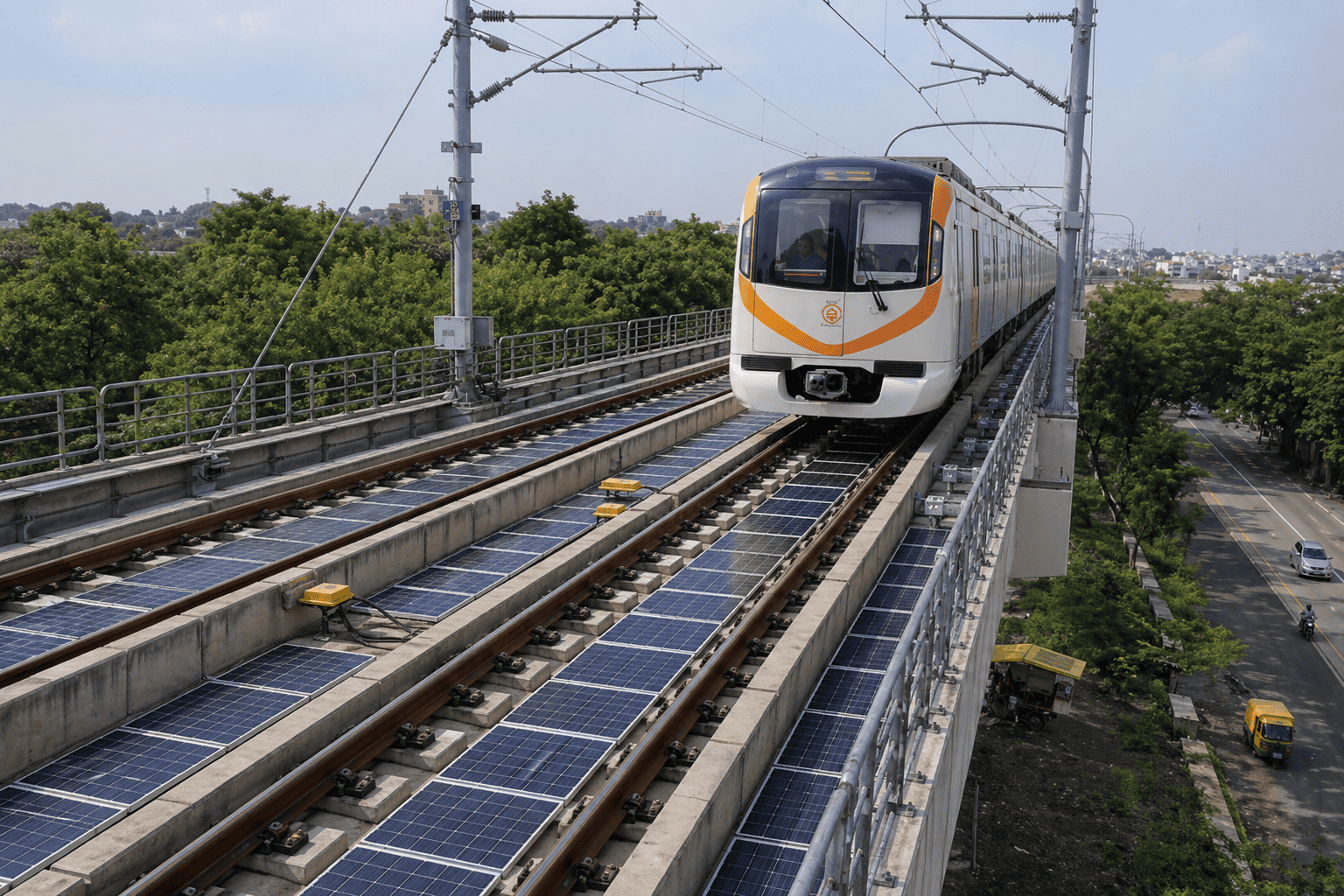
The Maharashtra Metro Rail Corporation Limited (MMRCL) has installed solar panels in the inter-track space between two live, operational metro tracks at the Hingna Depot — making Nagpur Metro the first metro rail project in India to deploy solar generation directly within an active track corridor. It is a deceptively simple idea that nobody had attempted before, and it works.
What Exactly Has Been Done at Hingna Depot?
The pilot installation covers a 200-metre stretch within the Hingna Depot — the operational base for Nagpur Metro’s trains on the south corridor. In the space between the two parallel tracks, which had previously served no functional purpose, MMRCL engineers have installed monocrystalline solar panels.
The system has a generation capacity of 50 kWp (kilowatt peak). To put that in terms that matter: the installation is expected to produce approximately 70,000 units of electricity every year, reducing carbon dioxide emissions by an estimated 65 tonnes annually. The electricity generated feeds directly into the depot’s internal power grid — powering lighting, administrative systems, and depot operations — reducing the facility’s dependence on conventional grid electricity.
Monocrystalline panels were chosen for a specific reason. Among the main types of commercially available solar panels, monocrystalline panels offer the highest efficiency per square metre — a critical consideration in this project, where the available surface area is fixed and determined by track geometry. You cannot widen the gap between two metro tracks to fit more panels. You have to get the most out of the space you have.
The Idea Sounds Simple — The Engineering Was Not
Installing solar panels on a rooftop is one thing. Installing them between two live railway tracks that carry electric trains is something else entirely.
The engineering challenges were significant. The panels had to be positioned at a height and angle that generates maximum solar exposure without creating any obstruction risk to train operations. The mounting structure had to be vibration-resistant — metro trains passing overhead at speed create ground vibrations and air displacement that ordinary panel mounting systems are not designed for. The entire installation had to be accessible for maintenance without requiring track shutdowns, which would disrupt metro services.
The wiring and electrical integration required careful planning to ensure no interference with the track signalling and power systems that keep the trains running safely. Every component had to meet railway safety standards — not just standard solar installation norms.
That MMRCL successfully completed this pilot is, by itself, an achievement worth noting. It is one thing to propose the idea. It is another to engineer it safely in a live operational environment.
Why the Inter-Track Space Was Always There — and Always Wasted
Every metro system has this space. Between any two parallel tracks, there is a gap — determined by safety clearance requirements for train operations. This space cannot be eliminated. It cannot be built over. Until now, it has simply existed as dead ground: maintained, kept clear of obstructions, and otherwise unused.
Across India’s metro network — Delhi, Mumbai, Chennai, Bengaluru, Kolkata, Hyderabad, Pune, Kochi, and others — this inter-track space runs for hundreds of kilometres in total. If Nagpur Metro’s pilot proves commercially and operationally viable for wider deployment, it opens up a vast untapped solar resource that exists within infrastructure that is already built, already maintained, and already electrified.
That is the larger significance of what has happened at Hingna Depot. It is not just about 50 kWp or 70,000 units. It is about demonstrating a replicable model.
How Nagpur Metro Got Here — A Track Record of Green Firsts
This is not the first time Nagpur Metro has stood out on sustainability. Since beginning operations in 2019, MMRCL has consistently positioned itself as one of India’s most environmentally conscious metro systems.
Nagpur Metro stations run on a combination of solar and grid power, with rooftop solar installations generating a significant share of station energy needs. The metro was among the first in India to achieve green building certification for its stations. Rainwater harvesting systems are operational across the network. Energy-efficient LED lighting and regenerative braking systems — which recover energy when trains brake and feed it back into the power grid — are standard across the fleet.
The inter-track solar pilot is the latest chapter in this consistent approach, but it is also the most ambitious — because it moves solar generation from passive infrastructure like rooftops into the active operational heart of the metro system itself.
What It Means for Nagpur Metro’s Operating Costs
Metro rail is an energy-intensive business. A single metro train consumes significant electricity with every journey, and the cumulative energy bill across an entire network running from early morning to late night, seven days a week, is enormous. For MMRCL — which, like most Indian metro corporations, operates on thin margins and depends on a mix of fare revenue, advertising, and government support — reducing energy costs has a direct impact on financial sustainability.
Every unit of electricity generated from the inter-track solar installation is a unit that does not need to be purchased from the grid. At current electricity tariff rates in Maharashtra, 70,000 units of annual generation translates to a tangible reduction in depot operating costs. If the model is scaled — to other depots, to longer stretches of the operational corridor — the savings compound significantly.
The carbon benefit, while important, is also increasingly relevant from a regulatory standpoint. India has committed to ambitious renewable energy and net-zero targets. Urban infrastructure projects are increasingly evaluated on their environmental footprint. Nagpur Metro’s green track record strengthens its case for central government support, international climate finance, and public goodwill.
How Does This Compare With What Other Metro Systems Have Done?
India’s other metro systems have been active on solar energy — but nobody has gone where Nagpur has gone.
The National Capital Region Transport Corporation (NCRTC), which operates the Rapid Rail between Delhi and Meerut, has installed solar panels along portions of its elevated corridor — but on the external edges and structural surfaces of the viaduct, not within the inter-track space itself. Delhi Metro has one of the largest rooftop solar installations among Indian metro systems. Mumbai Metro has incorporated solar in station design.
The distinction that makes Nagpur’s approach genuinely new is the location: not on structures adjacent to or above the tracks, but in the ground-level space between operational running lines. This is a fundamentally different engineering proposition — and no other metro in India has attempted it until now.
The Pilot Phase and What Comes Next
MMRCL has been clear that what has been deployed at Hingna Depot is a pilot. The 200-metre, 50 kWp installation is designed to demonstrate technical feasibility, measure actual generation performance against projections, and identify any operational issues that need to be addressed before larger-scale deployment.
If the pilot performs as expected over the coming months, MMRCL has indicated interest in expanding the concept to other depot areas and potentially to sections of the elevated metro corridor itself. As Phase II of the Nagpur Metro moves forward — extending lines toward Hingna, Kanhan, and Butibori — new stretches of inter-track space will become available. Planning for solar integration from the design stage of new sections would be significantly more efficient than retrofitting it later.
The success of this project will also be watched closely by metro corporations in other cities. If Nagpur can demonstrate a reliable, cost-effective model for inter-track solar generation, it provides every other metro system in India with a blueprint for unlocking solar potential from infrastructure they already own.
What This Means for the Ordinary Nagpur Metro Passenger
For someone who rides the Nagpur Metro to work every morning, the immediate impact of this project is indirect but real. Every rupee saved on depot electricity costs is a rupee that does not need to be recovered through higher fares. Every tonne of carbon emissions reduced contributes to the city’s air quality. And every innovation that Nagpur Metro demonstrates successfully adds to the system’s credibility — which supports continued investment, network expansion, and improved services.
Nagpur has always had ambitions that exceed what a city of its size might typically claim. The inter-track solar project is another example of the city doing something larger Indian metros had not yet attempted — and doing it first.

