


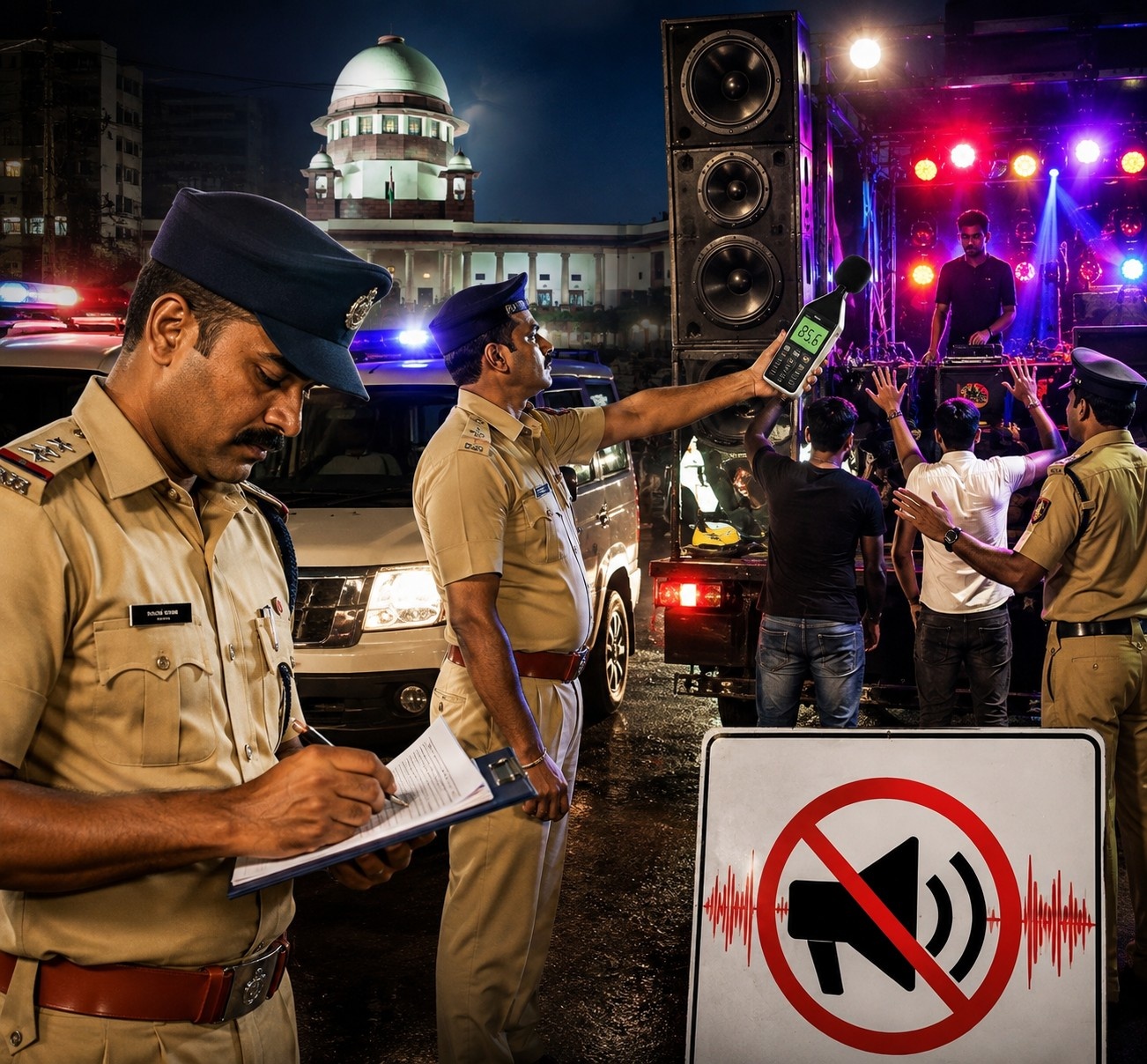
Nagpur residents fed up with late-night DJ music, blaring loudspeakers and firecracker noise are getting a powerful new tool. The district administration is launching the Pollution Free Nagpur integrated online complaint portal very soon. Furthermore, this initiative comes directly after strong directions from the Bombay High Court’s Nagpur Bench on noise pollution.
Once live, any Nagpur citizen can file a noise complaint with just a few clicks. Moreover, the complaint will automatically reach NMC, Nagpur Police and the Maharashtra Pollution Control Board simultaneously. As a result, three agencies will receive the complaint at the same time — no more going from office to office.
Why the High Court Stepped In on Nagpur’s Noise Problem
The High Court did not take up noise pollution on its own. A case was already pending before the Nagpur Bench. During the hearing, the court expressed serious concern about rising noise levels across the city.
The court observed that loud music from lawns, wedding venues, DJ events and firecrackers is causing major disturbance. Furthermore, the court specifically noted that the noise is affecting not just citizens but also animals. As a result, the bench gave strict directions to NMC, Nagpur Police and the district administration to develop an effective noise control system.
In response, all three agencies filed affidavits in the High Court. They committed to creating a proper online complaint and action mechanism. Therefore, the Pollution Free Nagpur portal is a direct result of judicial pressure — not voluntary administrative initiative.
How the Pollution Free Nagpur Portal Will Work
The NMC Commissioner has clarified that NMC’s existing online complaint registration system will serve as the main platform. Furthermore, NMC will not build a separate new website. Instead, it will integrate noise pollution complaints into the current portal.
The process for citizens will be simple. First, visit the NMC website and choose the complaint option. Second, verify your identity using your mobile number and OTP. Third, select the Environment Department category. Fourth, file your noise pollution complaint with details of the location and incident.
Once submitted, the complaint will instantly reach all three agencies simultaneously — NMC, Nagpur Police and MPCB. Moreover, the entire process from complaint to resolution will be trackable online. Therefore, citizens can monitor what action was taken on their complaint at every stage.
The system will also have an automatic escalation feature. If a complaint remains pending beyond a defined period, it will automatically escalate to a higher authority. As a result, complaints cannot simply be ignored or buried in pending files.
Police Apologise in Court — Sound Meters Were Missing
One of the most revealing moments in the High Court hearing came from the police department itself. Police submitted an unconditional apology to the court during the noise pollution hearing.
The reason was damaging. Police admitted that sound measuring meters — devices used to measure decibel levels at noise violation sites — were not available with their officers. As a result, police could not actually measure whether a DJ or loudspeaker was exceeding the legal noise limit at the time of receiving complaints.
However, police assured the court that this will change. In future, sound measuring meters will be mandatory at all public events. Furthermore, officers conducting noise checks will carry these meters. Therefore, when they arrive at a complaint location, they can immediately measure and record the decibel level as evidence.
This admission is significant. It confirms that noise pollution enforcement in Nagpur has been largely ineffective — not because laws were missing, but because basic measurement tools were absent.
FIR Filed at Samvidhan Chowk — Real Action Has Begun
The administration is no longer just promising action. It has already taken concrete steps. An FIR has been registered related to a noise violation at Samvidhan Chowk in Nagpur.
According to an additional affidavit submitted by the Deputy Commissioner of Police in the High Court, a public event at Samvidhan Chowk violated noise rules. Five organisers had applied for permission. However, one organiser among the five did not have valid permission at all. A notice was issued and a case was registered against this organiser under the Bharatiya Nyaya Sanhita.
Furthermore, three of the remaining four organisers — Lubhesh Meshram, Rakesh Motghare and Dhammadeep Lokhande — used DJ and loudspeaker equipment at volumes exceeding the permitted decibel limit. They violated the specific conditions of their permission. As a result, FIRs have been registered against all three for breach of permission conditions.
This enforcement action shows that the High Court’s pressure is producing real results — not just portal announcements.
What Are the Legal Noise Limits in Nagpur?
Many Nagpur residents are unaware of the actual legal noise limits. The Environment Protection Act and Noise Pollution Rules 2000 set clear limits for different zones.
In residential areas, the daytime noise limit is 55 decibels. The night limit is 45 decibels. In commercial areas, the daytime limit is 65 decibels and the nighttime limit is 55 decibels. In silence zones near hospitals, schools and courts, limits are even stricter at 50 decibels during the day and 40 at night.
A typical DJ at a wedding venue can generate 90 to 100 decibels — nearly double the residential limit. Furthermore, loudspeakers at religious and political events regularly exceed permitted levels. However, without sound measuring meters at the scene, enforcement was impossible. The new portal and mandatory meters together address both the reporting and the measurement gaps.
How to File a Noise Complaint in Nagpur Right Now
The Pollution Free Nagpur portal is not yet live. However, Nagpur residents can already file noise complaints through existing channels while waiting for the new system.
Call 100 to report any noise violation to Nagpur Police. The police station nearest to the noise source is responsible for responding. Furthermore, you can file a written complaint directly at the police station and ask for a copy with a complaint number.
For persistent violations — a venue that repeatedly breaks noise rules on weekends, for example — a written complaint to the Maharashtra Pollution Control Board’s Nagpur office is also an option. MPCB has the authority to cancel permissions and impose fines on repeat violators.
Once the Pollution Free Nagpur portal launches, Nagpur Updates will immediately publish the step-by-step guide for using it. Furthermore, we will report on the High Court’s next hearing and any further directions given.

