


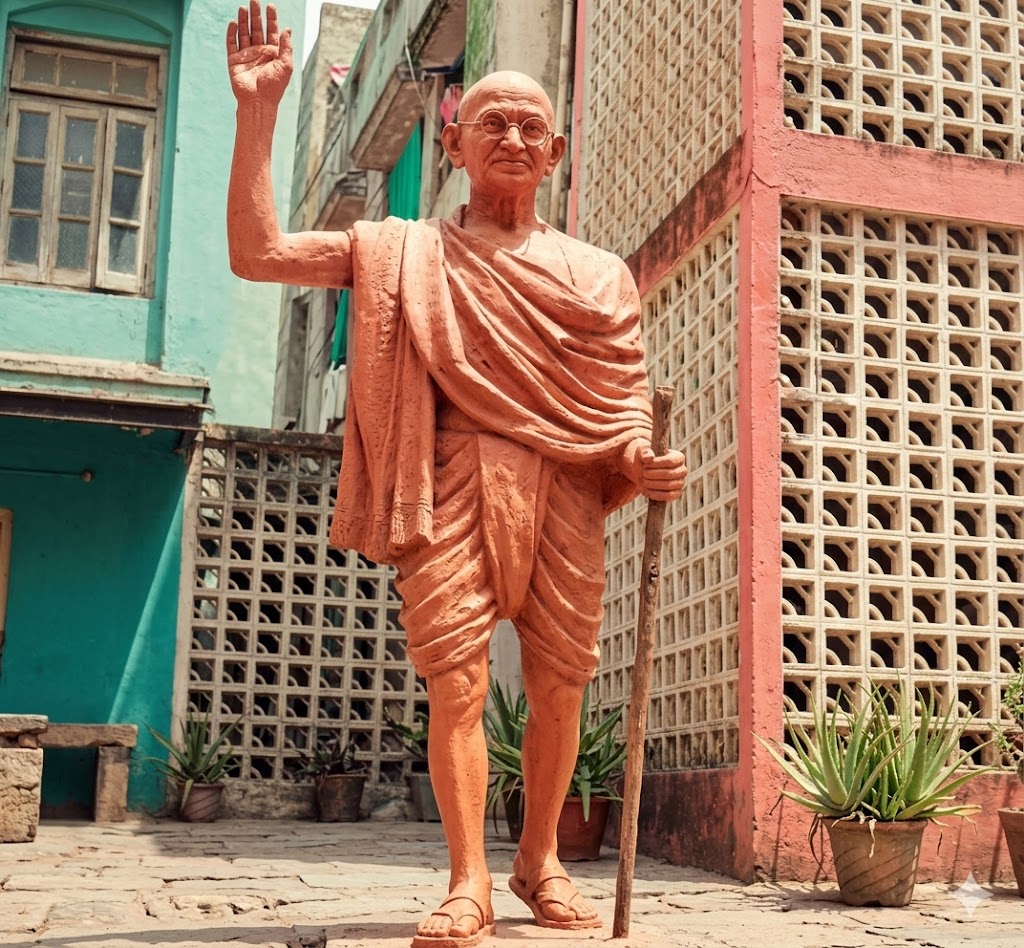
Published: June 18, 2026 | Category: Nagpur Local | Satranjipura Mahatma Gandhi statue | By: Nagpur Updates Desk
For over a month, Mahatma Gandhi’s iconic round glasses had slipped down his statue’s face in Nagpur’s Satranjipura — all the way to the chin. Nobody from the administration noticed. Or if they did, nobody acted.
Then a newspaper published the story. Within hours, a Congress leader escalated it to the NMC Commissioner. And within minutes of officials being notified, civic workers arrived at the site and fixed the glasses.
It is a small story. But it says something significant about how civic accountability actually works in Nagpur today.
Timeline: From Neglect to Fix
| Date/Event | What Happened |
|---|---|
| ~1 month before June 10 | Glasses on Gandhi statue slip down to chin — go unnoticed by authorities |
| Wednesday, June 10 | Newspaper publishes prominent story: “He Ram… Chashma Khisak Gaya” |
| Same day | Nagpur Congress President Praful Gudadhe sees report, escalates to NMC Commissioner |
| Immediately after | NMC Commissioner Dr. Vipin Itankar directed Satranjipura and Lakadganj zone staff |
| Within minutes | Civic workers reach the site and fix the glasses |
| Result | Statue restored to proper dignity; citizens express relief |
What Happened to the Statue?
The Mahatma Gandhi statue located in the Satranjipura area of Nagpur had a problem that, while seemingly minor, carried real symbolic weight: the statue’s iconic round-frame glasses — an inseparable part of Gandhi’s visual identity recognised across the world — had gradually slipped down from the eyes to the chin.
This had been the case for approximately one month before it was addressed. During that time, the statue stood at its public location with this visibly undignified appearance — and despite presumably being seen by hundreds of people daily, no civic department took notice or initiated repair.
The Headline That Triggered Action: “He Ram… Chashma Khisak Gaya”
On Wednesday, June 10, 2026, the issue was published prominently with the evocative headline: “He Ram… Chashma Khisak Gaya” (translation: “Oh Ram… The Glasses Have Slipped”) — invoking Gandhi’s own famous last words to highlight the irony and indignity of the situation.
The story did what good local journalism is supposed to do: it made a small, overlooked civic failure visible — and gave the public a reason to demand accountability.
The Political Push: Praful Gudadhe’s Intervention
The newspaper report did not go unnoticed in political circles. Nagpur Congress President Praful Gudadhe took the matter seriously and personally escalated it — informing NMC Commissioner Dr. Vipin Itankar directly about the situation.
This is a notable example of opposition political leadership using a civic apathy story constructively — not for political point-scoring, but to genuinely push the administration toward action on a matter of public dignity and heritage respect.
NMC’s Response: Genuinely Fast
What happened next deserves credit. Upon receiving the information, NMC administration swung into action immediately. Workers from both the Satranjipura and Lakadganj zone offices were dispatched to the site without delay.
The repair itself, once workers arrived, took only a few minutes. The glasses were realigned and properly fixed onto the statue’s face — restoring it to its intended, dignified appearance.
This rapid response is worth highlighting precisely because it stands in contrast to how long the problem persisted before it was reported. The technical fix was trivial — a matter of minutes. The real bottleneck was not capability; it was awareness and institutional attention.
Citizens React With Relief — And Gratitude to the Press
Local residents in the Satranjipura area expressed satisfaction upon seeing the statue restored to its proper condition.
Notably, citizens did not just thank the NMC for fixing the problem — they specifically thanked Dainik Bhaskar for prominently raising the issue in the first place. This reflects a broader, important truth about civic governance in Indian cities: local journalism continues to be one of the most effective tools citizens have for triggering administrative action on issues that might otherwise be ignored indefinitely.
Why This Small Story Matters
It would be easy to dismiss this as a minor, almost trivial local news item — a pair of glasses on a statue. But the story carries weight for several reasons.
Symbolic respect matters. Mahatma Gandhi’s statues exist across India as a constant visual reminder of the values he stood for — truth, non-violence, simplicity, and dignity. A statue in visible disrepair, even in a small way, represents a failure to honour those values in the most literal, visible sense.
It reveals how civic monitoring actually works (or doesn’t). The month-long delay shows that NMC currently relies heavily on public complaints and media reports to identify and act on small-scale heritage and monument maintenance issues — rather than proactive, scheduled inspection and maintenance.
It demonstrates that the system can work — when triggered. The good news embedded in this story is that once the issue was escalated appropriately — through media coverage and political channels — the response was fast, efficient, and complete. This is encouraging. It suggests that NMC’s capacity to act quickly exists; what is often missing is the trigger.
A Pattern Worth Watching in Nagpur
This incident fits into a broader pattern of how Nagpur’s civic monuments and heritage sites are maintained — largely reactively rather than proactively.
We have previously reported on how the Jai Stambh war memorial near the Army Recruitment Office has been left in poor condition for an extended period, and how Nanga Putla Square — one of old Nagpur’s most beloved informal landmarks — continues to lack any formal heritage protection or maintenance schedule.
The Satranjipura Gandhi statue case offers a useful contrast: here, the system did respond — and respond fast — once the spotlight was placed on it. The question for Nagpur’s citizens and civic society is how to get that same speed of response before problems persist for a month, rather than only after media pressure forces the issue.
Q: Where is this Mahatma Gandhi statue located? The statue is located in the Satranjipura area of Nagpur, under the jurisdiction of the Satranjipura and Lakadganj NMC zones.
Q: How long were the glasses out of place? Approximately one month before the issue was resolved on June 10-11, 2026.
Q: Who fixed the statue? NMC civic workers from the Satranjipura and Lakadganj zone offices, acting on directions from NMC Commissioner Dr. Vipin Itankar.
Q: Who first raised the issue? Dainik Bhaskar newspaper first published the story prominently, after which Congress City President Praful Gudadhe escalated it to the NMC Commissioner.
Q: How can I report similar civic issues with statues or monuments in Nagpur? Citizens can report such issues through the NMC’s online complaint portal, by contacting their local ward office, or by reaching out to local media outlets if the response from civic channels is slow.
A Small Fix, A Larger Lesson
In the end, fixing Mahatma Gandhi’s glasses took NMC workers only a few minutes. The lesson from this story is not about the difficulty of the task — it is about the importance of attention, accountability, and the role that local journalism and citizen complaints play in ensuring that even small acts of civic neglect do not go unnoticed indefinitely.
Gandhi himself spent his life insisting that even small acts — done consistently and with integrity — matter. It is fitting, in a way, that his own statue’s restoration became a small but real demonstration of civic responsiveness in the city that bears his memory at Satranjipura.
Nagpur Updates will continue to highlight civic maintenance issues across Nagpur’s monuments and heritage sites — and the administrative responses they receive.
Tags: Mahatma Gandhi Statue, Satranjipura Nagpur, NMC Nagpur, Praful Gudadhe, Lakadganj Zone, Civic Apathy, Nagpur Heritage, Nagpur Local News 2026

