


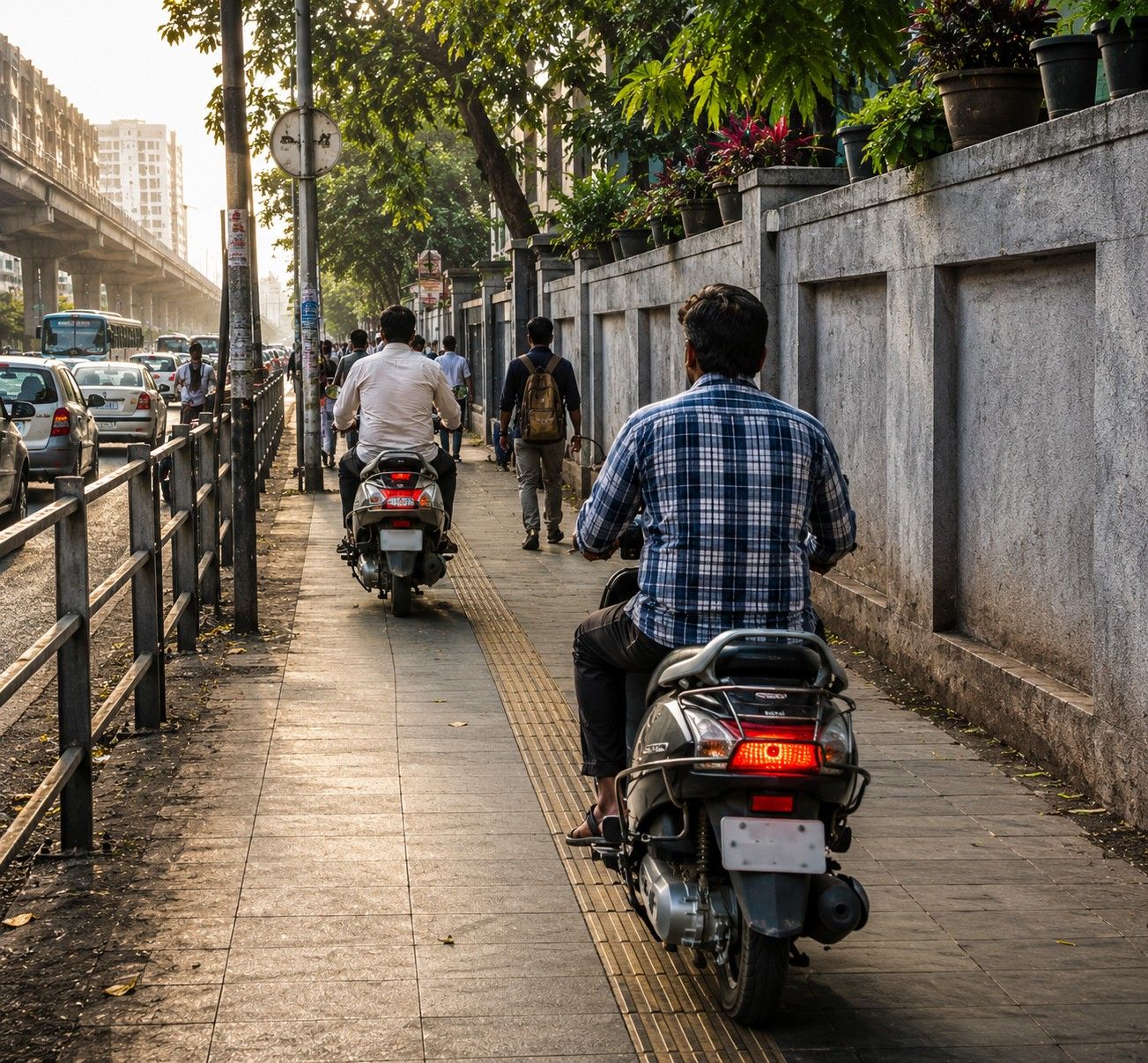
Supreme Court footpath pedestrian right: The Supreme Court of India delivered a landmark ruling on June 19, 2026, that directly affects every pedestrian in the country. The court declared that the Supreme Court footpath pedestrian right 2026 verdict is a fundamental constitutional right. Walking on a designated footpath takes priority over the movement of motor vehicles. This judgment has wide-ranging implications for urban planning, road safety, and civic infrastructure across India, including Nagpur.
What Did the Supreme Court Exactly Rule?
A bench of Justices P.S. Narasimha and Atul S. Chandurkar delivered the judgment. The bench held that the right to walk is derived from Article 19(1)(d) of the Constitution. This article guarantees freedom of movement to every citizen. The court also read this right alongside Articles 19(1)(a), 19(1)(b), 19(1)(c), and Article 21, which protects the right to life.
The bench clearly stated that the fundamental right to walk on a demarcated footpath is primary. This right takes priority over movement by motorised vehicles. No authority can override this constitutional guarantee.
Who Is Responsible for Building and Maintaining Footpaths?
The Supreme Court placed the responsibility squarely on civic bodies. The bench stated that whenever a road is constructed, authorities have a corresponding obligation to provide safe pedestrian infrastructure. Urban development bodies, municipal corporations, municipalities, and panchayats are all responsible for this duty.
Their responsibilities include demarcating, constructing, preserving, and protecting footpaths. This ruling directly applies to civic bodies like the Nagpur Municipal Corporation. NMC must ensure that every new road includes a proper and safe footpath.
What Can Citizens Do If Their Right Is Violated?
The Supreme Court gave citizens a powerful legal tool. Any violation of the right to walk on a footpath now allows citizens to seek constitutional remedies. This includes the right to claim compensation. Importantly, citizens can seek this remedy independently of the Motor Vehicles Act. They do not need to go through that law alone.
This is a significant development. It means a pedestrian who is injured due to the absence or poor condition of a footpath can approach the court directly under constitutional provisions.
What Was the Case That Led to This Ruling?
The case arose from a heartbreaking incident. Maniyar Iliyaz, also known as Shaik Riyaz, filed a civil appeal after his five-year-old son was killed in a road accident. The child was walking to a nearby school with his father around 9 AM. A tanker lorry struck the child from behind. The boy later succumbed to his injuries.
The Supreme Court restored and enhanced the compensation amount payable to the bereaved father to Rs 11,44,628. The court overturned the High Court’s earlier reduction of this award. It directed the compensation to be paid within two months.
What Did the Court Say About Urban Planning?
The bench made pointed observations about how urban planning has failed pedestrians for decades. The court noted that policies under the Motor Vehicles Act have often favoured motorised transport at the expense of pedestrians. This has resulted in inadequate and unsafe footpaths across the country.
The bench remarked that wheels have eclipsed our imagination when it came to urban planning priorities. The court also described walking as the simplest of all human activities. It noted that walking has long been an integral part of Indian culture, daily life, and even the country’s freedom movement.
What Action Has the Supreme Court Directed?
The court directed its registry to forward copies of this judgment to three central ministries. These are the Ministry of Housing and Urban Affairs, the Ministry of Rural Development, and the Ministry of Road Transport and Highways. The Law Commission of India has also been directed to receive a copy for consideration of legal and policy measures.
The court also recommended the creation of a dedicated regulatory mechanism to safeguard the right to walk. In a notable procedural step, the apex court converted the matter into a petition under Article 32 of the Constitution. It made the Union Government a party to the proceedings.
What Does This Mean for Nagpur?
This ruling has direct implications for Nagpur’s footpaths, many of which are broken, encroached upon, or completely absent on major roads. Citizens who face unsafe or missing footpaths in Nagpur can now use this Supreme Court judgment to file complaints against NMC or even seek constitutional remedies.
The ruling puts pressure on NMC to treat footpath construction as a legal obligation and not merely a convenience. Every road project in Nagpur must now include a properly designed and maintained footpath as a matter of constitutional compliance.

