


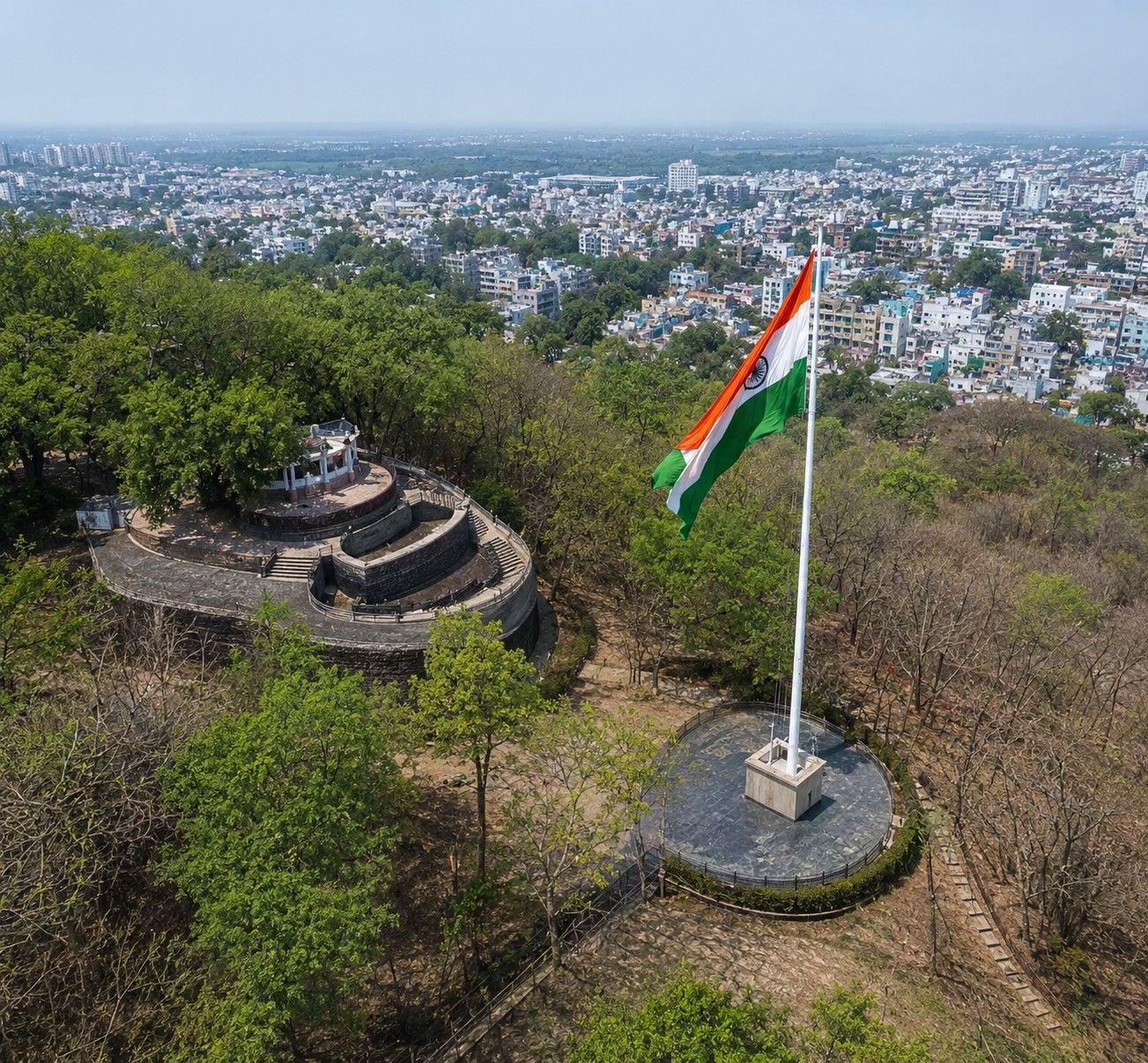
Sitabuldi Fort tallest flag Nagpur: For more than two centuries, Sitabuldi Fort has stood watch over Nagpur from its twin hilltops — silent witness to the Battle of Sitabuldi in 1817, to the British era that followed, to the independence movement, and to the modern city that has grown up around its ancient stone walls. Now, the fort has a new feature that can be seen from miles away across the city: a magnificent 108-foot-high national flag, fluttering proudly above one of Nagpur’s most treasured historical landmarks.
The towering tricolour was inaugurated during a special ceremony on Monday, installed as a joint initiative of Headquarters Uttar Maharashtra & Gujarat Sub Area (UMANG) and the Flag Foundation of India. The ceremony brought together senior defence officials, civic leaders, NCC cadets, and a large gathering of citizens to witness the moment the flag was raised over Nagpur’s most historic hilltop.
Why Sitabuldi Fort Was Chosen for This Honour
Sitabuldi Fort is not just any location in Nagpur — it is the city’s most historically significant military landmark. Built by the British in 1822 atop the two hillocks known as Mothi Tekdi and Choti Tekdi, the fort marks the exact site of the Battle of Sitabuldi, fought in November 1817 between the forces of Appa Saheb Bhonsle of Nagpur and the British East India Company. The battle was one of the pivotal military engagements of the Anglo-Maratha Wars and remains a defining chapter in Nagpur’s history.
For more than two centuries since then, the fort has continued to carry military significance. It was home to the Indian Army’s 118th Infantry Battalion (Territorial Army) Grenadiers until 2019, and is currently associated with the UMANG Sub Area Headquarters — the Army’s administrative command covering Uttar Maharashtra and Gujarat, which relocated to Nagpur from Mumbai in 2018.
Given this deep military heritage, the decision to install a monumental national flag atop Sitabuldi Fort carries symbolic weight that goes far beyond its physical scale. It connects the fort’s 19th-century military history directly to a modern expression of national pride — a tricolour visible across the city, rising from the very ground where soldiers once fought and where the Indian Army continues to maintain a presence today.
The Flag Foundation of India — The Organisation Behind the Mission
The flag installation was made possible through the involvement of the Flag Foundation of India, a national organisation whose mission centres on a simple but powerful idea — every Indian citizen’s right to hoist the national flag with pride.
Speaking at the inauguration ceremony, Major General (Retd) Ashim Kohli, Chief Executive Officer of the Flag Foundation of India, explained the organisation’s founding purpose. “The foundation was established to ensure every Indian has the right to hoist the national flag with pride,” he said. Reflecting on the significance of the Sitabuldi Fort installation specifically, he added, “The 108-foot flag at Sitabuldi Fort will continue to inspire a deep sense of national pride among citizens.”
The Flag Foundation of India has, over the years, been associated with installing monumental national flags at significant locations across the country — landmarks chosen specifically for their historical, cultural, or strategic importance, where a towering tricolour can serve as both a visual landmark and a lasting symbol of national unity. Nagpur’s Sitabuldi Fort now joins this select group of locations.
The Indian Army’s Role — A Tribute to Sacrifice
The installation was equally significant from a military perspective, given the active involvement of Headquarters Uttar Maharashtra & Gujarat Sub Area in making it happen.
Major General NS Sohal, General Officer Commanding of HQ UMANG Sub Area, spoke at the ceremony about the deeper meaning the flag carries. “The national flag symbolises the country’s unity and the sacrifices of soldiers who have given their all for the nation,” he said. He went on to describe the emotional impact the installation is expected to have on the city. “Watching the tricolour flutter high atop the fort will further strengthen the spirit of patriotism among citizens,” he added.
For an institution like the Army — whose daily work is built on service, sacrifice, and duty to the nation — placing a monumental flag at a location with as much military history as Sitabuldi Fort is a deeply meaningful act. It transforms the fort from a historical site that is occasionally visited into a living, visible reminder of patriotism that thousands of Nagpur residents will see simply by going about their daily lives in the city.
Who Attended the Inauguration Ceremony
The inauguration drew a notable gathering of senior officials from across Nagpur’s defence, police, and civic administration — reflecting the city-wide significance attached to the occasion.
Special Inspector General of Police (Anti-Naxal Operations) Sandip Patil represented Maharashtra’s police leadership at the ceremony. Nagpur Municipal Commissioner Vipin Itankar — representing the civic administration that has overseen much of Nagpur’s recent infrastructure transformation — was also present, underlining the city corporation’s support for the initiative.
Major General (Retd) Anil Bam and Flight Lieutenant (Retd) Shiwalee Deshpande, both senior retired defence personnel with distinguished service records, attended alongside a wider gathering of serving and retired defence personnel and soldiers. The presence of both active-duty and retired officers at the ceremony reflected a sense of continuity — generations of those who have served the nation coming together to witness this new landmark.
Perhaps most significantly, a large number of National Cadet Corps (NCC) cadets were present at the ceremony. The NCC, which trains young students in discipline, leadership, and national service, represents the next generation who will carry forward the spirit that the flag installation is meant to inspire. Their presence at the inauguration was a fitting reminder that monuments like this are built not just to commemorate the past, but to shape the values of the future.
What the Flag Means for Nagpur Going Forward
At 108 feet, the flag at Sitabuldi Fort becomes one of the most visually commanding landmarks in central Nagpur. Given the fort’s elevated position atop the city’s twin hillocks, the flag is expected to be visible from a considerable distance across multiple directions of the city — a constant, dignified presence over Nagpur’s skyline.
The installation is expected to become a major attraction for both Nagpur residents and visiting tourists. Sitabuldi Fort, which is already a well-known heritage site featuring thick stone walls, sloping bastions, and a history connecting the Maratha and British colonial eras, now has an additional reason for citizens and tourists alike to visit — particularly around occasions like Independence Day, Republic Day, and Maharashtra Day, when the fort traditionally opens to the public.
For residents of Sitabuldi and the surrounding commercial heart of Nagpur — an area that sees enormous daily footfall as one of the city’s busiest market and business districts — the flag offers a moment of pause amid the bustle. Looking up from the streets of Sitabuldi, residents and shoppers will now see the tricolour rising high above the historic fort, a visual reminder of the city’s military heritage and the nation it represents.
For the National Cadet Corps cadets who attended the ceremony, and for generations of Nagpur students who will grow up seeing this flag, the installation offers something more lasting than a single ceremonial moment — a daily, visible symbol of the values the Flag Foundation of India and the Indian Army sought to honour: unity, sacrifice, and pride in the nation.
A Landmark Befitting a Landmark City
Nagpur holds a unique place in Maharashtra and in India more broadly — as the state’s winter capital, as the geographical centre of the country, and as a city whose history stretches from the Maratha Bhonsle dynasty through the British colonial era to its modern role as a growing metropolitan and logistics hub.
The addition of a 108-foot national flag atop one of the city’s most historic military sites adds a new chapter to that story — one that connects Nagpur’s past directly to a renewed, visible expression of national pride for the present and future.
As the tricolour flutters above Sitabuldi Fort’s centuries-old stone ramparts, it stands as both tribute and invitation — tribute to the soldiers who fought and served on that hill, and invitation to every Nagpur resident and visitor to look up, take pride, and remember.
Nagpur Updates will continue to cover developments at Sitabuldi Fort and other heritage landmarks across the city.
Sources: HQ Uttar Maharashtra & Gujarat Sub Area (UMANG), Flag Foundation of India, field reporting. Published: June 2026.

