Nagpur’s Beloved Nanga Putla Square Is Being Stripped of Its History — And Nobody Seems to Care


Published: May 31, 2026 | Category: Nagpur Local | By: Nagpur Updates Desk
Every Nagpurian knows Nanga Putla Square. Very few know its real story. And the city’s civic administration seems to be doing its best to ensure that the story — and the statue — fade into neglect.
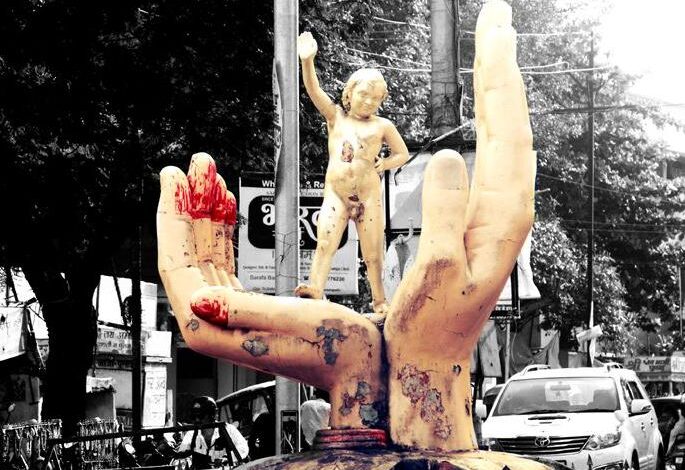
Located at the heart of old Nagpur’s commercial corridor — in the Gandhibag-Itwari area — Nanga Putla Square is one of the most instantly recognisable spots in the city. The small junction, anchored by the iconic statue of a naked child, is a reference point for millions of Nagpurians across generations. It is also, according to heritage experts and citizens, a site that is being allowed to deteriorate through sheer administrative apathy.
Here is the full story — the history, the folklore, and the neglect.
What Is Nanga Putla Square?
Nanga Putla literally means “naked doll” or “naked child figure” in Hindi and Marathi. The name refers to a small statue of a naked child that stands at this junction in the Gandhibag area of Nagpur — near Itwari.

The square sits at one of central Nagpur’s busiest commercial intersections — surrounded by the wholesale markets, shops, and lanes of old Nagpur that have been trading for over a century. For residents of Mahal, Itwari, Gandhibag, and surrounding areas, Nanga Putla Square is simply part of life — a daily reference point, a meeting spot, a navigational landmark.
Over time, the informal name “Nanga Putla Chowk” completely eclipsed whatever official name the junction may have been given. Even today, the official name is all but forgotten — this square is known only as Nanga Putla to every Nagpurian who has ever lived in or visited the old city.
The Origin Story: Folklore, Fact, and a Tragic Accident
Ask any old-time Nagpurian about Nanga Putla Square and you will hear some version of the same story. A child — often referred to as “Munna” — was tragically killed in a road accident at this very junction. The grieving family or community erected the statue of the naked child to immortalise his memory. The junction was named after the statue, and the name stuck.
For years, this narrative was accepted as the definitive origin of the square’s name.
However, local historians and researchers have found that the story is more nuanced. According to reports in Marathi dailies, the tale of the accident-inspired memorial, while based on a real incident, does not fully account for the statue’s origin. The sequence of events, they suggest, intertwines genuine local folklore with facts that are more complicated than the popular version suggests.
What is clear is this: whether the statue was specifically commissioned as a memorial or arrived at the junction through other circumstances, it became adopted by the community as a memorial — and over time, the identity of the place became inseparable from the statue and the stories around it.
This is how heritage works in India’s old cities. Places accumulate meaning through layers of memory, story, and emotional attachment. Nanga Putla Square is a perfect example.
Moments That Defined the Statue’s Place in Nagpur’s Heart
The Nanga Putla statue has been more than a static object at a junction. It has been a living part of Nagpur’s civic life — a canvas onto which the city has projected its stories, its emotions, and its messages.
The COVID-19 Moment (2020) In mid-2020, as the COVID-19 pandemic swept through India, someone affixed a face mask to the Nanga Putla child statue. It was a simple, spontaneous gesture — but the image of the iconic naked baby wearing a protective mask was widely shared on social media. The statue, which had been a childhood memory for generations of Nagpurians, became a public health messenger. It demonstrated, more powerfully than any campaign poster, how deeply ingrained this little monument is in the city’s consciousness.
The Naming Tradition The fact that the square’s entire identity — to the exclusion of any official name — is defined by this single statue speaks to something rare in Indian urban life. Most junctions are named after politicians, buildings, or landmarks. Nanga Putla Square is named after a small, unofficial statue of a child. That says something profound about how ordinary Nagpurians create their own cultural geography — one that has nothing to do with official plaques or government decisions.
The Heritage Crisis: What Is Being Lost
This is where the story turns from charming to alarming.
The Nanga Putla statue and the character of its surrounding square are being eroded — not through any dramatic act of demolition, but through the slow, grinding neglect that claims so many of India’s informal heritage sites.
Reports indicate that the physical state of the statue and the square has deteriorated significantly. The area around the junction — once a vibrant, if chaotic, commercial hub — has seen changes that have diminished the square’s character. The statue itself has reportedly suffered from inadequate maintenance and protection.
More importantly, the historical and cultural significance of the square is not formally recognised — there is no heritage plaque, no conservation order, no institutional acknowledgment that this is a site worth protecting. Without formal recognition, it has no protection against the kind of gradual erasure that commercial development, road widening, and infrastructure projects routinely inflict on informal heritage sites in Indian cities.
Nagpur does have a heritage list — a catalogue of 47 heritage structures designated for conservation by the Government of Maharashtra and managed through the NMC’s Heritage Conservation Committee. Nanga Putla Square, despite being arguably one of the most emotionally significant public spaces in old Nagpur, is not on it.
Nagpur’s Wider Heritage Problem
Nanga Putla’s story is not unique. It reflects a broader pattern of heritage neglect in Nagpur — a city with an extraordinarily rich history that is, in many places, being allowed to disappear.
The city’s British-era buildings, the historic lanes of old Nagpur, the informal monuments and public sculptures that have accumulated meaning over generations — all of these face the same challenge. Without formal protection, they are vulnerable to the pressures of urban development, commercial expansion, and the simple passage of neglected time.
This is all the more painful given the extraordinary investment Nagpur is making in new landmarks — the 162-foot Hanuman statue at Koradi, the Ashoka Stambh at Ashok Square, the revival of the Futala Musical Fountain. These are wonderful additions. But a city’s identity is not built only on new monuments. It is equally preserved — or lost — through how it treats the informal, organic, community-made landmarks that generations of ordinary people have adopted as their own.
Nanga Putla Square is one of those places. It deserves better.
What Needs to Happen
The ask is not complicated or expensive. It requires will, not resources:
1. Formal heritage recognition Add Nanga Putla Square to Nagpur’s official heritage conservation list — giving it the legal protection it needs against encroachment, road widening, and development.
2. Restoration and maintenance of the statue Commission a professional restoration of the Nanga Putla statue — and establish a regular maintenance schedule to ensure it is not allowed to deteriorate further.
3. A heritage plaque Install a properly researched and written heritage plaque at the junction — telling the story of the square, the statue, and its place in Nagpur’s history and memory.
4. Community involvement Engage the residents of Gandhibag, Itwari, and Mahal — who have lived with and loved this square for generations — in its conservation. Community ownership is the most sustainable protection any heritage site can have.
Q: Where exactly is Nanga Putla Square? It is located in the Gandhibag area near Itwari in central Nagpur — one of the city’s oldest and most densely commercial neighbourhoods.
Q: Is Nanga Putla on Nagpur’s official heritage list? No — despite its cultural and historical significance, Nanga Putla Square is not formally recognised on Nagpur’s heritage conservation list.
Q: Why is the square called Nanga Putla? The name comes from the statue of a naked child (nanga putla in Hindi/Marathi) that stands at the junction. The popular story connects the statue to a child killed in a road accident at the spot — though historians have found the origin to be more complex.
Q: What happened during COVID with the statue? In 2020, someone placed a face mask on the Nanga Putla statue as a public health gesture. The image went viral — demonstrating how deeply the statue is embedded in Nagpur’s collective identity.
A City That Builds New and Forgets the Old
Nagpur is building new landmarks faster than at any point in its recent history. That ambition is admirable. But the measure of a city’s relationship with its own identity is not only in what it builds — it is also in what it chooses to protect.
Nanga Putla Square has been protecting itself for decades — held in the memory of millions of Nagpurians who have passed through it, grown up near it, and made it part of their personal geography of the city.
It is time for the city to return the favour.
Nagpur Updates will continue to highlight the city’s heritage sites that need attention, protection, and the recognition they deserve.
Tags: Nanga Putla, Nagpur Heritage, Nagpur History, Itwari Nagpur, Nagpur Landmarks, NMC Nagpur Heritage, Nagpur Local News 2026