


Nagpur, April 30, 2026.
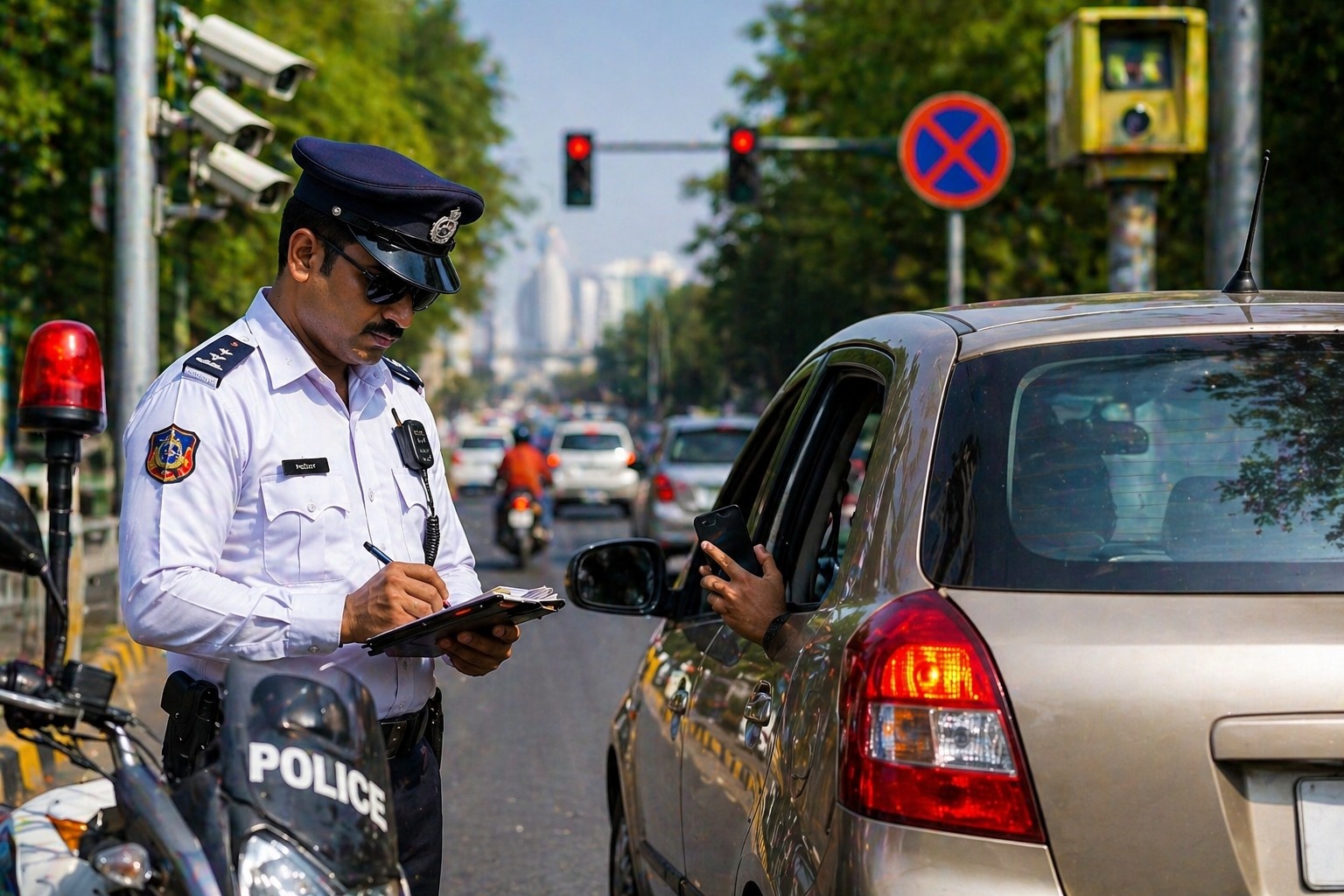
New Traffic Rules 2026 Nagpur | e-challan new rules Maharashtra 2026: Most Nagpur drivers know that a traffic challan means paying a fine. What they may not know is that from January 20, 2026, the rules around repeated violations have changed fundamentally — and the consequences of crossing a specific threshold have become significantly more serious.
Under the Central Motor Vehicles (Third Amendment) Rules, 2026, notified by the Central Government and effective across India from January 20, 2026, any motorist who accumulates five or more traffic violations within a single calendar year will now be classified as a repeat or habitual offender — a category that attracts action under serious offence provisions, not just routine compounding fines.
For the millions of vehicle owners in Nagpur — a city where traffic enforcement has intensified significantly with the expansion of e-challan camera networks across major roads and intersections — this is a change that demands attention.
The Single Biggest Change: The Five-Violation Rule
The heart of the new amendment is straightforward. Starting from January 1, 2026, traffic violations are being counted per calendar year for each vehicle and driver. If you receive five or more challans within that calendar year — for any combination of traffic offences — you cross into the serious offence category.
What does “serious offence” mean in practice? It means your case is no longer handled through simple compounding — paying a fixed fine at a counter and walking away. Instead, you may be required to appear before a court, where penalties can include significantly higher fines, licence suspension, or in extreme cases, imprisonment depending on the nature of the violations involved.
There is one important clarification that offers partial relief: violations from one calendar year do not carry forward into the next. If you received four challans in 2025, those four do not count toward your 2026 tally. The count resets on January 1 each year. But within any single year, the clock is running — and five violations is not as high a threshold as it might sound for a driver navigating Nagpur’s busy roads daily.
Think about what five violations can look like in the course of a year: one challan for jumping a signal, one for a lane violation, one for speeding caught on camera, one for a mobile phone use detection, and one for a parking violation near a no-parking zone. That is five. That is the new threshold.
The E-Challan System: Faster, Tighter, Harder to Ignore
The second major change in the 2026 amendment concerns the e-challan delivery system — and it closes a loophole that many vehicle owners had been exploiting, sometimes unknowingly and sometimes deliberately.
Under the revised rules, when a traffic violation is captured by an automated surveillance camera or issued electronically by a police officer, the e-challan must be delivered to the registered vehicle owner within three days of being issued. Physical challans — when issued manually by an officer on the road — must reach the offender within 15 days.
This is a significant tightening of the previous system, where challans sometimes took weeks to arrive — if they arrived at all — giving vehicle owners plausible deniability about whether they had received notice of a violation. The three-day e-challan delivery requirement eliminates that ambiguity for digitally issued challans.
Once you receive a challan — whether physically or electronically — you now have 45 days to either pay the penalty or contest it by presenting valid documents and your case before the relevant authority. Ignoring a challan beyond this window invites escalating consequences, including court summons and potential vehicle seizure.
The amended rules also formally authorise automated challans generated purely through electronic surveillance systems — cameras, speed sensors, and similar devices — without requiring a police officer to physically witness the violation. This is already operating in Nagpur through the integrated traffic management system, and the amendment now gives this system a clearer legal foundation.
What Are the Actual Fine Amounts in Nagpur / Maharashtra in 2026?
For Nagpur drivers who want to know exactly what they are risking for each type of violation, here is the current penalty structure applicable in Maharashtra:
Overspeeding for a light motor vehicle now attracts a compounding fine of ₹4,000 — a significant increase from earlier rates, reflecting the seriousness with which the government views speeding as a cause of road fatalities.
Driving without a valid licence has actually been revised downward in Maharashtra compared to the earlier Motor Vehicles Amendment Act 2019 peak rates — it now stands at ₹1,000 for two-wheelers and ₹2,000 for four-wheelers, compared to ₹5,000 that was briefly the notified rate under the 2019 amendment.
Not wearing a helmet for two-wheeler riders carries a fine of ₹500 for the first offence, with potential licence suspension for repeat violations. Not wearing a seatbelt in a car is ₹1,000.
Using a mobile phone while driving carries a fine of ₹1,000 for the first offence and ₹10,000 for a repeat offence — one of the steepest escalation rates in the fine structure, reflecting the danger posed by distracted driving.
Driving under the influence of alcohol — with blood alcohol content above 0.03% or 30 mg per 100 ml of blood — remains a non-compoundable offence carrying fines of ₹10,000 for the first offence and ₹15,000 for a repeat, along with possible imprisonment. This is a court challan — you cannot simply pay and leave.
A minor driving a vehicle now attracts a fine of ₹5,000 — up dramatically from the earlier ₹500 — with the registered vehicle owner also facing liability. This provision was strengthened specifically in response to incidents where parents or guardians allowed underage family members to drive vehicles.
Blocking emergency vehicles — ambulances, fire engines, police vehicles on emergency duty — carries a fine of ₹1,000, revised down from ₹10,000, though the offence remains a serious one in terms of its humanitarian consequences.
Driving without valid insurance is ₹2,000 for the first offence. Driving without a valid Pollution Under Control (PUC) certificate is ₹1,000.
Why Nagpur Drivers Face Higher Risk of Hitting the Five-Violation Limit
Nagpur’s traffic enforcement landscape has changed substantially over the past two years. The Nagpur Traffic Police has expanded its network of automated cameras at major intersections — including Variety Square, Sitabuldi, Dharampeth, Amravati Road, Wardha Road, and the Ring Road — and e-challans are being generated at significant volumes daily.
Additionally, Nagpur Metro’s elevated corridor passes over several major city roads, and the associated traffic management around metro stations has created new enforcement zones where lane discipline and signal compliance are now camera-monitored.
What this means practically is that a driver who previously might have committed minor violations without being noticed — because no officer was present — is now much more likely to receive an e-challan through the automated system. The combination of higher camera density and the new five-violation rule creates a situation where casual, habitual minor violations that drivers once ignored can now accumulate to serious offence classification within a single year.
How to Check Your Pending Challans in Nagpur Right Now | e-challan new rules Maharashtra 2026
If you have not checked your vehicle’s challan status recently, now is the time. The process is simple and takes under two minutes.
Visit the official Parivahan e-Challan portal at echallan.parivahan.gov.in. Enter your vehicle registration number. The portal will show all pending challans linked to that vehicle — including those issued by automated cameras that you may not have been aware of. You can pay directly through UPI, net banking, or debit/credit card on the same portal.
You can also check through the Maharashtra State e-Challan payment portal and through the mParivahan app on your smartphone. If you prefer to handle it in person, any traffic police station in Nagpur can assist you with checking and paying pending challans.
Given the new three-day delivery requirement and the 45-day payment window, allowing challans to accumulate unpaid is now a significantly riskier strategy than it once was.
The Devendra Fadnavis Push: Why This Is Happening Now
The timing and content of the Central Motor Vehicles (Third Amendment) Rules, 2026 align with a broader national and state-level push for modernised, digitally-driven traffic enforcement.
Maharashtra Chief Minister Devendra Fadnavis has consistently prioritised road safety and digital governance in policing — themes that run through both his previous term as CM and his current one. The emphasis on digital evidence, automated enforcement, and stricter repeat-offender provisions also connects to the framework established by the Bharatiya Nyaya Sanhita (BNS) — the successor legislation to the Indian Penal Code — which places greater weight on digital records and electronic evidence in criminal proceedings.
An e-challan record, under this framework, is not just an administrative notice. It is a digital legal document that can form part of a case file if violations escalate to the level of court proceedings. The blockchain and digital evidence emphasis visible in Maharashtra’s forensic modernisation programme — including the new forensic vans for Nagpur Police — is part of the same continuum of governance thinking.
What Nagpur’s Transport Commissioner Is Saying
The Transport Commissioner’s Office in Mumbai has issued a formal advisory urging citizens across Maharashtra — including Nagpur — to clear all pending e-challans promptly and to strictly adhere to traffic regulations going forward. The advisory specifically highlighted the five-violation rule and the new e-challan timeline requirements as the most immediately impactful changes for ordinary motorists.
No amnesty or grace period has been announced for pending challans from 2025 or before. The expectation from authorities is clear: pay what is owed, and drive within the rules going forward.
A Simple Rule for Nagpur Drivers in 2026 | e-challan new rules Maharashtra 2026
The new rules do not change what good driving looks like. They change the consequences of bad driving — making them faster, more certain, and more cumulative.
If you wear your helmet every ride, wear your seatbelt every drive, stay within speed limits, stop at red lights, keep your phone down while driving, and maintain your vehicle’s insurance and PUC validity — the five-violation rule will never touch you. It is designed specifically for those who treat traffic rules as optional.
For everyone else in Nagpur — check your pending challans today, pay what you owe, and start 2026 on a clean slate. The counter is already running.
Sources: Central Motor Vehicles (Third Amendment) Rules 2026, Maharashtra DGIPR, Transport Commissioner’s Office Mumbai, Parivahan e-Challan portal, field reporting. Published: April 30, 2026 | This article will be updated as Maharashtra issues state-level implementation guidelines.

