


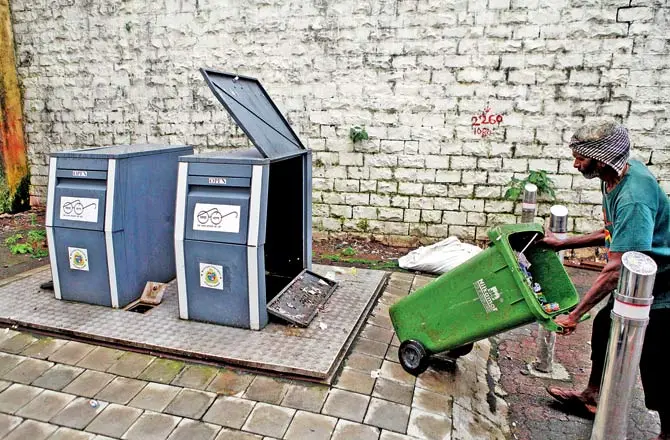
Nagpur, May 1, 2026. NMC underground dustbins Nagpur 2026: If you have ever walked past an overflowing garbage bin on a Nagpur roadside — the stench hitting you before you even see it, waste spilling onto the footpath, flies circling the heap — you will understand exactly why the Nagpur Municipal Corporation has spent years trying to solve this problem.
The latest solution is ambitious, practical, and has worked in several cities across India and abroad: underground dustbins. NMC is now ready to move forward with installing non-hydraulic underground bins at 15 identified locations across the city under the first phase of the project. And this time, the civic body has thought through the engineering, the specifications, and the lessons from previous failed experiments — in enough detail to suggest this could actually work.
What Are These Underground Bins — And How Do They Work?
The concept is straightforward but the engineering is precise. At each selected location, NMC will excavate a pit measuring approximately 6 by 7 feet — or 2×1.5 cubic metres — into which a large stainless steel bin will be sunk into the ground. The bin itself measures 1,531 mm by 1,796 mm, giving it a storage capacity of 1.5 tonnes per unit.
Each selected location will receive two bins side by side — giving each site a combined storage capacity of 3 tonnes of solid waste (NMC underground dustbins Nagpur 2026). The bins will sit below ground level, with only a flat lid visible at street level — flush with the pavement or roadside surface. When the lid is closed, the bin is completely out of sight. No overflow. No exposed waste. No smell seeping onto the street.
The bins are made of stainless steel, with walls between 1.5 mm and 3 mm thick depending on the structural requirement. A rubber seal runs along the rim of each bin, making the underground chamber watertight — ensuring that rainwater does not flood the bin from below and that the waste contained inside does not leach into the surrounding soil.
To help residents deposit waste without effort, each bin is equipped with two gas spring cylinders — the same mechanism used in car boot lids — that allow the lid to be raised and lowered smoothly with minimal physical effort. This is important for elderly residents and people depositing larger quantities of household waste.
When a NMC collection vehicle arrives for pickup, workers use hooks attached to the bins to lift them out of the ground pit. The contents are then emptied into the vehicle, the bin is lowered back into its pit, and the lid is sealed again. The entire process is mechanical, quick, and does not require the bins to be physically dragged across a road or footpath.
Where Will These Bins Be Placed (NMC underground dustbins Nagpur 2026) — and Why Was That Decision Important?
Dr Gajendra Mahalle, Chief Sanitation Officer of NMC, confirmed that the bins will be positioned specifically by the roadside — not in the middle of footpaths or pedestrian zones. The placement is deliberately chosen to ensure they create no obstruction to either pedestrian movement or traffic flow.
This distinction matters because one of the recurring criticisms of NMC’s past garbage infrastructure — including the open bins that were eventually removed — was that they were placed at busy pedestrian corners where they both blocked movement and subjected passers-by to odour. The underground design, combined with roadside placement, directly addresses both of these complaints.
The 15 specific locations identified for Phase 1 have not yet been publicly announced, but NMC sources indicate they will be at high-footfall areas of the city — prominent roads, market areas, and residential zones where solid waste accumulation has historically been a persistent problem.
Why Did NMC Abandon Open Bins in the First Place?
To understand why this project is significant, it helps to trace the history of NMC’s evolving approach to on-street waste storage — because the underground bin initiative is the third attempt at solving a problem the corporation has been grappling with for years.
The first era was the open bin era. For decades, large open collection bins were a standard feature of Nagpur’s roadsides. Sanitation staff used them as staging points — collecting waste from homes and sweeping roads, then depositing the material in these bins before it was loaded into pickup vehicles for transport to the Bhandewadi Dumping Yard.
In theory, the system was functional. In practice, it became progressively worse over time. Citizens discovered that the open bins were convenient for disposing of household waste at any hour — not just the waste that sanitation workers deposited. Food waste, household garbage, construction debris, and other materials began going in at all hours. The bins overflowed almost constantly. The stench became a neighbourhood-wide problem. Images of NMC’s overflowing open bins circulated widely and became symbolic of the city’s waste management failures. NMC eventually responded by removing the open bins and launching a bin-free city initiative.
The second era was the bin-free experiment. Under this policy, NMC moved toward door-to-door waste collection — the idea being that if there are no bins on the street, citizens have no choice but to hand their waste directly to the collection vehicle when it comes to their door. This concept has worked well in several cities, particularly in areas with disciplined, high-density residential zones. In Nagpur, however, the reality was more complicated. The coverage of door-to-door collection was not universal. Transfer stations — the large intermediate waste processing facilities planned to replace roadside bins in the logistics chain — have not been built at the scale originally envisioned. Two transfer stations are currently under construction, but the scale and technical complexity of those facilities means they cannot serve as an immediate substitute for local storage points.
The result of removing bins without adequate alternatives was that waste began to accumulate in informal spots — on corners, against walls, at the base of electric poles — wherever residents found it convenient to leave bags and packages of garbage. The problem the bins were meant to solve had simply relocated from the bin to the street.
The Bin-Stand Theft Problem — and Why Underground Makes Sense
NMC also tried an intermediate solution: elevated bin stands — metal frames that held bins at a raised height, positioned at locations across the city. The intention was to make waste more accessible for collection vehicles without the overflow problems of open bins.
These were stolen. Repeatedly. The metal frames, valuable as scrap, disappeared at a rate that made the programme financially unsustainable. NMC lost significant public money to replacement costs before concluding that above-ground metal infrastructure in public spaces in Nagpur needed to be theft-proof if it was going to last.
Underground bins solve the theft problem definitively. A 1.5-tonne stainless steel bin sunk into a 6-by-7-foot concrete pit is not something that can be dug up and carried away. The investment in each unit is protected by the physics of the installation itself.
The Hydraulic vs Non-Hydraulic Choice — Why NMC Went Non-Hydraulic
NMC is also installing one hydraulic underground bin at its Civil Lines headquarters — a more sophisticated system in which a hydraulic mechanism raises and lowers the bin automatically at the press of a button. This technology is common in European cities and is considered the premium standard for underground waste storage.
However, for the citywide rollout under Phase 1, NMC has opted for the non-hydraulic version. The reason is practical: hydraulic systems require electrical connections, maintenance of hydraulic pumps, and technical expertise to repair when they malfunction. In a city where electrical infrastructure on residential streets is sometimes unreliable, and where sanitation department technical capacity for specialised equipment maintenance is limited, a non-hydraulic system with manual hook-lifting is simply more robust.
Non-hydraulic does not mean inferior. The bins at these 15 locations will function effectively for their intended purpose. The gas spring cylinders make operation physically manageable for sanitation workers. The sealed, waterproof chambers protect the waste and the surrounding environment. And the absence of hydraulic machinery means there is less to break down and fewer specialised technicians needed to keep the system running.
What This Means for Nagpur Residents
For citizens living near the 15 identified locations, the change will be immediately tangible. Where there is currently either a bare roadside where waste accumulates informally, or no organised collection point at all, there will be a clean, flush-to-ground waste deposit point that looks like nothing more than a sealed lid set into the pavement.
The odour problem — perhaps the most universally complained-about aspect of street-level garbage infrastructure — will be substantially reduced. Sealed underground bins with rubber gaskets contain odour in ways that open or partially covered above-ground bins simply cannot. For pedestrians and residents of nearby buildings, this alone represents a significant improvement in daily quality of life.
For the sanitation department, the bins provide a reliable, fixed local storage point that can be incorporated into predictable collection routes. Workers do not have to manage scattered informal dumping points or coordinate with residents over door-to-door timing. The bin is there, it fills up, the vehicle empties it, and the cycle continues without the variables that make informal systems difficult to manage efficiently.
The 15-Location Phase 1 — What Comes Next | NMC underground dustbins Nagpur 2026
NMC has described this as Phase 1, which implies a phased rollout. The success of the 15 pilot locations — in terms of community acceptance, operational reliability, and waste containment performance — will determine how quickly and how broadly the underground bin model is expanded across the city.
Nagpur has dozens of high-footfall locations where the problem of street-level waste accumulation is persistent and where an underground bin would represent a genuine improvement. If Phase 1 performs as planned, a Phase 2 and Phase 3 expansion could transform the street-level waste infrastructure of major corridors and market areas across the city.
Dr Mahalle confirmed that NMC is committed to the project and that the 15 Phase 1 locations are already identified. Tender processes and construction timelines will be confirmed as the project moves forward.

