Two Students From Shegaon Are Working on Roads That Fix Their Own Potholes and Glow in the Dark — And They Have Already Tested It Near the Temple


Shegaon engineering students: Every monsoon season in India, the same story plays out on roads across the country. The rains arrive. The potholes appear. The complaints flood social media. Municipalities scramble to patch roads. The patches fail within weeks. The potholes return. And the cycle repeats itself — costing the government money, costing vehicle owners in repairs, and costing lives in accidents that would never have happened on a properly maintained road.
Two young engineering students from Shegaon — a town in Buldhana district best known as the home of the Sant Gajanan Maharaj Temple, one of Maharashtra’s most revered pilgrimage sites — have decided they are done watching this cycle repeat. Rajvardhan Thakur and Atharv Deshmukh have developed a project they call Bio-Based Self-Healing and Night Visibility Road Technology — a dual innovation that addresses two of India’s most persistent road problems simultaneously: potholes and night-time accidents caused by poor road visibility.
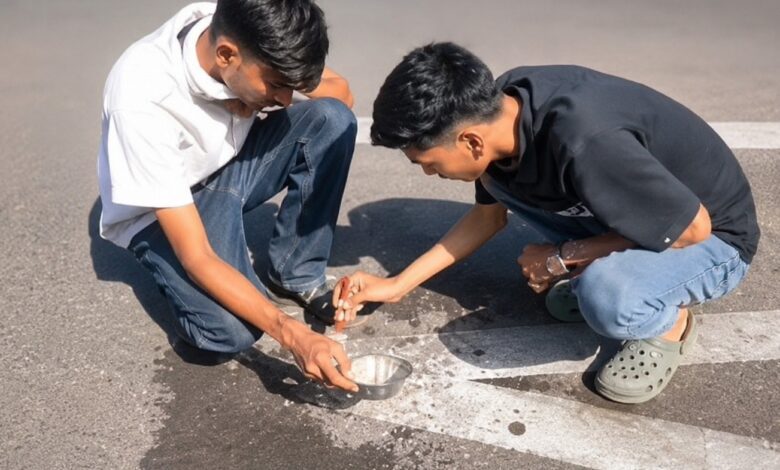
The project has already moved beyond a college presentation. Small-scale demonstrations have been conducted near the Sant Gajanan Maharaj Temple and at the Shegaon railway station. Local residents saw it in action and responded positively. The innovation has earned recognition at multiple technical competitions, including awards for project presentations and research paper events. And the two innovators have formed a company — Relvian Group — through which they intend to develop and commercialise the technology for use on highways, smart city infrastructure, village roads, and accident-prone areas across India.
The First Innovation: Roads That Glow Without Electricity
The more immediately deployable of the two technologies Rajvardhan and Atharv have developed is the glow-based road visibility system.

The concept addresses a problem that anyone who drives on Indian roads at night knows viscerally: beyond the range of your headlights and the occasional working streetlight, roads become genuinely dangerous. Lane markings fade. Road edges blur into the darkness beyond. Dividers and curves appear suddenly. Pedestrians and cyclists become nearly invisible until they are dangerously close. And in the absence of clear visual cues, drivers make misjudgements that result in accidents.
Conventional thermoplastic road markings — the white and yellow lines painted on roads — are intended to address this, but they have a well-documented weakness. Tyre friction erodes them. Rainwater washes them. Dust from traffic obscures them. Within months of application, markings that were clearly visible when fresh become nearly indistinguishable from the road surface around them, particularly at night and in poor weather.
Rajvardhan and Atharv’s solution is a special glow-based coating that changes the energy physics of the marking entirely. The coating is photoluminescent — it absorbs visible light during daytime exposure and re-emits it in dark conditions through a process that requires no electricity, no power source, and no maintenance. When a vehicle’s headlights illuminate the coating during the day, or when ambient sunlight falls on it, the material charges itself. After sunset, it emits this stored light as a visible glow — delineating road edges, marking dividers, indicating curves, and outlining pathways for drivers who are navigating with limited visibility.
The innovation is not a wholesale replacement of streetlighting — it does not produce the same illumination intensity as a functioning sodium or LED streetlight. What it does is provide continuous passive guidance along the road surface itself, in the places where drivers most need to see: the edges, the lane markings, the hazard indicators. This passive guidance is most valuable precisely in the situations where streetlights are most likely to fail or be absent — rural roads, accident-prone stretches outside town limits, areas where electricity supply is unreliable, and the gaps between functioning streetlights on urban roads.
The demonstrations conducted near the Sant Gajanan Maharaj Temple and the Shegaon railway station took this technology from a laboratory concept to a real-world trial in a location where it is genuinely relevant. The temple complex draws enormous footfall — particularly during festival seasons when pilgrims arrive throughout the night — and the surrounding roads see significant pedestrian and vehicle movement in low-light conditions. Testing the glow coating in this environment, rather than just in a controlled college lab, gave Rajvardhan and Atharv real-world performance data and community feedback that will inform further development.
The Second Innovation: Cement That Seals Its Own Cracks
The self-healing cement component of the project is at a more experimental stage than the glow coating — but its potential implications are even more significant for India’s infrastructure maintenance challenge.
The concept of self-healing concrete is not new to materials science. Researchers around the world have been working on it for over a decade, with various approaches including the use of bacteria, chemical capsules, and fibre-reinforced composites that activate when a crack forms. The idea in every case is the same: build into the road material itself a mechanism that responds to damage by filling, sealing, or bonding the damaged area before it develops into a significant structural failure.
In India’s road context, the practical value of this is enormous. Indian roads — particularly at the sub-national and municipal level — are built to standards that are frequently compromised by contractor cost-cutting, inadequate quality monitoring, and materials that do not account for the extreme stresses imposed by monsoon water infiltration, heavy truck traffic, and extreme temperature variations. A road built with conventional concrete or asphalt develops micro-cracks that water then enters, eroding the sub-base and causing the surface to collapse — creating the potholes that are so characteristic of post-monsoon India.
A concrete that can seal its own micro-cracks before water enters them attacks the pothole problem at its earliest stage. Rather than waiting for a micro-crack to become a full pothole and then sending a crew to patch it — a reactive, expensive, and often inadequate response — the road material itself prevents the progression from micro-crack to structural failure. The pothole never fully forms because the cement heals the crack that would have caused it.
Rajvardhan and Atharv’s bio-based approach to this technology — using organic or biological materials as the healing agent rather than purely synthetic chemistry — is aligned with a broader trend in sustainable construction materials that is gaining significant research and commercial attention globally. Bio-based self-healing concrete typically uses bacterial spores or plant-derived materials that activate in the presence of water — the same water that would otherwise infiltrate and damage the road — as the sealing agent. The biological mechanism is elegant: the material that threatens to damage the road triggers the protective response that prevents the damage.
The students are candid that this component of their project is still in its experimental stage and requires further testing before it can be scaled to real-road application. The variables in real-world road conditions — load intensity, temperature range, water chemistry, traffic frequency — are significantly more complex than laboratory conditions, and demonstrating reliable performance across these variables takes time and systematic testing that goes beyond what two students can accomplish alone. But the direction of the research is sound, the global scientific literature supports the potential, and the innovators have a clear path for what further development needs to look like.
Relvian Group — The Startup Behind the Innovation
One of the most significant aspects of Rajvardhan and Atharv’s project is that they are not treating it as a college competition entry to be filed away after the award ceremony. They have incorporated a company — Relvian Group — through which they intend to develop the technology commercially.
This step from innovation to enterprise is the critical transition that most student innovations never make. The history of Indian engineering colleges is full of technically impressive projects that earned awards at competitions and then disappeared into the archives because the students graduated, moved on to jobs, and had no mechanism for taking the technology further. Rajvardhan and Atharv have created that mechanism by forming a company.
Through Relvian Group, the two innovators are targeting specific market segments for their technology. Highways — where NHAI and state road development corporations manage thousands of kilometres and spend enormous sums on resurfacing — are an obvious target for both the glow coating and the self-healing cement, since the economic case for technologies that reduce maintenance frequency is strongest at the national highway level. Smart city infrastructure is another target — where municipalities implementing integrated urban development are actively looking for innovative materials and systems that align with sustainability and efficiency goals. Village roads — which in Maharashtra’s rural hinterland are often the most poorly maintained and the most dangerous for night travel — represent a socially impactful market where the glow coating could save lives at relatively low cost.
The startup path is not easy. Commercialising a materials science innovation requires moving through proof-of-concept trials, field testing, regulatory approvals, cost analysis, and eventually supply chain development — a process that takes years and funding. Rajvardhan and Atharv’s recognition at technical competitions is a start, but converting that recognition into the investment and institutional partnerships that scale a startup requires a different set of skills and connections than the engineering innovation itself.
Incubators at Nagpur’s engineering institutions — including VNIT (Visvesvaraya National Institute of Technology) and RTMNU (Rashtrasant Tukadoji Maharaj Nagpur University) — along with Maharashtra’s Startup Week and the MSME development programmes that support Vidarbha-based entrepreneurs, are potential resources that Relvian Group should be engaging with as it seeks to scale its technology from Shegaon demonstrations to commercial deployment.
Why This Matters for Nagpur and Maharashtra — The Road Safety Context
Rajvardhan and Atharv’s innovation needs to be understood against the backdrop of India’s road safety crisis — which, in Nagpur specifically, DCP Lohit Matani’s Operation U-Turn brought into sharp relief.
Nagpur recorded 345 road accident deaths in 2024 before Operation U-Turn’s enforcement-driven reduction to 259 in 2025. Of those deaths, a significant proportion occurred in conditions of poor visibility — night-time accidents, accidents at unmarked curves and intersections, accidents in the gaps between functioning streetlights. Poor road markings and inadequate night visibility are not marginal contributors to India’s road death toll. They are structural factors that claim lives reliably and predictably every year.
If Rajvardhan and Atharv’s glow coating technology can be deployed at scale on accident-prone stretches — the black spots that DCP Matani’s traffic data identified as disproportionate contributors to Nagpur’s accident toll — it would address a dimension of road safety that enforcement operations alone cannot reach. An enforcement officer can change driver behaviour at a specific intersection during the hours they are present. A passive glow marking can guide drivers safely through that same intersection 24 hours a day, 365 days a year, regardless of whether anyone is watching.
NHAI has been exploring self-healing road technology as a national priority. The global research community is converging on bio-based approaches as the most sustainable path forward. And two students from a small town in Vidarbha — working with the resources available to them, testing in their own community, and building a startup to take their idea to market — are contributing to that global conversation from a very local starting point.
That is a story worth telling. And if Relvian Group’s technology matures and reaches roads across Maharashtra — the pilgrimage routes connecting Shegaon to Nagpur, the accident-prone state highways of Vidarbha, the village roads where a painted edge line lasts one monsoon season and then disappears — the two innovators who demonstrated it near the Sant Gajanan Maharaj Temple in 2026 will have contributed something genuinely lasting to their region.
What Rajvardhan and Atharv Need to Scale This — And Who Should Help
The path from a promising student innovation to a deployed commercial technology requires specific inputs that government, industry, and academic institutions in Maharashtra can provide.
Research funding from CSIR, DST, or the Maharashtra government’s innovation support schemes would enable the systematic field testing that the self-healing cement component currently requires. Pilot project approval from NHAI or Maharashtra’s MSRDC for a monitored real-road trial of the glow coating — with rigorous before-and-after accident data collection — would generate the evidence base that procurement bodies need before adopting any new road material. Corporate partnerships with materials companies in Nagpur’s industrial network could provide manufacturing capacity and supply chain support that a two-person startup cannot build alone.
Nagpur Updates encourages any institution, investor, or government official who has read this story and sees the potential in Rajvardhan and Atharv’s work to reach out to them through Relvian Group. Innovations that address real problems with practical, locally tested solutions deserve more than competition awards. They deserve the support systems that can take them from Shegaon to the nation.