Published: May 27, 2026 | Category: Nagpur Local | By: Nagpur Updates Desk
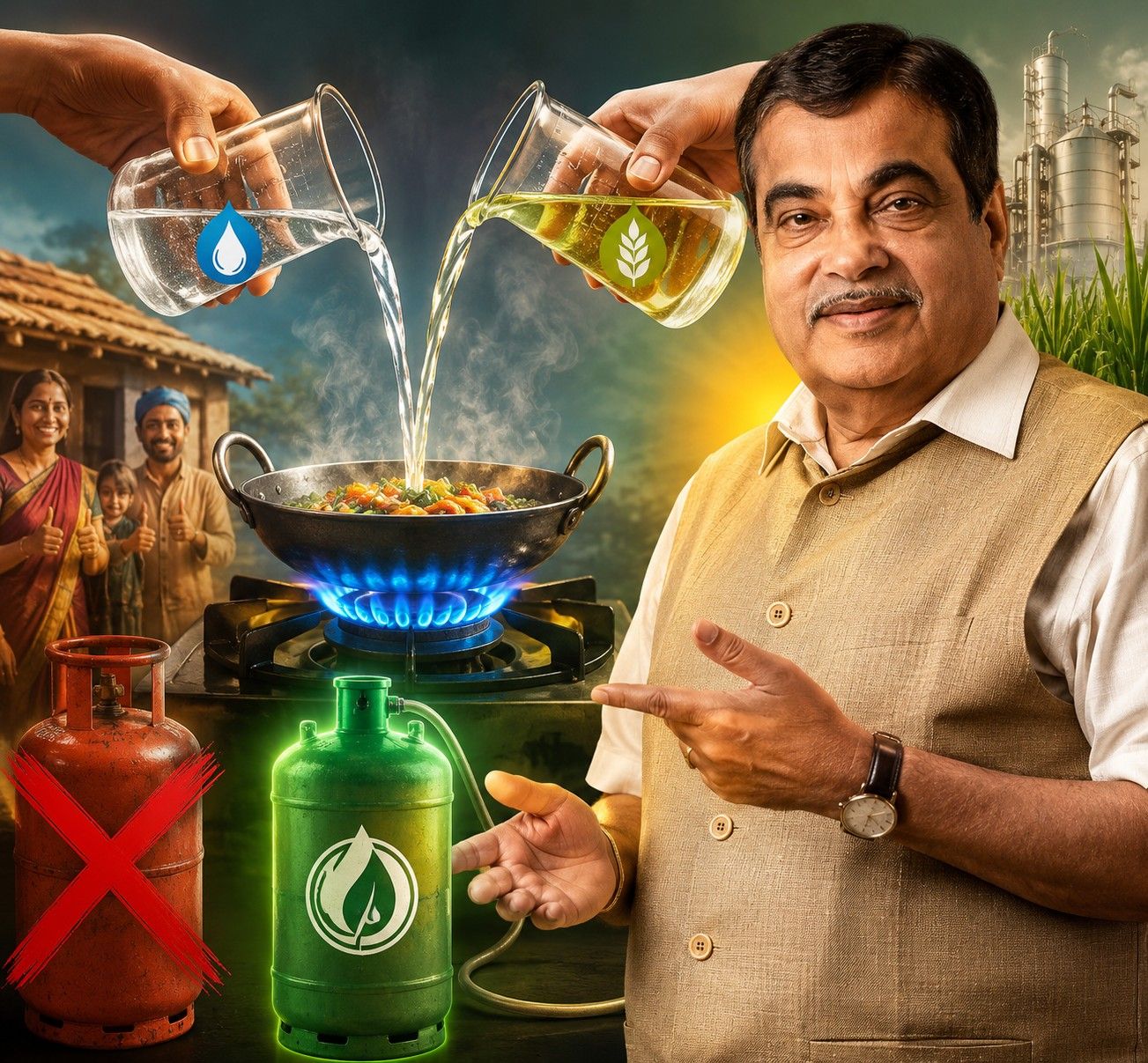
Union Minister Nitin Gadkari has unveiled an ethanol-based cooking stove in Nagpur — claiming it can generate cooking flames at a cost lower than commercial LPG cylinders using just 7% ethanol mixed with water.
The announcement was made at the ‘Mitron Ke Bich’ programme held in Nagpur. It has since sparked significant debate online — with supporters calling it a breakthrough for affordable, clean cooking and critics questioning the science behind it.
Here is everything you need to know.
What Exactly Did Gadkari Announce?
At the Nagpur event, Gadkari demonstrated an indigenous ethanol-based cooking stove technology. The key claim:
- A mix of just 7% ethanol and 93% water can fuel the stove
- The cost of cooking with this stove is lower than a commercial LPG cylinder
- The technology is indigenous — developed in India
- It aligns with India’s broader ethanol push — from E20 petrol blending to reducing crude oil imports
Gadkari connected the stove directly to farmers — arguing that wider ethanol adoption boosts demand for sugarcane and other crops, increasing farmers’ incomes while reducing India’s dependence on imported crude oil.
How Does an Ethanol Stove Work?
Q: Can ethanol-water really burn?
Yes — but with nuance. Pure ethanol burns well. However, a 7% ethanol + 93% water mixture is significantly more complex to ignite and sustain as a cooking flame compared to pure ethanol or LPG.
Standard ethanol stoves typically require 95% ethanol to burn efficiently. At 7% concentration, the water content is very high — and sustaining a stable cooking flame requires either:
- A specially designed catalytic burner that vaporises the mixture before combustion
- A pressurised system to atomise and ignite the diluted fuel
The technology Gadkari unveiled appears to use such an advanced burner design — which is why this is being described as an innovation, not a standard ethanol stove.
Q: Is ethanol-water cheaper than LPG?
At current ethanol prices in India — approximately ₹65–70 per litre for fuel-grade ethanol — and with only 7% ethanol used per litre of fuel mixture, the effective cost per cooking use could potentially undercut LPG.
A standard 14.2 kg LPG cylinder costs approximately ₹900–₹950 in Nagpur currently. Independent verification of the stove’s actual cooking cost per unit has not yet been published — which is a key gap that needs to be filled before the claim can be confirmed.
Why Is There a Debate?
The announcement has divided opinion sharply — and here is why:
Supporters say:
- Ethanol is a renewable, cleaner-burning fuel compared to LPG
- If the cost claim holds up, it is a genuine breakthrough for millions of low-income households
- Reduced LPG dependence = reduced crude oil imports = foreign exchange savings for India
- More ethanol demand = better prices for sugarcane farmers
- The technology could complement India’s existing ethanol blending programme
Critics question:
- The science — burning a 7% ethanol mixture efficiently requires highly specific technology. Can it scale affordably?
- Real-world cost — the claim of being cheaper than LPG needs independent lab verification, not just a demonstration
- Cooking efficiency — LPG burns at very high temperatures. Does ethanol-water deliver comparable cooking speed and heat?
- Stove cost — what does the stove itself cost? A cheap fuel with an expensive stove may not save money overall
- Safety — ethanol flames are nearly invisible, raising safety concerns in home kitchens
These are legitimate questions — and they are not attacks on the concept. They are the standard tests any new energy technology must pass before being adopted at scale.
Gadkari’s Ethanol Vision: The Bigger Picture
This announcement does not come in isolation. It is part of Gadkari’s long-standing and consistent vision for ethanol as a transformative fuel for India.
Here is the broader context:
| Initiative | Status |
|---|---|
| E20 Petrol Blending | Nationwide rollout underway — 20% ethanol in petrol |
| Ethanol from sugarcane/rice | Production capacity being expanded aggressively |
| Flex-fuel vehicles | Gadkari has been pushing automakers to manufacture flex-fuel cars |
| Ethanol cooking stove | Newly announced — demonstration stage |
| Crude oil import reduction | India imports 85% of its crude — ethanol can reduce this |
The ethanol cooking stove is the latest piece of this puzzle. If it works at scale and at the claimed cost, it could be a genuinely significant development — particularly for rural and semi-urban households that still cook on LPG or biomass.
Gadkari has consistently delivered on ambitious energy targets — his role in the satellite-based toll collection system replacing traditional toll plazas by December 2026 and Nagpur airport’s ₹7,000 crore PPP modernisation show a track record of turning ambitious announcements into reality.
What This Means for Nagpur — and India
For Nagpur specifically:
Nagpur is Gadkari’s constituency. Announcements made here tend to get implementation priority. If the ethanol stove technology is piloted, Nagpur and the Vidarbha region — with its significant sugarcane farming base — are natural candidates for early adoption.
For India:
The implications are enormous — if the technology works at scale. India has over 300 million households. A significant portion still use LPG, biomass, or kerosene for cooking. A cheaper, cleaner, indigenous alternative that also benefits farmers would be transformative.
However, “if” is the operative word. The technology needs:
- Independent scientific verification of the 7% ethanol claim
- Cost auditing — stove cost + fuel cost vs LPG total cost
- Safety certification for home use
- Pilot deployment in real households before mass rollout
FAQ: Your Questions Answered
Q: Is the ethanol cooking stove available to buy now? No. The technology was demonstrated at the Nagpur event. It is not commercially available yet. No launch date or price has been announced.
Q: Will this replace LPG cylinders? Not immediately. This is at demonstration stage. Large-scale adoption — if it proceeds — would take several years of piloting, manufacturing scale-up, and distribution network building.
Q: How does ethanol cooking compare to LPG for health and environment? Ethanol burns more cleanly than LPG in terms of particulate emissions. However, an incomplete combustion at low ethanol concentrations can produce acetaldehyde — a concern that proper burner design must address.
Q: What is E20 petrol and how is it related? E20 petrol contains 20% ethanol and 80% petrol. It is part of India’s fuel blending programme to reduce crude imports. The cooking stove technology is a separate application of the same ethanol economy.
Q: Where can I follow updates on this technology? Nagpur Updates will track the ethanol stove technology as it develops. Bookmark our site for the latest updates.
Verdict: Promising, But Questions Remain
Gadkari’s ethanol cooking stove announcement is genuinely exciting — if the science holds up at scale.
The vision is compelling. The alignment with India’s ethanol programme is logical. The potential benefits for farmers, households, and India’s trade balance are real.
But extraordinary claims require extraordinary evidence. A demonstration at a public event is a beginning — not a conclusion. Independent verification, real-world pilots, and transparent cost comparisons are the next essential steps.
Nagpur Updates will bring you verified updates on this technology as they emerge. Stay tuned.
Tags: Nitin Gadkari, Ethanol Stove, LPG Alternative, Nagpur, Clean Cooking India, Ethanol Blending, E20 Petrol, Nagpur Local News 2026