Nagpur’s New Collector Office Was Supposed to Be Ready by Now — Here Is the Full Story of a ₹271 Crore Building That Got Delayed, Redesigned, and Is Finally Moving Again

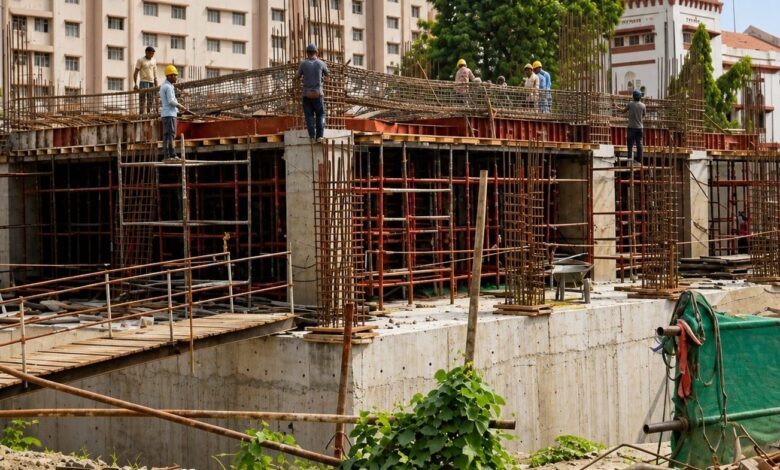

Nagpur, May 4, 2026. Nagpur new administrative building: If the project had gone to plan, Nagpur would already have its new District Collector Office building. The funds were approved in March 2023. The two-year completion target would have meant the building was ready — or close to it — by early 2025.
Instead, construction stalled almost immediately after it began. Trees had to be felled. Citizens objected. The matter went to court. Work halted. For months, the basement sat excavated while the legal and administrative machinery churned slowly toward a resolution.
Now, finally, there is movement. The court has given its clearance. Construction has picked up pace. Ground-floor work is visible and progressing. And the new completion target — revised significantly from the original timeline — is the end of 2027.
The story of how one of Nagpur’s most important administrative infrastructure projects went from approved funding to a multi-year delay and back again is a case study in everything that can go wrong with government construction in India — and in what it takes to get things back on track.
What Is Being Built — And Why Nagpur Needs It

The new building going up at the Nagpur District Collector Office compound in Civil Lines is not merely a replacement for an aging structure. It is a fundamental reorganisation of how Nagpur district’s revenue administration is housed and accessed.
The planned structure is 11 floors tall — a significant vertical footprint for a government building in Nagpur’s Civil Lines area. The design, prepared by a German architectural firm, features two towers connected to each other through a central link — giving the building both structural efficiency and a distinctive modern profile.
When complete, the new building will house the entire revenue administration of Nagpur district under a single roof. This includes the Divisional Commissioner’s Office, the Deputy Commissioner’s offices, the District Collector’s administrative wings, and all revenue-related departments that currently operate from separate, scattered buildings across the Collector’s compound. The Tehsil Office, which had previously been part of the compound, has already been shifted to a new location as part of the space clearance process.
The consolidation matters enormously for ordinary citizens. Anyone who has had to deal with revenue matters in Nagpur — land records, caste certificates, income certificates, mutation entries, revenue appeals — knows the current experience: multiple queues, multiple counters, multiple buildings, and often confusion about which office to go to for which purpose. A single, modern 11-floor building with all revenue offices together eliminates that fragmentation in one stroke.
The Money: How ₹271 Crore Became the Project Budget
The financial history of this project reflects how government projects evolve — sometimes for the better, sometimes not.
The process began when former Nagpur District Collector R. Vimala sent a proposal for a new Collector Office building valued at ₹200 crore during her tenure. The proposal was approved by the then-Maha Vikas Aghadi (MVA) government — the coalition of Shiv Sena, NCP, and Congress that was in power at the time. The late Ajit Pawar, then serving as Finance Minister in the MVA government, gave the initial clearance for the ₹200 crore proposal. At that stage, the plan was for a 7-floor building.
Then the government changed. The Mahayuti alliance came to power in Maharashtra. The project continued to move through administrative channels, but the incoming team looked at the design and the requirements afresh. Former District Collector Vipin Itankar, reviewing the project, suggested that the design needed substantial modifications to genuinely meet the administrative needs of Nagpur’s revenue department. His inputs led to a comprehensive redesign.
The redesigned proposal expanded the building from 7 floors to 11, incorporated additional functional requirements, and brought in the German architectural firm to design a structure that would serve Nagpur’s administrative needs for decades. The revised proposal also brought in new elements — smart building features, better accessibility infrastructure, and modern workspace design. The revised budget came to ₹271.34 crore — a ₹71 crore increase over the original proposal. The state government cleared this revised, enhanced budget in March 2023.
Under the original 2-year timeline, the building was to be completed by March 2025. That target is now missed by approximately two to three years.
The Delay: Trees, Objections, and Courts
The stalling of the project almost immediately after funds were sanctioned is one of those episodes that reveals how many layers of complication can attach themselves to even a well-funded, well-intentioned public construction project.
The Collector Office compound in Civil Lines is a mature, tree-lined campus. Several of the trees on the compound premises are old and significant — some having been part of the campus landscape for decades. Clearing the construction footprint for the new building required the felling of a number of these trees — a process that triggered formal objections from citizens and environmental groups in Nagpur.
Tree felling in Maharashtra requires permissions under the Maharashtra (Urban Areas) Protection and Preservation of Trees Act, 1975, and objections to felling orders can be challenged before the Tree Authority and, subsequently, in court. In this case, the objections went to court, and the Nagpur bench of the Bombay High Court became involved in reviewing whether the felling of trees in the Collector’s compound for the construction project had followed proper procedure.
While the court process was underway, construction could not proceed — at least not in the contested portions of the site. Basement excavation had already been completed before the legal challenge was filed. But with the court matter pending, the contractor could not advance to the superstructure. For months, the project sat in limbo — funds available, contractor engaged, basement dug, but construction frozen by a legal order.
The heritage character of the existing old Collector Office building also added a layer of sensitivity. The original colonial-era building — a recognised heritage structure in Nagpur’s Civil Lines area — will not be touched by the new construction. The new 11-floor building is being constructed on the land occupied by the demolished tehsil office, the old Setu Kendra building, the old Mining and Excise Department building, and the old Sanjay Gandhi Niradhar Office building. Several of these have already been demolished. The tehsil office was shifted out. The Setu Kendra and Mining Department buildings are already gone.
Once the High Court cleared the construction to proceed — satisfied that the process had been followed or corrected — the contractor resumed work. Ground floor construction is now underway and visible on site, confirming that the project has genuinely restarted.
Who Is Building It — And Why the Choice Matters
The Maharashtra State Infrastructure Development Corporation Limited — MSIDC — is the executing agency for the new Nagpur Collector Office building. This choice of agency has its own backstory that illuminates the administrative challenges the project faced even before construction began.
Originally, the responsibility for constructing the new Collector Office building was given to Nagpur Metro Rail Corporation — the agency overseeing Nagpur’s metro rail project. The logic was straightforward: Metro Rail was an active, technically capable agency already working in Nagpur with an established team.
In practice, however, Metro Rail’s new management team showed no interest in taking on this project. The Collector Office building was a significant departure from Metro Rail’s core competency of mass transit infrastructure, and the agency’s leadership — focused on the metro rail network — did not prioritise what was, from their perspective, a real estate and administrative building project.
With Metro Rail unwilling to engage, the state government looked to its other infrastructure agency. The Public Works Department (PWD) — the default government construction agency — was considered but rejected. The state government has, in recent years, developed serious concerns about PWD’s track record on project timelines. PWD is widely acknowledged within Maharashtra’s administrative system as prone to delays, cost overruns, and quality issues. The state did not want to hand a ₹271 crore project with already-accumulated delays to an agency associated with further delay.
MSIDC was the natural alternative. The Maharashtra State Infrastructure Development Corporation has an established reputation for delivering projects on time — and sometimes ahead of schedule. MSIDC manages roads, bridges, airports, and other critical infrastructure across Maharashtra. Its project management systems and contractor management practices are considerably tighter than PWD’s. The assignment of this project to MSIDC reflects the state’s confidence that the agency can complete what has been started.
The question — as one Navbharat Live report puts it — is whether this “Smart Collectorate” will actually be completed on time, or whether additional delays will push the 2027 deadline further. MSIDC’s track record gives grounds for optimism. The remaining challenges — completion of the superstructure across 11 floors, interior fit-out, electrical and HVAC systems, and the transition of multiple revenue offices into the new building — are substantial but manageable if execution stays on track.
What the Completed Building Will Look Like — and What It Will Offer
The German-designed twin-tower structure will be a landmark in Civil Lines when complete. The two towers, connected through a central bridging element, will rise 11 floors above the Civil Lines campus — visible from considerable distance and marking a clear visual break from the low-rise colonial architecture that currently defines the Collector’s compound.
Inside, the building will feature modern, climate-controlled workspace for the full revenue administration of Nagpur district. Citizens visiting for any revenue matter — whether a land mutation, a caste certificate, an income certificate, or a revenue appeal — will find all relevant offices within the same building, accessed through a single entry and managed through a centralised reception and token system.
Smart building features — as the project’s informal designation “Smart Collectorate” implies — are expected to include digital displays, centralised queuing management, energy-efficient systems, and modern accessibility infrastructure including lifts and ramps for differently-abled visitors.
The old heritage building on the compound will be preserved and maintained separately — possibly repurposed for display, archival, or administrative functions that benefit from the building’s historic character rather than requiring modern office space.
What This Means for Nagpur Citizens Who Deal With Revenue Offices
For the ordinary Nagpur resident, the completion of the new Collector Office building in 2027 will represent a significant improvement in the quality of one of the most frequently used government services in the district.
Revenue offices handle matters that affect virtually every family that owns land, needs a certificate for education or employment, is dealing with a succession matter, or has a dispute involving land or property. The current experience of visiting the Nagpur Collector’s compound involves navigating multiple buildings, finding the right counter among many, and often making multiple visits because different aspects of the same matter are handled in different offices.
A single, modern 11-floor building with all revenue departments under one roof — equipped with digital queuing, clear wayfinding, and accessible facilities — will transform that experience. It will not eliminate all difficulties, but it will remove the most frustrating and time-consuming sources of confusion.
The 2027 target is approximately 18 months away. If MSIDC’s construction pace holds, Nagpur will have its new Collector Office building within that window. After years of delays, redesigns, legal battles, and agency changes, that would be a genuine achievement for the city’s administrative infrastructure.
Nagpur Updates Will Track This Project
Nagpur Updates will monitor the progress of the new Nagpur Collector Office building through to its completion, reporting on construction milestones, any further delays, and the timeline for the revenue department transition.