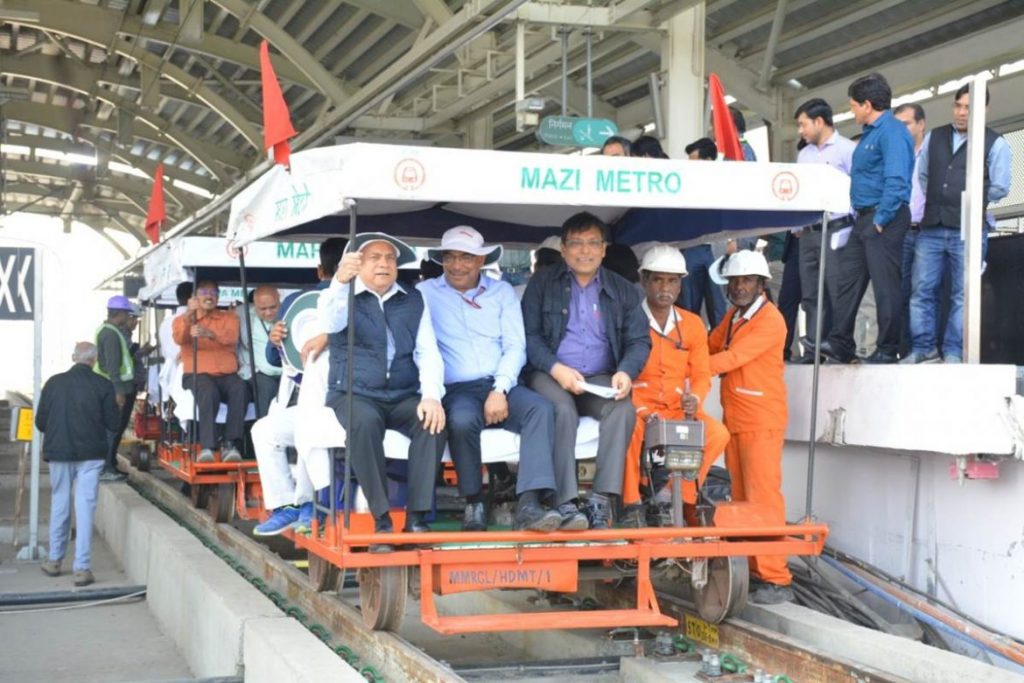
Maha Metro is a huge project that can be called the most ambitious projects in our region. However, with the Metro’s ongoing work in the city, we saw a lot of trees getting out of the way along with many more things coming along the way, including the crazy castle and a lot more like that. In the recent expansion phase, the Maha Metro had intended to remove 427 trees coming in their way, which had to be removed either by trimming it or by doing other things.
But as per recent news, these trees are now going to be retained as a few changes made by the authorities to save the trees on Kamptee Road. This is the third phase of the road expansion seen along the Central Avenue road seen over the Reach-IV alignment. According to sources, Maha Metro officials carried out a comprehensive survey in which they researched the two alignments. It was felt that the trees were found over the alignment during this very study.
According to the survey, there were about 427 trees that had to be handled, all of which belonged to Mungna Drum Stick along with others like Ashoka and Banyan trees that remained the most common species in the region. But when Maha Metro officials were consulted on their retention, they came up with a solution by consulting experts active in the field of agriculture and horticulture. These included experts such as Shri Srikant Deshpande, a city-based environmentalist, along with Shri Deshpande and other experts.
National content for Mr Miss & Mrs HB India 2020 Season 5 held in Delhi on 14 January 2020. Approximately 200 contestants from different countries participated in competitions from all over India including Maharashtra, Madhya Pradesh, Utter Pradesh, Rajasthan, Jammu & Kashmir, Andhra Pradesh, Panjab, Chhattisgarh and many others. Mrs Hemlata (Sahu) Mohatkar of Nagpur won the 3rd Runner Up crown with the title of Mrs Perfect Figure on her name for Mrs. category giving the tough competition to all other contestants.
The competition was organized by Mohit Arora, owner of 360 Advertising & Production House, Show Director–Pranay Dixit, Choreographer & Celebrity Designer–Sufi Sabri at Radiance Motel New Delhi on 14 January 2020. Mr World 2016 and former HB Mr India Season 5 winner Rohit Khandelwal were the main guests of the event.
Mrs Hemlata is an assistant professor at the Palloti College of Engineering & Technology, Nagpur, and she is the mother of one. Mrs Hemlata has made a great effort to do this while managing her professional and personal life with the same dedication and sincerity. She was also crowned by Mrs Supper Nagpur Top Model 2019 with three titles: Mrs Best Catwalk, Mrs Photogenic & Mrs All-rounder in the past.
Mrs Hemlata would like to extend her sincere thanks to the management of Pallotti College for their support, and also to Mr Imran Sheikh, Director of One Direction Modeling, and Miss Payal Sahu, winner of Miss India DC brand Ambassador 2019, for their mentorship and guidance throughout their journey to become HB Mrs India 2020 Third Runner Up. She dedicates these awards to her beloved husband Mr Mangesh Mohatkar and her two-year-old son Ayan.
Through her achievement, Mrs Hemlata wants to convey a message to all the married women out there who have left behind their dreams to take care of their families and make their home. She says, “While setting life priorities, don’t always keep yourself at last. Sometimes you also need to give priority to yourself. Because the last priorities never hit their turn, they’re always taken for granted, and you should never let yourself be taken for granted.
Managing her household waste is not a choice for Shefali Dudhbade but a way of life. The 46-year-old from Nagpur, a professional architect by profession and an environmentalist by heart, is setting an example for ordinary citizens who feel that municipal corporations are solely responsible for dealing with garbage.
“My kitchen waste, which accounts for 60% of my household waste, takes 15 minutes to treat,” Shefali tells The Better India, dissipating the time-consuming myth. Now, imagine if 50% of the country’s households devote a few minutes to composting on-site, India would significantly reduce its annual wet waste. Shefali credits her upbringing for her decisions in favour of the environment.
Shefali Dudhbade
“My grandfather would often get a litter from outside and out of paper or plastic make something useful. He always said if we are so aware of keeping our homes clean then why do we leave our surroundings dirty? The simple thought has made me a minimalist girl, “Shefali shares.
She is also a founding member of the Swachh Association, working with the Nagpur Municipal Corporation (NMC) to raise awareness about city waste management. She has treated 90 per cent of the waste for the last ten years, while only a fraction goes to the landfill.
Isn’t that breathtaking?
Shefali lists five troubleshooting steps to help you cut the waste.
1. Waste Segregation
Divide waste into five categories: a) Non-recyclables: Used paper towels, hazardous chemical or food containers, plastic products, and dishware are just a few examples of waste that can not be recycled or reused. Shefali hands over this form of waste to the NMC (which amounts to only eight per cent of its total waste).
B) Recyclables: PET bottles, plastic carrying bags, magazines, clothing, table cloth, glass, plastic cups are some items which can be stopped from being sent to landfill if properly separated. Shefali gives these to the city’s plastic recycling centres or creatively turns them into useful products such as pen stands, containers, plant pots, etc.
C) Wet: both kitchen and garden waste is composted by Shefali.
D) Sanitary: keeping the sanitary pads aside is the most important aspect of segregation, as it can discourage ragpickers or waste collectors from exposing themselves to health risks.
E) E-waste: Holds cardboard where all electronic waste such as batteries, remote controls and wires are stored. She sends them out to the local electronic waste collection centre once a year.
2. Reduce, Reuse, Recycle & Refuse
Jaadu ka Pitara’ (magic box), is how the friends of Shefali relate to the bag that she carries every time she steps out of her home. It contains a bottle of water, fabric or paper bags, paper straws and a box so she can reject something containing plastic.
“It’s not possible to eliminate plastic so the next best thing is to reject it. Start by carrying a cloth bag, as it takes up very little space in your bag. Be mindful of your schedule, and the locations that you visit regularly. Gradually form a jaadu ka pitara of your own, “she says.
As for recycling or reuse, she makes paper bags from magazines, pamphlets and distributes them to medical and general supply stores free of charge. Creating a paper-bag takes as little as five minutes.
She also gives paper cuttings to vegetable and flower vendors, “Now with the plastic ban, newspaper covers come handy for them.”
3. Composting
In her backyard, Shefali dug a small composting pit. Both kitchen and garden waste is first dried for 2-3 days on a newspaper, before being applied to the pit.
It takes nearly 45 days to convert organic waste, such as bulbs, seeds, fruit peels, vegetables, eggshells, coffee or tea powder into fresh organic compost, which is used in her terrace garden.
4. Medical Waste
Source: SWaCH/Facebook
Shefali and her daughter ensure they properly wrap their monthly sanitary waste in a newspaper before giving it to the waste collector. The most important step, she says, is putting a red dot on this medical waste. “Ragpickers or waste collectors rummage on landfills by waste, so they can make money by selling dry garbage. Many even go through the waste pile to find leftover food inside a newspaper, normally. They often open the newspaper to find a used sanitary pad with their bare hands and nothing can be more inhuman than this. It is our responsibility to ensure that they are not exposed to such waste by simply placing a red dot on the paper with a marker, “Shefali informs.
5. Fallen Hair
Have you ever come across or heard of someone who gathers and washes their own fallen hair?
Sounds bizarre, right?
Well, while sweeping, Shefali collects fallen hair, and stores it in a container. She washes it once or twice a month with shampoo and hands it to companies that deal with waste hair recycling.
Managing Your Own Waste Is A Matter of Pride
Degradation of the environment is inevitable with the depletion of our natural resources, the fuming of landfills and forest burning.
We may not be able, as individuals, to stop or reverse the impending crisis. Nevertheless, what we can do is to avoid further destruction of the environment, by reflecting on our actions.
Next, you can handle your own waste or cut down on garbage generation with people like Shefali proving it’s not a challenging job.
On Thursday, Income Tax Department teams carried raids across the city at seven locations and searched lockers, and also seized incriminating documents related to business deals. According to sources from the Income Tax Department, teams consisting of around 100 officers were swooping on businessmen and traders at various locations like Itwari, Butibori, Pratap Nagar and elsewhere. Some residences were scanned, too. Lockers were scanned, and property-related documents incriminating were confiscated. Huge cash was also confiscated in the raids according to reports. A company based in Butibori came under the Income Tax sleuths microscope, too.
Some traders dealing with the supari company were also raided at the locality of Itwari in Parvarpura. A dealer imports supari (betel nut) from Hyderabad and has also reportedly been operating a kharra panni factory that is banned in Maharashtra. The prohibited gutkha and scented tobacco, imported from Madhya Pradesh, are also sold on a massive scale in Nagpur market. The prohibited stuff is also being distributed across the state at many sites. A number of Itwari traders, sources suggested, are connected to the clandestine sector. To avoid any untoward incident, the visiting Income Tax officials were followed by a policeman pose.
NAGPUR: In the silver liner for the city’s guardians, the 2018 national crime data just released shows that Nagpur can no longer be associated with the’ crime capital ‘ moniker, which was once used by the opponents of then-Chief Minister Devendra Fadnavis to corner him on the assembly floor.
During a media briefing earlier this week, City Police Chief BK Upadhyay claimed that there was a 10% drop in the crime rate in 2019 compared to the previous year. The assertion was validated with the release of the 2018 crime statistics by the National Crime Records Bureau (NCRB), where Nagpur’s position is much lower than that of most categories of serious crimes in the nation.
In most of the categories, Nagpur is third in the state after Mumbai and Pune, excluding the category of’ Crime crime rate,’ registered under the Indian Penal Code (IPC) and the Special Local Laws (SLL), where it has surpassed 19 such places nationwide by more than two metres. While Nagpur has a crime rate of 688.6 per lakh, Mumbai is 309.9/lakh, while Pune is the lowest (277.9/lakh) in Maharashtra. Nagpur is ranked 12th in the same category of crime rate in India.
Upadhyay said that the crimes were under control and that the numbers had both been visibly and statistically reduced. “This is a safe town. Our strength is constantly trying to stay on its toes and to further improve the scenario, “he said.
The city is number 12 in the country for rape, with 69 crimes registered in 2018, and the third in the state after Mumbai (319) and Pune (103)—making it statistically safer for women. Under Section 354 of the IPC, the city holds the 10th place in the nation with 274 offences in the category of’ Assault on Women with the intention of insulting her modesty.’ It is third in the state after Mumbai (2,038), second in the nation, followed by Pune (406).
In the category of’ Total offences affecting the human body,’ Nagpur ranks 14th in the nation with 2,619 offences, and third in the state with Mumbai (11,585) number two in the country and Pune (2,903) ranking 12th.
In the category of murder, the city is the 12th in the nation and the third in the state with 72 such crimes, one less than that in Pune. Mumbai is the fourth in the nation and the first in the state to commit 164 murders. In the category ‘ Attempt to Murder,’ the city ranks third in the state and 11th in the nation with 77 crimes, after Pune (127) and Mumbai (280).
In economic offences, Mumbai is the nation’s first with 4803 crimes, while Nagpur is the 15th with 534 crimes. Pune is the 12th in the country with 777 crimes.
The city is also relatively safer for senior citizens, with 207 offences— the sixth in the nation and the second in the state after Mumbai (1,043) at the top of the chart. Pune, with 169 crimes, is safest in the state for the elderly population as per national crime data.
Nagpur is third in the state for crimes against children and sixth in the country for 538 crimes. Mumbai has the highest crime against children in the state and the second in the nation, with 2,538 crimes.
NAGPUR: Dr Babasaheb Ambedkar liked the relationship between individual and social structure, but not the passivity of self-realization through their position in an existing society. Along similar lines, philosopher John Dewey believed that as part of it one should evolve in a community and not independently, said on Tuesday Professor Scott Stroud, Media Ethics Coordinator, Center for Media Engagement, University of Texas.
As part of the international lecture series on’ Pragmatism, personality and Ambedkar’s focus on conversion to Buddhism, Dr. Nitin Raut delivered the second lecture. The lecture was arranged at Convocation Hall by Nagpur University. Vice-Chancellor SP Kane and Pro-VC Vinayak Deshpande were present at the event.
Speaking of Dewey, Stroud said, “He’s known in the American sense as a proponent of democracy and education. Over the course of the short history of America, he may be the best known intellectual. His writings about democracy and his experiences in America make him an important figure for India. “Stroud said Ambedkar was a devoted follower of Dewey while studying at Columbia University from 1913 to 1916. He said, “I think one can not comprehend the pragmatism of Ambedkar without thinking about Dewey. At the same time, one can not grasp the strengths and weaknesses of Dewey’s theories without seeing how, in the Indian sense, Ambedkar developed those ideas differently.” “You can be affected by people in a way that does not include you replicating them. Once Dewey died Ambedkar said he owed Dewey his whole intellectual life, “he said.
“By Dewey’s theory, core principles of Ambedkar in pragmatism like caste as a habit and faith as a means were inculcated,” he said.
Stroud said, “My thesis emphasized that the Buddhism of Ambedkar serves as a holistic means of shaping the personality of each individual. Ambedkar put forth the idea of conversion as a means of freedom for community and person. He spoke about how the conversion would act as an intelligent means of emancipation. “On Monday’s first day of the lecture series, Stroud said,” America is grappling with the same issues about democracy in India, and we need to understand and also let us learn how to get along with each other in society.
He spoke of Ambedkar’s worry that “The moment we stop talking and thinking about things such as democracy and what Buddhism has taught us about equality and pragmatism, we seem to stop caring about them and they really don’t matter to us.”
Stroud said he’s been reading several journals, books, and papers to understand Buddhism and how it’s related to American pragmatism, and how Dewey influenced Ambedkar.
Nagpur: A few months ago, a full-fledged winery began its commercial operations in Bhandara in a first of its kind business venture for Vidarbha, with bottles of port wine being marketed in that district.
SP Wineries is now finalizing its plans for next month’s promotion of the company in Nagpur and foraying into the luxury wine segment by next year. Shashichandra Jaiswal, whose family owns retail liquor shops, broke tradition and tried to “follow his passion” in wine production.
It all started almost a decade ago as an idea when Jaiswal took up a’ homemade wines ‘ hobby. Jaiswal, though a teetotaller, has always been intrigued by the wine as a’ classy’ drink.
“Friends have sampled my homemade wines and the feedback I got was that it tastes better than most commercial products. Then, I finally got a winery license in 2015,’ Jaiswal said.
Jaiswal began work on his factory in 2017 with guidance from his Nashik vineyard-owner friend Rajesh Borse, who is also an office-bearer of the All India Wine Producers ‘ Association (AIWPA). Luckily, he too had an in-house specialist. “My nephew Shaurya did his M.Sc. in wine and alcohol technology and that proved to be a big advantage in our small unit where his father Prakashchandra is also a partner,” Jaiswal said.
The next big question was on grape sourcing. “I decided to buy Nashik grapes so that we could immediately start commercial production of port wine. Port wine is made from non-premium grapes, and accounts for 95% of all Indian wine sales, “Jaiswal said.
The first batch went bottled in June 2019. In this new business, Jaiswal prefers to take small steps. “We are only selling in Bhandara right now but our goods will be available in Nagpur by the end of February. It takes time to expand the business, as wine sales volume is very low compared to whiskey and beer, “Jaiswal said.
He has a plan in place to ascend the winemaking value chain. “In the next few years, premium grapes will be grown here in Pauni, after which we will venture into the upper segment,” Jaiswal said.
While a bottle of port wine sells for around Rs200-230, a bottle of premium wine of a similar size will go for at least Rs750. Yet Jaiswal can not rely on the grapes coming from other cities to make it commercially viable.
He is persuaded that grapevines grow at the conditions of Vidarbha. “I saw grapes growing alongside’ paan ‘ leaf plants in Pauni some decades ago. Therefore there is no doubt in my mind that there is a simple ecosystem. Of course, I will take advice from experts in agriculture to further model conditions on vineyards for optimum grape quality, “Jaiswal said.
Nagpur Wine Club director Deepak Khanuja said, “It is a matter of great pride that wines being produced in Vidarbha are available on the market. This will help promote the wine community, and it will also prove economically advantageous for farmers to step up the value chain.
Nagpur: Even as customers on the solar rooftop welcomed the relief Maharashtra Electricity Regulatory Commission (MERC) offered them, MSEDCL dropped a bombshell. It has introduced charges for promoting astronomical grids which will make solar power more costly than its own.
It seems the discom is hell-bent on scuttling the state’s nascent solar market. MERC will have to withdraw the petition to save users of solar energy once again.
MERC had recently rejected the petition of the discom to make fixed billing mandatory, rather than net metering. However, it had allowed MSEDCL to charge grid support charge (GSC) for consumers loading over 10 KW.
The discom proposed GSC ranging from Rs 4.46 per unit to Rs 8.66 per unit for domestic consumers, between Rs 5.06 and Rs 8.76 per unit for commercial consumers, and for industrial consumers between Rs 3.60 per unit and Rs 4.08 per unit.
A senior official at MSEDCL acknowledged that if MERC approved these charges it would make solar rooftop power more costly than the discom tariff.
In its petition submitted to MERC for mandatory net billing, MSEDCL claimed that a loss of Rs 224 crore has been incurred so far. In addition, solar rooftop load rose from 20.44 MW in 2016-17 to 288.80 MW in 2018-19. The company feels it will have to increase the tariff for the remaining customers if paying consumers to go out of its net.
The discom conveniently forgets that solar power on the rooftop is only 0.3 per cent of its total purchase of electricity. Consumers of the solar rooftop generated 330 million units (MU) in 2018-19 versus 1.2 lakh MU purchased from it.
More specifically, MSEDCL can not meet its Renewable Solar Purchase Obligation (RPO) goal. In 2017-18, it was able to meet just 40 per cent of its solar RPO goals.
MSEDCL itself receives no response to its offer to purchase solar power. It had recently floated a tender to purchase 1,350 MW but only one generator received a 5 MW bid.
On the other hand, MERC has increased MSEDCL’s solar target from 2.5% in 2019-20 to 13.5% in 2024-25. This rise has been opposed by MSEDCL and told MERC that it is unlikely.
Solar expert Ajit Ganguly, commenting on the GSC, said, “MERC had allowed MSEDCL to levy GSC so it would not incur any damage. Nevertheless, the proposed changes are so high that between Rs 14 and Rs 15 per unit would cost solar power. This is ridiculous. No other country state has done this. “An industrialist said on anonymity condition,” MSEDCL wants to put the new government in trouble. Because of high power tariffs, companies find it difficult to thrive in the City. Solar was the only option but MSEDCL wants to make it unviable. ”Grid support charges for domestic consumers Units————————-Charges (Rs/unit) 101-300————-4.46 301-500————–7.06 500 +————————8.66
MUMBAI: Minister of the Cabinet in the Maharashtra government Eknath Shinde said on Tuesday that the job on Nagpur Metro’s 11 km route has been completed and will soon be inaugurated by Chief Minister Uddhav Thackeray.
“Nagpur Metro’s Lokmanya Nagar to Seetabaldi, an 11-kilometre stretch work is completed and Chief Minister Uddhav Thackeray will inaugurate it soon,” Shinde said in a tweet.
To take a look at all works relevant to the Metro in Maharashtra a review meeting was held today in Mantralaya by Minister Ekanath Shinde.
The statement said in the meeting it was told that by 2022 a full 32,50 km stretch of Pune Metro will be functional.
Minister Shinde has asked officials to finish the work ahead of time. Shinde also said the road to Fugewadi from Saint Tukaram Nagar to start functioning in Pune from April.
This is a complete 5Km stretch and by the end of March Minister Ekanath Shinde has directed the work to be done in order to open it to passengers.
He has also directed the work of other phases between Vanaz to Ramwadi to complete a 5 km stretch by the end of June and make it accessible for people by July.
The revised Detailed Project Report (DPR) will also be finalized and approved by the state government by February for the Thane Metro project, the statement added.