Nagpur Gets a New Cyber Cell Chief — DCP Deepak Aggrawal Takes Charge as City’s Digital Crime Cases Keep Rising

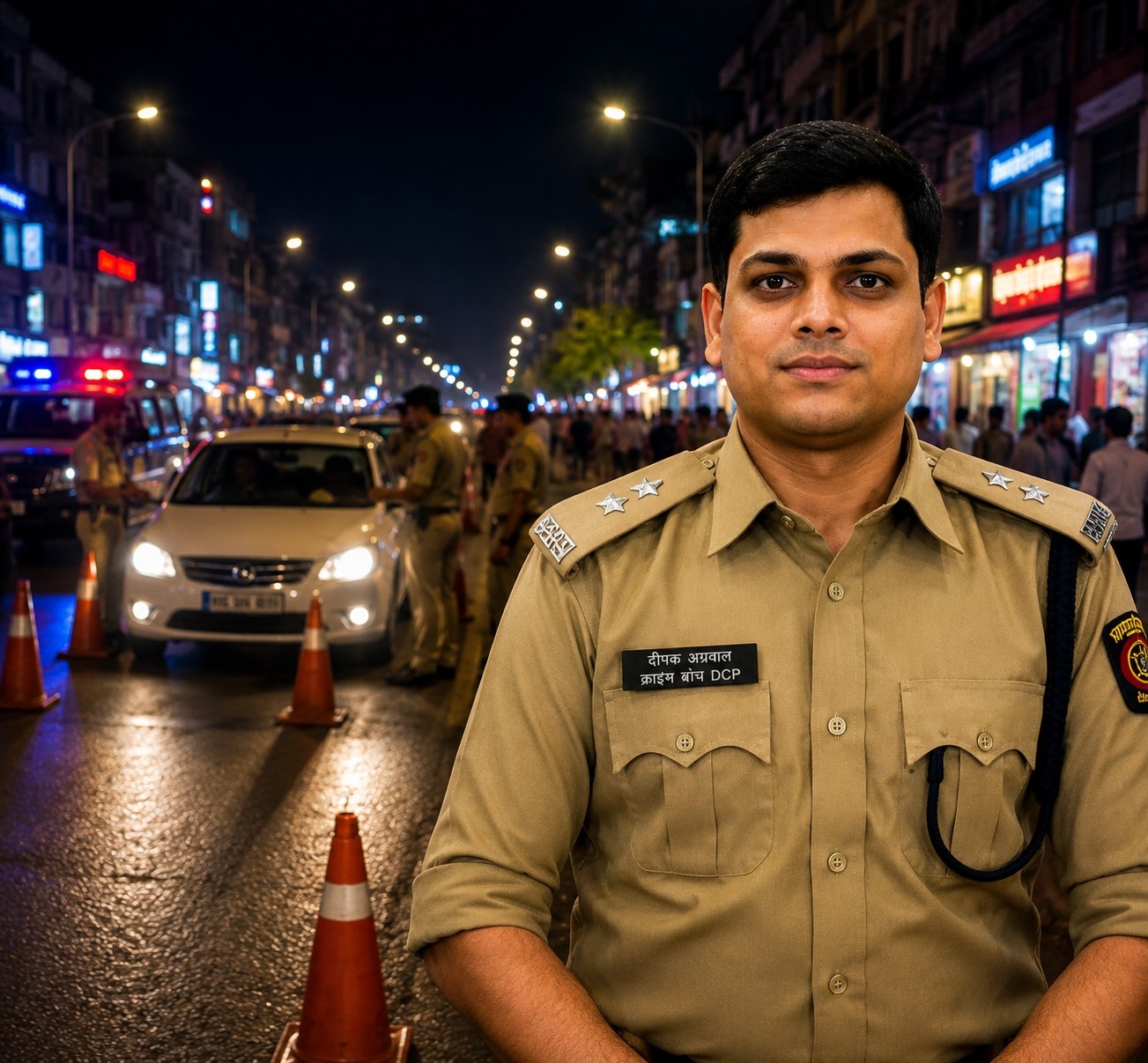
Nagpur, May 5, 2026. In a significant administrative reshuffle within the Nagpur City Police Commissionerate, Deepak Aggrawal has been appointed as the new Deputy Commissioner of Police — Cyber Cell for Nagpur. Aggrawal was previously posted at the Police Headquarters. He takes over the Cyber Cell, replacing DCP Lohit Matani, who had been holding additional charge of the position. nagpurupdates

The appointment comes at a moment when cybercrime in Nagpur — as in every major Indian city — is not merely a policing challenge but a daily reality for ordinary residents. Cybercrime cases are steadily increasing in Nagpur, and the officer who heads the Cyber Cell carries a portfolio that directly affects the financial safety and digital security of millions of people in the city and surrounding district. nagpurupdates


Who Is DCP Deepak Aggrawal?

Known for his administrative experience and handling of critical assignments, Aggrawal’s appointment comes at a time when cybercrime cases are steadily increasing in Nagpur. nagpurupdates

His previous posting at the Maharashtra Police Headquarters in Mumbai gives him a distinct perspective that field-posted officers sometimes lack. Officers who serve at the HQ level work at the intersection of policy, data, and inter-agency coordination — they see the statewide picture of crime trends, understand how the Maharashtra Cyber and the national cybercrime coordination framework operates, and develop relationships with officers across multiple districts and divisions.

For the Nagpur Cyber Cell — which does not operate in isolation but coordinates with Maharashtra Cyber, the national Cyber Crime Coordination Centre (I4C) under the Ministry of Home Affairs, and private platforms like banks, Google, Meta, and telecom providers — an officer with HQ-level exposure brings valuable connectivity to those larger systems.

DCP Aggrawal’s specific track record in cybercrime investigation or cyber policy has not been publicly detailed at the time of this report. Nagpur Updates will profile his background in greater depth as more information becomes available from official sources.


Why Lohit Matani Was Holding “Additional Charge” — and What That Means

To understand the significance of this appointment, it helps to understand the phrase “additional charge” — a term used frequently in Indian police and government administration that often signals something important about institutional capacity.

When an officer holds “additional charge” of a position, it means they are doing two jobs simultaneously — their primary posting plus the responsibilities of a second, vacant position. In DCP Matani’s case, he was primarily heading the Traffic Branch — the role for which he earned the DG Insignia 2025 through Operation U-Turn and its dramatic reduction in road accident fatalities. The Cyber Cell DCP position was being managed by him on top of that primary responsibility.

Holding additional charge of the Cyber Cell while simultaneously running Nagpur’s entire traffic enforcement operation is an enormous workload for any single officer. While Matani’s calibre is not in question — he demonstrated under Operation U-Turn that he can drive transformational results even in challenging conditions — having the Cyber Cell run as a secondary responsibility of a traffic-focused DCP is not the ideal arrangement for a function as demanding and specialised as cybercrime investigation.

The appointment of DCP Aggrawal as a dedicated, full-time head of the Nagpur Cyber Cell — rather than a continuation of additional charge — is therefore an institutional improvement. The Cyber Cell now has an officer whose primary focus, every working day, is cybercrime. That undivided attention matters for the quality and speed of investigations, the responsiveness to new complaint types, and the leadership of a team that handles some of the most technically complex cases in Nagpur’s police portfolio.


What the Nagpur Cyber Cell Does — and Why Its Leadership Matters So Much

The Cyber Crime Unit of Nagpur is a specialised division within the Nagpur Police Department dedicated to combating cybercrimes. This unit addresses the growing threat of criminal activities facilitated by digital technology, ensuring the protection of citizens and businesses in the digital space. nagpurupdates

In practice, the Nagpur Cyber Cell’s work falls into several broad categories — each of which has grown substantially in volume and complexity over the past few years.

Financial fraud investigation is the single largest category. This includes UPI fraud, OTP fraud, online loan app scams, fake investment platforms, job offer scams, and impersonation-based fraud where callers pose as police officers, CBI officials, or TRAI representatives to extract money from victims. The amounts involved range from a few thousand rupees to lakhs — and in some cases crores — depending on the victim’s vulnerability and the sophistication of the fraud.

Social media crimes — including cyberbullying, morphed images, fake profiles, threatening messages, and defamation through digital platforms — form a growing share of the Cyber Cell’s complaint load. These cases often involve younger victims and require coordination with social media platforms to obtain account information and content evidence.

Hacking and data breach cases involve unauthorised access to corporate or personal systems, ransomware attacks on local businesses, and account takeovers across email, banking, and social media platforms.

The unit handles cases involving hacking, online fraud, identity theft, and other digital offenses, analyzing electronic devices and data to gather evidence for cybercrime investigations, and conducting awareness programs to educate the public about safe online practices. nagpurupdates

Child online abuse content investigation — a sensitive and technically demanding category — is also within the Cyber Cell’s mandate, coordinated with national agencies including the National Crime Records Bureau and Interpol for cases with international dimensions.

The Garud Drishti social media surveillance initiative — built under DCP Matani’s watch — also sits within the Cyber Cell’s operational environment. This system, which monitors social media for incitement, hate content, and criminal activity in real time, played a critical role during and after the March 2025 communal disturbances in Nagpur. DCP Aggrawal will inherit this system and will be responsible for its continued operation and development.


Nagpur’s Cybercrime Numbers — The Scale of the Problem

To appreciate the weight of DCP Aggrawal’s new role, consider the scale of cybercrime that Nagpur residents face.

Maharashtra consistently ranks among the top three states in India for reported cybercrime cases, alongside Uttar Pradesh and Telangana. Within Maharashtra, Mumbai, Pune, and Nagpur account for the largest share of cases. The national cybercrime helpline — 1930 — receives tens of millions of calls annually from across India, and Maharashtra’s contribution to that volume is significant.

In Nagpur specifically, the combination of a growing digital payment adoption, an increasingly online-active middle-class population, and the city’s role as a major commercial hub for central India makes it a consistent target for organised cybercrime networks — many of which operate from other states or even from abroad.

The city has seen waves of specific fraud types over the past two years: the “digital arrest” scam — in which fraudsters pose as police or CBI officials and tell victims they are under “digital arrest” for alleged crimes, then extort money to “resolve” the fake case — has claimed numerous victims in Nagpur, including educated, senior citizens who had no reason to suspect that such a sophisticated deception could be aimed at them. Investment fraud through fake trading apps and fake mutual fund platforms has also claimed significant sums from Nagpur residents.

The police helpline 1930 — the national cybercrime helpline — and the portal cybercrime.gov.in are the first points of contact for victims. The faster a complaint is registered after a fraud, the higher the probability that funds can be frozen in the fraudster’s account before they are withdrawn or transferred. Speed is critical in financial fraud cases, and the Cyber Cell’s ability to act quickly on incoming complaints directly affects how much money victims can recover.


What the Nagpur Cyber Police Station Looks Like — Infrastructure and Capacity

The Nagpur City Cyber Police Station is located at Patel Bungalow, Chhaoni, Nagpur — 440013. The official email is cybercrime.ngp@gmail.com and the phone number is 0712-2584377.

The Cyber Cell operates with a team of trained cyber investigators — officers with specialisation in digital forensics, social media investigation, financial fraud tracking, and technical evidence collection. The lab is equipped with forensic tools for mobile device analysis, computer forensics, and CDR (Call Detail Record) analysis — allowing investigators to reconstruct communication networks and trace fraudsters through their digital footprints.

Under DCP Matani’s tenure, the Garud Drishti initiative added 30 advanced workstations dedicated to social media monitoring — significantly expanding the Cyber Cell’s surveillance and intelligence capability. DCP Aggrawal inherits this infrastructure and will be expected to both maintain its operational intensity and potentially expand its scope as new digital crime trends emerge.


What Nagpur’s Cyber Crime Victims Should Know Right Now

Whether or not you have ever interacted with the Nagpur Cyber Cell, here is the information every resident should have:

If you are the victim of any cybercrime — financial fraud, social media abuse, hacking, identity theft, or any other digital offence — the first step is to call 1930 immediately. This is the national cybercrime helpline, available 24 hours a day. For financial fraud, calling 1930 as quickly as possible after the fraud is discovered gives the best chance of freezing the fraudster’s account before funds are dispersed.

You can also file a complaint online at cybercrime.gov.in — the national portal for cybercrime complaints. This portal allows you to upload evidence, track your complaint, and connect with the investigating cyber cell.

For Nagpur-specific complaints, you can also approach the Nagpur City Cyber Police Station at Chhaoni directly, or call 0712-2584377 during working hours.

Do not be embarrassed to report cybercrime. These frauds are perpetrated by sophisticated, organised criminal networks that specifically target people who are trusting, unfamiliar with digital scam tactics, or momentarily distracted. Reporting promptly — both to 1930 and to the Cyber Cell — is the responsible action, and it helps investigators build cases against networks that are victimising multiple people simultaneously.


What DCP Aggrawal’s Priority Should Be — An Editorial Perspective

The Nagpur Cyber Cell has benefited significantly from DCP Matani’s foundational work — Garud Drishti, the cyber lab infrastructure, and the institutional relationships with Maharashtra Cyber and national agencies. DCP Aggrawal’s challenge is to build on this foundation rather than restart from scratch.

Three priorities stand out as most urgent for the new DCP Cyber in Nagpur.

First, the “digital arrest” and fake investment fraud scams continue to claim new victims in the city every week. A targeted, visible public awareness campaign — going beyond the standard social media posts to reach older, less digitally savvy residents through community outreach, housing society visits, and coordination with banks — could prevent significant financial harm.

Second, the complaint processing speed at the Cyber Cell needs continued improvement. Every hour of delay in registering a financial fraud complaint reduces the probability of fund recovery. Systems that allow 1930 complaints to be triaged and acted upon within the first hour — not the first day — save money and restore victim confidence in the system.

Third, Garud Drishti needs to be maintained at full operational intensity. The March 2025 disturbances demonstrated that social media monitoring is not a peripheral function — it is a front-line tool for preventing physical violence. DCP Aggrawal must ensure that the 30-workstation monitoring system inherited from his predecessor continues to function at the level for which it was designed.

Nagpur’s New Collector Office Was Supposed to Be Ready by Now — Here Is the Full Story of a ₹271 Crore Building That Got Delayed, Redesigned, and Is Finally Moving Again

Nagpur, May 4, 2026. Nagpur new administrative building:  If the project had gone to plan, Nagpur would already have its new District Collector Office building. The funds were approved in March 2023. The two-year completion target would have meant the building was ready — or close to it — by early 2025.

Instead, construction stalled almost immediately after it began. Trees had to be felled. Citizens objected. The matter went to court. Work halted. For months, the basement sat excavated while the legal and administrative machinery churned slowly toward a resolution.

Now, finally, there is movement. The court has given its clearance. Construction has picked up pace. Ground-floor work is visible and progressing. And the new completion target — revised significantly from the original timeline — is the end of 2027.

The story of how one of Nagpur’s most important administrative infrastructure projects went from approved funding to a multi-year delay and back again is a case study in everything that can go wrong with government construction in India — and in what it takes to get things back on track.


What Is Being Built — And Why Nagpur Needs It

The new building going up at the Nagpur District Collector Office compound in Civil Lines is not merely a replacement for an aging structure. It is a fundamental reorganisation of how Nagpur district’s revenue administration is housed and accessed.

The planned structure is 11 floors tall — a significant vertical footprint for a government building in Nagpur’s Civil Lines area. The design, prepared by a German architectural firm, features two towers connected to each other through a central link — giving the building both structural efficiency and a distinctive modern profile.

When complete, the new building will house the entire revenue administration of Nagpur district under a single roof. This includes the Divisional Commissioner’s Office, the Deputy Commissioner’s offices, the District Collector’s administrative wings, and all revenue-related departments that currently operate from separate, scattered buildings across the Collector’s compound. The Tehsil Office, which had previously been part of the compound, has already been shifted to a new location as part of the space clearance process.

The consolidation matters enormously for ordinary citizens. Anyone who has had to deal with revenue matters in Nagpur — land records, caste certificates, income certificates, mutation entries, revenue appeals — knows the current experience: multiple queues, multiple counters, multiple buildings, and often confusion about which office to go to for which purpose. A single, modern 11-floor building with all revenue offices together eliminates that fragmentation in one stroke.


The Money: How ₹271 Crore Became the Project Budget

The financial history of this project reflects how government projects evolve — sometimes for the better, sometimes not.

The process began when former Nagpur District Collector R. Vimala sent a proposal for a new Collector Office building valued at ₹200 crore during her tenure. The proposal was approved by the then-Maha Vikas Aghadi (MVA) government — the coalition of Shiv Sena, NCP, and Congress that was in power at the time. The late Ajit Pawar, then serving as Finance Minister in the MVA government, gave the initial clearance for the ₹200 crore proposal. At that stage, the plan was for a 7-floor building.

Then the government changed. The Mahayuti alliance came to power in Maharashtra. The project continued to move through administrative channels, but the incoming team looked at the design and the requirements afresh. Former District Collector Vipin Itankar, reviewing the project, suggested that the design needed substantial modifications to genuinely meet the administrative needs of Nagpur’s revenue department. His inputs led to a comprehensive redesign.

The redesigned proposal expanded the building from 7 floors to 11, incorporated additional functional requirements, and brought in the German architectural firm to design a structure that would serve Nagpur’s administrative needs for decades. The revised proposal also brought in new elements — smart building features, better accessibility infrastructure, and modern workspace design. The revised budget came to ₹271.34 crore — a ₹71 crore increase over the original proposal. The state government cleared this revised, enhanced budget in March 2023.

Under the original 2-year timeline, the building was to be completed by March 2025. That target is now missed by approximately two to three years.


The Delay: Trees, Objections, and Courts

The stalling of the project almost immediately after funds were sanctioned is one of those episodes that reveals how many layers of complication can attach themselves to even a well-funded, well-intentioned public construction project.

The Collector Office compound in Civil Lines is a mature, tree-lined campus. Several of the trees on the compound premises are old and significant — some having been part of the campus landscape for decades. Clearing the construction footprint for the new building required the felling of a number of these trees — a process that triggered formal objections from citizens and environmental groups in Nagpur.

Tree felling in Maharashtra requires permissions under the Maharashtra (Urban Areas) Protection and Preservation of Trees Act, 1975, and objections to felling orders can be challenged before the Tree Authority and, subsequently, in court. In this case, the objections went to court, and the Nagpur bench of the Bombay High Court became involved in reviewing whether the felling of trees in the Collector’s compound for the construction project had followed proper procedure.

While the court process was underway, construction could not proceed — at least not in the contested portions of the site. Basement excavation had already been completed before the legal challenge was filed. But with the court matter pending, the contractor could not advance to the superstructure. For months, the project sat in limbo — funds available, contractor engaged, basement dug, but construction frozen by a legal order.

The heritage character of the existing old Collector Office building also added a layer of sensitivity. The original colonial-era building — a recognised heritage structure in Nagpur’s Civil Lines area — will not be touched by the new construction. The new 11-floor building is being constructed on the land occupied by the demolished tehsil office, the old Setu Kendra building, the old Mining and Excise Department building, and the old Sanjay Gandhi Niradhar Office building. Several of these have already been demolished. The tehsil office was shifted out. The Setu Kendra and Mining Department buildings are already gone.

Once the High Court cleared the construction to proceed — satisfied that the process had been followed or corrected — the contractor resumed work. Ground floor construction is now underway and visible on site, confirming that the project has genuinely restarted.


Who Is Building It — And Why the Choice Matters

The Maharashtra State Infrastructure Development Corporation Limited — MSIDC — is the executing agency for the new Nagpur Collector Office building. This choice of agency has its own backstory that illuminates the administrative challenges the project faced even before construction began.

Originally, the responsibility for constructing the new Collector Office building was given to Nagpur Metro Rail Corporation — the agency overseeing Nagpur’s metro rail project. The logic was straightforward: Metro Rail was an active, technically capable agency already working in Nagpur with an established team.

In practice, however, Metro Rail’s new management team showed no interest in taking on this project. The Collector Office building was a significant departure from Metro Rail’s core competency of mass transit infrastructure, and the agency’s leadership — focused on the metro rail network — did not prioritise what was, from their perspective, a real estate and administrative building project.

With Metro Rail unwilling to engage, the state government looked to its other infrastructure agency. The Public Works Department (PWD) — the default government construction agency — was considered but rejected. The state government has, in recent years, developed serious concerns about PWD’s track record on project timelines. PWD is widely acknowledged within Maharashtra’s administrative system as prone to delays, cost overruns, and quality issues. The state did not want to hand a ₹271 crore project with already-accumulated delays to an agency associated with further delay.

MSIDC was the natural alternative. The Maharashtra State Infrastructure Development Corporation has an established reputation for delivering projects on time — and sometimes ahead of schedule. MSIDC manages roads, bridges, airports, and other critical infrastructure across Maharashtra. Its project management systems and contractor management practices are considerably tighter than PWD’s. The assignment of this project to MSIDC reflects the state’s confidence that the agency can complete what has been started.

The question — as one Navbharat Live report puts it — is whether this “Smart Collectorate” will actually be completed on time, or whether additional delays will push the 2027 deadline further. MSIDC’s track record gives grounds for optimism. The remaining challenges — completion of the superstructure across 11 floors, interior fit-out, electrical and HVAC systems, and the transition of multiple revenue offices into the new building — are substantial but manageable if execution stays on track.


What the Completed Building Will Look Like — and What It Will Offer

The German-designed twin-tower structure will be a landmark in Civil Lines when complete. The two towers, connected through a central bridging element, will rise 11 floors above the Civil Lines campus — visible from considerable distance and marking a clear visual break from the low-rise colonial architecture that currently defines the Collector’s compound.

Inside, the building will feature modern, climate-controlled workspace for the full revenue administration of Nagpur district. Citizens visiting for any revenue matter — whether a land mutation, a caste certificate, an income certificate, or a revenue appeal — will find all relevant offices within the same building, accessed through a single entry and managed through a centralised reception and token system.

Smart building features — as the project’s informal designation “Smart Collectorate” implies — are expected to include digital displays, centralised queuing management, energy-efficient systems, and modern accessibility infrastructure including lifts and ramps for differently-abled visitors.

The old heritage building on the compound will be preserved and maintained separately — possibly repurposed for display, archival, or administrative functions that benefit from the building’s historic character rather than requiring modern office space.


What This Means for Nagpur Citizens Who Deal With Revenue Offices

For the ordinary Nagpur resident, the completion of the new Collector Office building in 2027 will represent a significant improvement in the quality of one of the most frequently used government services in the district.

Revenue offices handle matters that affect virtually every family that owns land, needs a certificate for education or employment, is dealing with a succession matter, or has a dispute involving land or property. The current experience of visiting the Nagpur Collector’s compound involves navigating multiple buildings, finding the right counter among many, and often making multiple visits because different aspects of the same matter are handled in different offices.

A single, modern 11-floor building with all revenue departments under one roof — equipped with digital queuing, clear wayfinding, and accessible facilities — will transform that experience. It will not eliminate all difficulties, but it will remove the most frustrating and time-consuming sources of confusion.

The 2027 target is approximately 18 months away. If MSIDC’s construction pace holds, Nagpur will have its new Collector Office building within that window. After years of delays, redesigns, legal battles, and agency changes, that would be a genuine achievement for the city’s administrative infrastructure.


Nagpur Updates Will Track This Project

Nagpur Updates will monitor the progress of the new Nagpur Collector Office building through to its completion, reporting on construction milestones, any further delays, and the timeline for the revenue department transition.

Nagpur’s Wardha Road Is Back to Its Old Misery — The U-Turn Is Gone, Ajni Square Is Jammed, and Commuters Are Asking Why Nothing Ever Sticks

Nagpur, May 5, 2026. Nagpur Traffic Police : If you drive on Wardha Road during the evening rush hour, you already know what has happened. The brief period of relative relief that commuters experienced over the past year and a half — when traffic between Morris College T-Point and Ajni Square had been significantly improved through lane management and turn restrictions — is over. The U-turn facility at Ajni Square has been removed. The intersection is a bottleneck again. And the daily crawl that once took 30 minutes for a distance that should take five is back.

For the thousands of Nagpur commuters who use Wardha Road daily — one of the city’s most critical arterial corridors, connecting the airport, MIHAN, Wardha district, and the southern residential belt to the city centre — this is not just frustrating. It is the latest episode in a years-long story of a traffic problem that has been partially solved, politically complicated, reversed, and partially solved again — without ever being permanently fixed.


The Wardha Road Problem: Four Years of Crawling

To understand why the removal of the Ajni Square U-turn matters so much, you need to understand the scale of the problem that existed before the traffic experiments of 2024.

Traffic on Wardha Road has faced severe jams since the opening of the new Ajni Road at Kriplani Square. For the past four years, motorists have crawled from Rahate Colony T-Point to Ajni Square, particularly during evening rush hours when two traffic signals — at Rahate Colony Square and Kriplani Square — created bottlenecks. Commuters often found themselves waiting for 2–3 green lights just to move a short distance.

In recent months before the 2024 experiment, vehicles plying on the Shaheed Govari Flyover were taking almost 30 minutes for four-wheelers to cross the distance from Morris College T-Point to Ajni Square during peak hours.

Thirty minutes. For a distance of roughly 2.5 kilometres. That is a speed of approximately 5 kilometres per hour — barely faster than walking. Every evening, Monday to Saturday, thousands of vehicles — office workers heading home, goods vehicles, schoolchildren in auto-rickshaws, airport-bound passengers — were subjected to this crawl with no alternative.

This was not a new problem. It had been building for four years. Nagpur Traffic Police had received complaints consistently. Citizens had raised it in public forums, on social media, and through formal civic channels. And for four years, nothing had decisively changed.


September 2024: The Experiment That Worked

In September 2024, then-DCP Traffic Archit Chandak decided to try something different. From September 23 to 28, commuters were prohibited from making a right turn from Ajni Chowk to Morris College T-Point — a five-day trial of a No Right Turn policy on the corridor.

The results were immediate and dramatic. The route now took just five minutes to cover — down from the previous 30 minutes — thanks to the changes implemented by Nagpur Traffic Police.

The trial revealed that about 80% of traffic on this route moves straight, with only 20% requiring right or U-turns. This single data point explains everything. The bottleneck at Rahate Colony Square and Kriplani Square was being caused by a minority of vehicles — those needing to turn right — blocking the majority of traffic that simply needed to go straight. Removing the right turns allowed the 80% to flow freely, eliminating the queue-within-a-queue that had been creating the 30-minute crawl for years. nagpurupdates

Citizens responded with rare enthusiasm for a traffic enforcement measure. Many citizens requested its continuation to address traffic bottlenecks. The public, it turned out, was entirely willing to accept the inconvenience of not being able to turn right — because the benefit of a 25-minute reduction in daily commute time vastly outweighed that inconvenience. nagpurupdates


September 30, 2024: The Experiment Ends — And the Questions Begin

Then, on September 30, 2024 — just two days after the five-day trial ended — the traffic police decided to restore the old system. The traffic police invited suggestions from citizens regarding the traffic experiment. nagpurupdates

However, there were murmurs in administrative circles about pressure from certain quarters to prevent the City Police from continuing the experiment. nagpurupdates

This is the line that Nagpur’s commuting public has never forgotten — and never forgiven. An experiment that reduced a 30-minute crawl to 5 minutes, that had public support, that was backed by data showing 80% of traffic goes straight — was quietly discontinued. No official explanation was given for why a demonstrably successful traffic management measure could not be made permanent. The “murmurs about pressure from certain quarters” were widely interpreted as referring to pressure from commercial establishments, auto-rickshaw unions, or area-specific interest groups whose business or operations were inconvenienced by the turn restrictions.


October 2024: A Partial Return Under New Rules

Following public backlash, right turns were prohibited at key intersections, including Rahate Colony Square and Kriplani Square, between 6:30 PM and 8:30 PM from Monday to Saturday. Signal timings at Rahate Square and Krupalani Square were set to blinker mode, and right turns were closed at both squares during peak hours.

The “No Right Turn” policy during peak hours from 5:30 PM to 8:30 PM resulted in a reduction in travel time from 20–25 minutes to just 5–6 minutes between Morris College T-Point and Ajni Square.

This was a partial restoration — limited to peak hours only, rather than the full-day restriction of the original trial. But it provided meaningful relief during the hours when the bottleneck was most severe. Commuters adapted. The route became manageable again during evenings. The U-turn at Ajni Square, under the revised October 2024 rules, was accessible via specific diversions — traffic from the Ajni Flyover and Congress Nagar T-Point areas was routed via a U-turn through the Central Jail Cutting to reach Dikshabhoomi or Lokmat Square.


May 2026: The U-Turn Is Gone — And the Bottleneck Is Back

This brings us to the current situation. The Times of India’s May 2026 report — the article that prompted this investigation — confirms that the U-turn facility at Ajni Square has now been removed entirely. The intersection has reverted to bottleneck status. Commuters who had experienced improvement are back to the frustrating reality of extended waits at Rahate Colony Square and Kriplani Square.

The removal of the U-turn is not a traffic management improvement. It is a regression. The specific diversion route that allowed vehicles needing to reach Dikshabhoomi, Lokmat Square, and other destinations on the far side of the Wardha Road corridor has been eliminated — forcing those vehicles back into the main Ajni Square intersection, adding conflicting movements to what was already a challenging junction.

The result is predictable and has already been confirmed by commuters: the evening peak-hour bottleneck on Wardha Road is back at its worst.


Why Does This Keep Happening? The Structural Problem

The Wardha Road–Ajni Square story is not really a traffic management story. It is a governance story. And it illustrates a pattern that repeats itself across Nagpur’s infrastructure and civic management: a problem is identified, a solution is found that works, the solution is reversed under pressure, a partial version of the solution is restored, and eventually that too is undone — leaving the city roughly where it started, having spent significant administrative energy going in circles.

The fundamental issue at Ajni Square has been known since before 2024. The intersection handles a volume of traffic that exceeds its designed capacity — particularly since the opening of the new Ajni Road at Kriplani Square added a new traffic stream to an already congested node. The long-term solution is not traffic signal timing adjustments or turn restrictions — these are management tools that improve flow within the existing infrastructure. The long-term solution is infrastructure: an underpass, a flyover, or a grade-separated interchange at Ajni Square that physically separates conflicting traffic movements.

Such a solution has been discussed in various planning documents and civic forums over the years but has not been executed. Until it is, Wardha Road’s commuters are dependent on traffic management measures that are vulnerable to political pressure, administrative changes, and the shifting priorities of whoever currently holds the DCP Traffic position.


The Data Case for a Permanent Solution

The data from the September 2024 trial makes the case for permanent action irrefutably. A single, simple traffic management change — restricting right turns between two intersections — reduced travel time on a 2.5-kilometre stretch from 30 minutes to 5 minutes. That is an 83% reduction in travel time. Applied across the thousands of vehicles that use this corridor daily, the economic value of that time saving — in fuel, productivity, and quality of life — is enormous.

If a simple turn restriction produces this result, an infrastructure solution — a grade-separated interchange that permanently eliminates conflicting movements at Ajni Square — would produce comparable or better results on a permanent basis, without requiring constant enforcement or being vulnerable to political pressure.

The cost of building such infrastructure needs to be weighed against the daily economic cost that tens of thousands of Nagpur commuters bear because this bottleneck has not been resolved. When you calculate the cumulative loss of productivity, fuel, and time across a city of over 2.5 million people over four years — it almost certainly exceeds the cost of building a proper intersection solution.


What Commuters on Wardha Road Can Do Right Now

For Nagpur residents who use the Wardha Road corridor daily, here is the practical situation as of May 2026:

The U-turn at Ajni Square is not available. Vehicles that previously used this U-turn to reach Dikshabhoomi, Lokmat Square, and Congress Nagar areas from the Wardha Road side will need to find alternative routes. The most commonly used alternatives include going via Sonegaon, using the Manish Nagar Flyover approach from Nari T-Point, or using the Outer Ring Road for longer journeys.

During evening peak hours — roughly 5:30 PM to 8:30 PM — avoid the Wardha Road corridor between Morris College T-Point and Ajni Square if you have a viable alternative route. The Shaheed Govari Flyover, while also congested, may provide marginally better flow than the ground-level signalised route.

Citizens who want to formally demand a permanent infrastructure solution at Ajni Square can write to the Nagpur Traffic Police at the DCP Traffic office, to NMC’s traffic and roads department, and to their elected ward representatives. The September 2024 data — which demonstrated a 30-minute to 5-minute improvement — is the strongest possible case for action, and it is already on the public record.


Nagpur Updates Will Track This Story

The Wardha Road–Ajni Square bottleneck is one of the most consequential daily quality-of-life issues for a significant portion of Nagpur’s population. Nagpur Updates will continue to track developments on this corridor — including any new traffic management measures by Nagpur Traffic Police and any infrastructure proposals from NMC or the state government.

BharatCabs Is Now at Nagpur Railway Station — But One Gate Is Open While the Other Remains a Mess

Nagpur, May 1, 2026. BharatCabs Nagpur Railway Station: If you have ever stepped off a train at Nagpur Railway Station and immediately faced the chaos of finding reliable transport — the auto-rickshaw overcharging, the lack of metered cabs, the long walk to find anything legitimate — today marks a meaningful change.

BharatCabs, the app-based cab aggregator, has officially commenced operations at Nagpur Railway Station from Friday, May 1, 2026. The Central Railway has allocated a designated space on the west gate premises of the station for BharatCabs’ pick-up and drop-off operations. A fleet of around 60 vehicles has been deployed — making it a significant addition to last-mile connectivity options at one of Maharashtra’s busiest railway junctions.

The resumption of organised cab services inside Nagpur Railway Station premises comes after a gap of nearly 18 months. The last time cabs had operated from a designated space within the station was in October 2024.


How It Started — And the Regulatory Situation Behind It

The development was confirmed by Senior Divisional Commercial Manager Aman Mittal, who clarified a question that many commuters and transport observers had been asking: how can BharatCabs operate at the station when there is no formal aggregator policy in place from the Maharashtra state government?

Mittal’s explanation was clear and important. The Regional Transport Office (RTO), he said, is currently not in a position to issue aggregator licences to operators like BharatCabs — because the state government is still in the process of drafting a formal policy that will govern cab aggregators across Maharashtra.

However, the absence of a formal aggregator licence does not make BharatCabs’ operations illegal. This is because there is currently no existing regulatory framework that specifically governs aggregator licences. In the absence of such a framework, the RTO simply has no legal basis to either issue or deny the licence.

Until the state policy is finalised, BharatCabs — like other app-based services currently functioning across Maharashtra — will continue to operate as a registered transport operator under the state government. Its role is facilitating connectivity for passengers arriving at and departing from Nagpur Railway Station. Once the state policy is finalised, all cab operators including BharatCabs will be required to comply with whatever guidelines are prescribed.

This is a pragmatic and legally sound position. The railway station needed organised cab services. BharatCabs can legally provide them under existing transport operator registration. The policy framework that will formally govern aggregators is on its way — and when it arrives, the compliance framework will follow.


What BharatCabs at Nagpur Station Means for Commuters

For passengers arriving at or departing from Nagpur Railway Station, the practical impact of BharatCabs’ presence at the west gate is significant and immediate.

You can now book a BharatCabs vehicle directly through the app before your train arrives, with the pick-up point set to the designated BharatCabs zone at the station’s west gate. The designated space means the vehicle waits in an organised, clearly marked area — rather than circling outside the station or asking you to walk to a distant road.

The fleet of approximately 60 vehicles means availability should be reasonable during most hours, including during the arrival of major express and intercity trains when demand spikes. For passengers who have previously had to negotiate with auto-rickshaw drivers — often facing inflated fares, refusals to use the meter, or demands for extra charges for luggage — the availability of a metered, app-booked cab at a fixed, transparent fare is a genuinely useful alternative.

For outstation visitors arriving in Nagpur for the first time — tourists, business travellers, families — having an organised cab zone at the station’s west gate removes one of the most stressful elements of arriving in an unfamiliar city: figuring out how to get from the station to your destination without being overcharged.


The East Gate Problem — Still Unresolved

However, the picture at Nagpur Railway Station on May 1 is not entirely positive. While BharatCabs has begun operations smoothly at the west gate, the situation at the station’s east side — near the Santra Market gate — remains unresolved and continues to cause significant inconvenience for a large number of passengers.

Ongoing friction between auto-rickshaw operators and cab operators on the eastern side of the station has not been resolved. This conflict — which has persisted for a considerable period — is restricting seamless access for passengers approaching from that side, compelling them to walk several hundred metres to reach their rides.

For passengers who arrive at the station’s east side — particularly those coming from or going toward Itwari, Gandhibagh, Mahal, and the Santra Market areas — this is not a minor inconvenience. Walking several hundred metres to reach transport, while carrying heavy luggage, navigating a busy road, and often in harsh weather conditions — Nagpur’s summer temperatures regularly exceed 45°C — is a genuine hardship, particularly for elderly passengers, families with children, and those with large amounts of baggage.

Authorities have acknowledged the problem. Their current position is that the east side access issue is expected to ease only after the station redevelopment project under the Amrit Bharat Station Scheme is fully completed. The redevelopment, which is currently in progress, will redesign the station’s approaches, passenger circulation areas, and external connectivity in ways that are expected to reduce the current friction between different transport operators.

That is, however, a long-term solution to a current problem. Until the redevelopment is complete — which could take months or longer — passengers on the eastern side of Nagpur Station will continue to face the same access difficulties.


18 Months Without Organised Cabs — What Happened?

The last time cabs had operated from a designated space within Nagpur Railway Station premises was in October 2024. The 18-month gap between October 2024 and May 2026 is significant — and represents the period during which Nagpur station’s passengers were left without the organised cab service option that major railway stations across India typically provide.

The dispute between cab aggregators and auto-rickshaw operators that played out over this period is not unique to Nagpur. Across India, the arrival of app-based cab services at railway stations has created tension with the pre-existing ecosystem of auto-rickshaws, pre-paid taxi services, and local cab operators who had previously dominated station transport. In Nagpur, that tension was severe enough to displace cab services from the station premises entirely for 18 months.

The resumption of BharatCabs at the west gate is therefore not just a new development — it is a restoration of a service that passengers had lost, and whose absence had been repeatedly cited as a gap in the station’s last-mile connectivity.


The Broader Context: Nagpur Station’s Last-Mile Challenge

Nagpur Railway Station — officially Nagpur Junction — is one of the busiest railway stations in central India. It handles a very high volume of daily passengers including long-distance intercity travellers, suburban commuters from nearby towns, and freight-related movement. The station’s connectivity to the rest of the city has always been a challenge given its central location — surrounded by dense commercial and residential areas with limited road width.

The introduction of Nagpur Metro has significantly improved connectivity for some passengers — the Metro’s Sitabuldi corridor brings the network close to the station area. But for the majority of passengers who need point-to-point transport to a specific destination, a cab or auto-rickshaw remains the most practical option.

Cab aggregators with app-based booking, transparent pricing, GPS-tracked vehicles, and cashless payment options represent the most passenger-friendly version of this transport category — and their organised presence at the station’s west gate is a long-overdue improvement.

The real test will come in the weeks ahead, as BharatCabs’ operations settle in and the volume of passengers using the service builds. If the 60-vehicle fleet proves sufficient to meet demand at peak hours, and if the service quality and pricing remain consistent with what passengers expect from an app-based aggregator, the west gate experience will improve meaningfully.

The east gate, meanwhile, remains a problem that neither BharatCabs, NMC, nor the railway administration has solved — and solving it will require either a negotiated resolution to the auto-cab operator conflict or the completion of the Amrit Bharat Station redevelopment, whichever comes first.


What Passengers Arriving at Nagpur Station Need to Know Right Now

If you are arriving at or departing from Nagpur Railway Station and want to use BharatCabs, here is what you need to know:

Download the BharatCabs app before you travel if you do not already have it installed. The designated pick-up and drop-off zone is at the west gate of Nagpur Railway Station — not the Santra Market east gate side. When booking, set your pick-up location to Nagpur Railway Station west gate. The fleet currently consists of approximately 60 vehicles, so booking a few minutes before you need the cab is advisable during busy train arrival periods.

If you are approaching the station from the Itwari or Santra Market side and want to use BharatCabs, you will currently need to walk to the west gate — until the east gate access issue is resolved.

Auto-rickshaws and pre-paid taxi services remain available at the station for passengers who prefer them or who need transport to destinations not well served by app cabs.

People Trapped in Fortune Mall’s Elevator Couldn’t Breathe — And Had to Wait for Staff to Break Glass Before Anyone Helped

Nagpur, May 2, 2026. What should have been a routine visit to one of Sitabuldi’s busiest shopping destinations turned into a frightening ordeal for five to six people on Saturday when the elevator at Fortune Mall in Sitabuldi suddenly broke down — trapping them inside with no immediate escape and no adequate response from the mall’s administration.

The incident, which occurred on May 2, 2026, quickly escalated from a mechanical failure into a safety crisis. As time passed and the elevator remained stuck, those trapped inside began experiencing difficulty breathing and a suffocating sensation from the enclosed, poorly ventilated space. Panic spread — both inside the elevator and among visitors and bystanders watching helplessly from outside.

What made the situation significantly worse was what did not happen in the critical minutes after the elevator stopped: the mall administration did not respond with urgency.


What Happened — Minute by Minute

The elevator at Fortune Mall, located in the heart of Sitabuldi — one of Nagpur’s most active commercial districts — malfunctioned and came to an abrupt halt with five to six people inside. The exact floor at which the elevator stopped has not been officially confirmed.

The trapped individuals — whose identities have not been publicly disclosed — immediately began calling for help. They contacted mall administration through whatever means were available to them, requesting urgent assistance. According to witnesses at the scene, these calls for help were made repeatedly. And for a period of time, no concrete action followed.

As minutes passed inside the enclosed elevator, the air quality deteriorated. Those trapped began experiencing breathing difficulty and a sensation of suffocation — a common and serious risk when multiple people are confined in an unventilated elevator cabin for an extended period. Their condition, by all accounts, was deteriorating.

Outside the elevator, other visitors and bystanders who became aware of the situation grew increasingly agitated. They could see that people were in distress inside, that the administration was not responding with adequate urgency, and that the situation was worsening. Their anger — loudly and clearly expressed — finally pushed the mall management to act.

The decision was made to break the elevator’s glass panel to create an opening through which the trapped individuals could be safely extracted. Once the glass was broken, all five to six people were brought out safely. Fortunately, no fatalities or serious injuries occurred. Everyone was rescued.

But the question that has followed this incident is one that the rescued individuals, the bystanders, and Nagpur’s wider public are all asking: why did it take public outcry to get the mall administration to act?


The Administration’s Failure — Why It Matters

A malfunctioning elevator is not an unusual event. Mechanical failures happen in buildings across the world. What distinguishes a responsibly managed building from a negligently managed one is how quickly and effectively the emergency response kicks in when something goes wrong.

Standard elevator safety protocols, as prescribed under the Maharashtra Lifts, Escalators and Moving Walks Act and the National Building Code of India, require buildings to have emergency response procedures in place for exactly this type of situation. These procedures include maintaining direct communication between the elevator cabin and building security or management, deploying trained personnel to respond to elevator failures within minutes, having emergency equipment readily available, and — if passengers are in distress — escalating immediately to fire and rescue services if internal response is insufficient.

At Fortune Mall on Saturday, by all available accounts, these protocols were either not in place, not followed, or not followed with adequate urgency. Repeated calls for help from the trapped individuals went unanswered for a significant period. The administration did not act until outside pressure — from angry bystanders — forced them to do so.

This is not a minor procedural gap. In an elevator malfunction involving people in respiratory distress, every minute without rescue is a potential medical emergency. If any of the trapped individuals had had an underlying respiratory condition, a heart condition, or had been particularly vulnerable, the delay could have had fatal consequences.


The Law on Elevator Safety in Maharashtra

Maharashtra has a dedicated regulatory framework for elevators and escalators — the Maharashtra Lifts, Escalators and Moving Walks Act, 1939, which has been updated over the years and whose implementation is overseen by the Labour Department. Under this framework:

Every elevator in a commercial building must be inspected and certified as safe for operation by a licensed inspector at regular intervals — typically annually. The certificate of inspection must be displayed inside or near the elevator.

Building owners and management are responsible for ensuring that elevators are maintained by licensed and competent mechanics, that defects are reported and repaired promptly, and that adequate emergency procedures are in place.

In cases where an elevator failure results in injury or entrapment due to negligence in maintenance or emergency response, the building management can be held liable under both the Maharashtra Lifts Act and relevant provisions of the Bharatiya Nyaya Sanhita (BNS).

Residents and visitors who are aware of elevator safety violations in any Nagpur building — including expired inspection certificates, non-functional emergency alarms, or inadequate maintenance — can file a complaint with the Labour Department, Maharashtra Government, or with NMC’s building inspection division.


Fortune Mall and Sitabuldi’s Commercial Density — Why This Incident Carries Wider Significance

Fortune Mall is located in Sitabuldi — arguably the single most commercially dense area in Nagpur. The Sitabuldi corridor, which runs from the Variety Square intersection toward the main market area, is home to some of Nagpur’s busiest retail establishments, offices, and public spaces. On any given day, thousands of people pass through the buildings and malls in this area.

Fortune Mall itself draws a significant volume of visitors — shoppers, families, office workers, and tourists exploring Nagpur’s commercial heart. The elevator is not a peripheral amenity for such a building. It is a critical piece of accessibility infrastructure, particularly for elderly visitors, people with disabilities, and those carrying shopping or heavy items.

When an elevator in a high-traffic commercial building fails and the management’s emergency response is inadequate, the risk is not limited to the handful of people who happen to be inside at the moment of failure. It is a signal about the broader safety culture of the building — and by extension, about how seriously the city’s commercial establishments are taking their responsibilities toward the public.


What Should Have Happened — And What Fortune Mall Must Explain

Mall management owes the public — and specifically the five to six people who were trapped on Saturday — a clear and detailed explanation of what happened, why the response was delayed, and what corrective measures are now being put in place.

Specifically, Fortune Mall should answer the following questions: Was the elevator in valid, current inspection certification at the time of the failure? When was the elevator last serviced, and by whom? What is the mall’s standard emergency procedure for elevator failures, and was it followed? What caused the elevator to malfunction? And what steps have been taken since Saturday to ensure this does not happen again?

Beyond Fortune Mall specifically, this incident is a reminder that NMC and the Labour Department need to conduct urgent inspection audits of elevators across commercial buildings in Sitabuldi and the wider Nagpur commercial area. A spot check of elevator inspection certificates across the city’s major malls, multiplexes, and commercial complexes would almost certainly reveal a concerning picture of overdue inspections and deferred maintenance.


What Nagpur Visitors Should Know — Your Rights in an Elevator Emergency

If you are ever trapped in a malfunctioning elevator anywhere in Nagpur, here is what you should know:

Stay calm and conserve air. Panicking increases breathing rate and depletes the available oxygen faster. The structural safety of an elevator cabin is extremely robust — falling is extraordinarily rare. You are far safer staying inside than attempting to force the doors open.

Use the emergency alarm button inside the elevator — every certified elevator must have one by law. This should connect to building security or management directly. If there is an intercom, use it.

Call 101 — the Nagpur Fire Brigade — if the building management is not responding. The Fire Brigade is trained for exactly this type of rescue and is equipped with tools to open elevator doors safely from the outside. Do not wait until you are in severe distress to make this call.

Call 100 — Nagpur Police — if you believe the building management is negligently ignoring a life safety emergency.

Do not attempt to force open elevator doors yourself. The gap between a stuck elevator and the floor of the shaft is unpredictable, and falls from elevator shafts are among the most serious types of building accidents.

Nagpur’s Dipti Signal Flyover Is Complete, Lit Up, and Cleared for Traffic — So Why Are Commuters Still Sitting in the Same Old Jam?

Nagpur, May 1, 2026. Dipti Signal flyover :  Drive past the Dipti Signal area in Wardhaman Nagar on any given morning and you will see two things simultaneously: a brand-new, fully built, four-lane Road Over Bridge gleaming in the sun — lights installed, surface complete, structurally cleared — and, a few metres away, the same long, choking traffic jam that has plagued this corridor for years.

The flyover is finished. The jam is not.

The reason is one that Nagpur residents have seen before and never stopped being frustrated by: the bridge cannot be opened until a senior political leader arrives to cut a ribbon, shake hands for the cameras, and formally inaugurate it. Until that ceremony happens — on a date that has not been confirmed — the barricades stay up, the commuters wait, and a multi-crore piece of public infrastructure built with taxpayer money sits idle.


What the Dipti Signal ROB Is — and Why It Was Built

The Road Over Bridge (ROB) at Dipti Signal is located at Railway Crossing No. 73 on the stretch between Itwari and Dighori  — historically one of the most congested and accident-prone bottlenecks in East Nagpur. The bridge connects Bhagwan Sambhavnath Chowk to Dipti Signal Road in the Wardhaman Nagar area, providing an elevated crossing over the railway line that eliminates the need for vehicles to stop at a level crossing gate.

Level crossings — where road traffic must stop and wait every time a train passes — are among the most significant sources of urban traffic delay and accident risk in Indian cities. Nagpur has many such crossings, and the one at Dipti Signal has been particularly notorious. Trains on the Itwari-Dighori line pass frequently, and every closure of the crossing gate sends a ripple of congestion through surrounding roads in Satranjipura, Wardhaman Nagar, and the Small Factory Area that can take 15 to 20 minutes to clear.

The ROB was built specifically to eliminate this problem — permanently. With the bridge in place, vehicles cross over the railway line without any interruption, regardless of train movements below. The level crossing gate becomes irrelevant. The ripple congestion disappears.

That is the promise the bridge holds. It is a promise currently being withheld while officials wait for a VIP.


Who Built It — and the Scale of the Project

The Dipti Signal ROB was constructed by the Maharashtra Rail Infrastructure Development Corporation Limited (MRIDC) — commonly known as MahaRail — under the Central Road Infrastructure Fund (CRIF). This funding mechanism reflects a partnership between central government infrastructure finance and state-level execution, with MRIDC serving as the implementing agency.

The bridge is a four-lane structure — two lanes in each direction — giving it the capacity to handle the substantial traffic volumes that characterise this corridor. The project was assigned to the contractor M/s Ansari Erectors for the girder launching phase, with MRIDC overseeing overall construction supervision.

Construction involved significant disruption to the surrounding road network. Traffic diversions were in place for extended periods — including during night-hour girder launching operations in early 2025 — as residents and commuters endured months of inconvenience specifically on the understanding that the finished bridge would make their daily journeys permanently easier.

MahaRail has confirmed that the structure has now been completed and is ready for inauguration. The agency’s announcement described it as a significant victory for Nagpur’s infrastructure and cited the project as an achievement under Chief Minister Devendra Fadnavis’s vision to make Maharashtra “Rail Fatak Mukt” — free of dangerous level crossings.

The project was executed under the managing direction of Rajesh Kumar Jaiswal, Managing Director of MRIDC.


The Problem: “Ready” Is Not the Same as “Open”

Here is where Nagpur residents — and the citizens of virtually every Indian city with similar experiences — find themselves at a familiar breaking point.

The Dipti Signal ROB has cleared all technical inspections. It is structurally safe for traffic movement, confirmed by NMC and MRIDC sources. The lighting poles are installed and functional. The surface is complete. There is nothing technically preventing vehicles from using the bridge today.

Except the barricades. And the ribbon that has not yet been cut.

Sources within the civic administration have acknowledged that the delay is not technical — it is political and ceremonial. The bridge’s formal inauguration requires the attendance of senior political leadership. Coordinating the schedules of ministers, confirming a suitable date, arranging the inauguration event — all of this takes time. And until that coordination produces a confirmed date, the barricades remain in place and the bridge remains closed.

Residents and daily commuters in the area have made their feelings clear. A local trader from Wardhaman Nagar put it bluntly: the flyover is ready for use, the lighting poles are up, yet it remains closed because someone is waiting for a ribbon-cutting ceremony. He described it as a complete mockery of taxpayers’ money.

That sentiment is widely shared. On social media, residents of Satranjipura, Wardhaman Nagar, and the Small Factory Area have been vocal about their frustration. The underlying question is one that no official has been willing to answer directly: if the bridge is safe, who does it protect to keep it closed?


The Human Cost of Waiting

To understand why the delay matters beyond symbolic frustration, consider what the Dipti Signal crossing currently puts residents through every single day.

Vehicles heading from Wardhaman Nagar and the Small Factory Area toward Satranjipura or vice versa must navigate the level crossing — where every train passage closes the gate and adds minutes to every journey. During peak hours, when trains pass frequently and gate closure times overlap with morning and evening commute traffic, the resulting jams force vehicles into narrow internal lanes of the surrounding residential and commercial areas.

Trucks and commercial vehicles serving the Small Factory Area — which is, as the name suggests, an active industrial zone — are particularly affected. Delays in freight movement translate directly into economic costs for businesses in the area. The bridge was partly justified on the grounds of improving freight connectivity to this industrial cluster.

For the residents who live in the lanes that absorb diverted traffic during crossing closures — the families whose streets become unofficial bypass routes — every day the bridge stays closed is another day of noise, congestion, and road wear in front of their homes.

These are not abstract inconveniences. They are daily lived realities for thousands of Nagpur residents who were told, when the construction started and the disruption began, that the end result would make their lives better. The end result is built. Their lives have not yet changed.


A Pattern Nagpur Knows Too Well

The Dipti Signal ROB is not the first completed infrastructure project in Nagpur to sit idle while waiting for a VIP inauguration — and it will not be the last unless the culture that produces this situation is directly challenged.

In November 2025, a separate Nagpur flyover connecting Satranjipura to the Small Factory Area in Wardhaman Nagar — a different project — was similarly reported as complete, barricaded, and awaiting political inauguration while commuters fumed. Residents at that time described it in identical terms: structurally safe, technically cleared, lights installed, and not open because of a ribbon-cutting delay.

The pattern is consistent enough across Maharashtra and indeed across India’s urban infrastructure landscape to be considered systemic rather than accidental. When the opening of public infrastructure becomes a political event — an opportunity for a minister or senior leader to associate themselves with a popular achievement — the timing of that opening is determined not by when the infrastructure is ready but by when the political moment is convenient.

This creates a perverse incentive structure. Citizens bear the inconvenience of construction for months or years. The project is completed with their tax money. And then, instead of immediately accessing what they paid for, they wait additional weeks or months while political schedules are coordinated. The infrastructure is held as a prop for a future photo opportunity.

Civic activists in Nagpur have consistently argued that this practice should be challenged through a simple rule: if infrastructure is technically cleared and structurally safe, it must be opened immediately for public use. A ceremonial inauguration can follow on whatever date politicians prefer. But the public benefit — the reason the infrastructure was built in the first place — should not wait for the ceremony.


What Nagpur’s Commuters Are Asking For

The demand from residents around the Dipti Signal ROB is straightforward and reasonable. Open the bridge immediately for traffic. Allow vehicles to use it now, based on the technical clearance that has already been issued. Schedule the formal inauguration ceremony separately, on whatever date is convenient for the political leadership, and hold it as a standalone event that does not require the bridge to be closed between now and then.

This is not a radical demand. It is the minimum that citizens who funded the project through their taxes are entitled to expect. The bridge was not built for a ceremony. It was built for them.

Several commuters and transport associations in the area have urged the civic administration to take exactly this position — open for use now, inaugurate formally later. It is a solution that serves everyone: citizens get immediate access to infrastructure they have waited years for, and political leaders still get their inauguration moment on a date of their choosing.

Whether the administration will act on this pragmatic approach before a confirmed inauguration date is announced remains to be seen.


Where This Sits in Nagpur’s Broader Infrastructure Story

The Dipti Signal ROB is one piece of a larger infrastructure transformation underway in East Nagpur. The Indora-Dighori flyover project — a massive 7-kilometre elevated corridor divided across two flyovers, two Road Over Bridges, two Road Under Bridges, and an elevated rotary — is also progressing in this part of the city, with Phase II targeting a June 2026 opening.

Together, these projects represent a generational investment in connectivity for an area of Nagpur that has historically been underserved by the city’s infrastructure compared to the Civil Lines, Dharampeth, and South Nagpur corridors. East Nagpur — the Wardhaman Nagar, Satranjipura, Kamptee Road belt — is home to dense residential populations, active industrial clusters, and significant daily freight and commuter traffic that has been strangled for decades by inadequate road infrastructure and level crossings.

When the Dipti Signal ROB opens — whenever that happens — it will be a meaningful improvement for this part of the city. When the Indora-Dighori flyover project is fully complete, East Nagpur’s connectivity will be transformed in ways that residents of the area have waited years to see.

The frustration over the inauguration delay does not diminish the significance of these projects. It simply underscores a principle that civic society in Nagpur needs to assert more forcefully: public infrastructure is not a gift from politicians. It is a delivery on a commitment made to citizens. And deliveries should not wait for ceremonies.

The Nagpur Police Officer Who Made the City’s Roads 25% Less Deadly — Now Honoured With Maharashtra’s Highest Police Recognition

Nagpur, April 30, 2026. DCP Lohit Matani | Operation U-Turn Nagpur : Road accident deaths in Nagpur had been climbing for years. From 268 deaths in 2021, the toll rose to 310 in 2022, barely dipped to 308 in 2023, and then surged alarmingly to 345 in 2024. The city’s roads were becoming progressively more dangerous — and neither enforcement campaigns nor awareness drives had managed to reverse the trend.

Then, in July 2025, DCP Lohit Matani took charge as Deputy Commissioner of Police (Traffic) for Nagpur and launched Operation U-Turn. By the end of 2025, road accident deaths had fallen to 259 — a reduction of 86 deaths in a single year, representing a 25% decline. Operation U-Turn had, by conservative official estimates, saved nearly 80 lives.

That achievement has now earned DCP Lohit Matani the Maharashtra Police Director General’s Insignia for 2025 — one of the highest formal honours the state police force awards to its officers.


Who Is DCP Lohit Matani?

Lohit Matani is not a typical traffic officer. He is an IIT graduate — a fact that immediately distinguishes him in a policing environment where engineering-level analytical thinking is rarely applied to traffic management. One of his professors at IIT used to quote a line he has carried with him throughout his career: “Never argue with an idiot. He will bring you down to his level and then beat you with his experience.” It is, he has said in interviews, a philosophy that has helped him navigate the many human challenges that policing presents daily.

When Matani took charge as DCP Traffic in Nagpur in July 2025, he was inheriting a department that had data, infrastructure, and personnel — but had not yet found the formula to turn enforcement into a sustained reduction in deaths. His first statement on taking charge was direct: reducing deaths on the roads was the main target. Not reducing challans issued. Not increasing fine revenue. Deaths.

The distinction matters. It defines the approach that followed.


Operation U-Turn: What It Was and How It Worked

Operation U-Turn was launched on July 10, 2025, under the overall leadership of Commissioner of Police Dr. Ravinder Kumar Singal and Joint Commissioner of Police Navinchandra Reddy. DCP Matani was the operational architect and day-to-day executor.

The operation targeted a specific and evidence-based list of life-threatening violations: drunk driving, wrong-side driving, helmetless riding, rash and negligent driving, and behaviour at accident-prone “black spots” across the city. These were not chosen arbitrarily. Matani’s team used data analytics to map exactly where accidents were happening, at what times, and what violations were most commonly involved. The enforcement plan followed the data — not assumptions.

The drunk driving component was particularly intensive. Nakabandi (checkpoint) operations were conducted daily at 33 locations across Nagpur between 7 PM and 2 AM — the hours when alcohol-related driving is most prevalent. This was not an occasional campaign. It ran every night, relentlessly, sustained over months. Matani has spoken about the importance of consistency: a deterrent that appears occasionally is not a deterrent. A checkpoint that a driver knows will be there every night changes behaviour.

Beyond enforcement, the operation incorporated what Matani describes as an educative dimension. Violators were not simply fined and released. Officers were directed to engage with offenders — explaining consequences, not just imposing penalties. The philosophy was that road safety begins with individual accountability, and you cannot build accountability purely through punishment. You need people to understand why the rules exist.

The operation also ran parallel awareness campaigns targeting residential areas, schools, and community groups. The goal was to build a culture of road safety that extended beyond the moments when a traffic officer was visibly present.


The Results: Numbers That Represent Real Lives

The impact of Operation U-Turn is best understood not through percentage figures but through what those figures represent.

In July 2024, Nagpur recorded 40 fatal road accident deaths. In July 2025 — just 21 days after Operation U-Turn launched — that monthly figure had fallen to 15. A 62.5% reduction in a single month. Serious injuries in the same period fell by 84.5%.

Across the full period from January to August 2025, fatal accidents fell from 253 to 195 compared to the same period in 2024. The number of deaths declined by 60 cases. Serious injuries dropped from 436 to 417.

Zone-wise, the results were dramatic in specific areas. Sonegaon recorded a 69% reduction in road accident deaths. Ajni saw a 40% reduction. Sakhardara recorded a 39% reduction. These were not marginal improvements — they were transformational shifts in specific parts of the city that had historically been among the most dangerous.

By the end of 2025, the full-year comparison was clear: deaths had fallen from 345 in 2024 to 259 in 2025. Official estimates across the force placed the number of lives saved by Operation U-Turn at nearly 80.

Matani himself has put it most starkly: in Nagpur, as in most Indian cities, deaths due to road accidents are almost four times higher than murders. Every one of those 80 lives saved was a family that did not lose a member. A child who still has a parent. A parent who still has a child.


The IIT Mindset Behind the Operation

What made Operation U-Turn different from previous traffic enforcement drives in Nagpur was its analytical foundation. DCP Matani’s engineering background is not incidental to his approach — it is central to it.

Most traffic enforcement campaigns in Indian cities operate on a broad-brush model: deploy more officers, conduct more checkpoints, issue more challans. The assumption is that more enforcement uniformly applied will produce results. What Matani brought was a data-driven targeting model. He and his team identified specific accident-prone locations across Nagpur — the black spots — and concentrated enforcement resources at those points during the hours when violations and accidents were statistically most likely to occur.

This is the difference between casting a wide net and precision fishing. The data told the team where to be, when to be there, and what to look for. Resources that might otherwise have been spread thin were concentrated where they had the highest probability of preventing a death.

The approach also influenced how success was measured. Rather than tracking the number of challans issued — a metric that can be inflated without producing safety outcomes — the team tracked accident data, fatality data, and injury data. The question was not “how many violators did we catch?” but “how many fewer people died this month compared to last year?”

Speaking to The Hitavada in December 2025, Matani said: “If you look at the statistics, deaths due to road accidents are almost four times higher than murders in a city. This holds true for Nagpur as well. Accidents are largely preventable. Most accidents occur because of human error — drunk driving and rash driving being the primary causes.” Operation U-Turn was designed to attack those root causes directly.


The Role of Commissioner Singal and the Nagpur Police Leadership

While DCP Matani was the operational leader of Operation U-Turn, it is important to understand the institutional support that made the operation possible. Commissioner of Police Dr. Ravinder Kumar Singal had established the broader “Smart Traffic Police” strategy for Nagpur — a framework that combined technology-driven monitoring, upgraded manpower deployment, and data analytics into a coherent approach to traffic management.

Operation U-Turn was launched within this strategic framework, with the active involvement of Joint Commissioner Navinchandra Reddy and senior officials including ACP Mahesh Thakur and inspectors from all 12 traffic divisions. Review meetings chaired by JCP Reddy brought together the full traffic leadership to analyse enforcement statistics and adjust deployment in real time.

This institutional depth — consistent leadership, data-driven review, and operational commitment sustained over months — is what allowed Operation U-Turn to move from an initial burst of enforcement intensity into a sustained, year-long transformation of Nagpur’s road safety outcomes.


Matani’s Other Portfolio: Cyber Policing and Garud Drishti

One of the more remarkable aspects of DCP Matani’s career in Nagpur is the range of his responsibilities. In addition to his work as DCP Traffic, Matani has been associated with the city’s cyber policing initiatives — including the Garud Drishti social media surveillance programme that monitors online content for incitement, criminal activity, and dangerous misinformation.

In a city where the March 2025 communal violence demonstrated how quickly social media can accelerate real-world unrest, Garud Drishti represents a critical layer of preventive policing. That the same officer who was redesigning traffic enforcement was also involved in building the city’s cyber intelligence capability speaks to a breadth of policing vision that is unusual and significant.

Matani has spoken about the growing importance of cyber vigilance in modern policing. “Cybercrime personnel must see themselves as integral to policing and not merely as officers awaiting a transfer,” he has said — a remark that reflects a clear-eyed understanding of how the nature of crime and civil disorder is changing in India’s cities.


What the DG Insignia Means — and Why Matani’s Selection Is Deserved

The Maharashtra Police Director General’s Insignia is awarded based on Government Resolutions issued by the Maharashtra Home Department. It recognises excellence in service, acts of bravery, and exceptional commitment to duty — and it is notified formally, making it part of an officer’s permanent service record.

For DCP Lohit Matani, the selection is a recognition of something that is rarer than it might appear in public service: a measurable, data-verified, sustained improvement in an outcome that directly affects the lives of ordinary citizens. Nagpur’s roads are statistically safer in 2025 than they were in 2024. The difference is 86 deaths that did not happen. That difference has a name attached to it — Operation U-Turn — and the officer who drove it is now formally recognised by the Director General of Maharashtra Police.


What Nagpur’s Roads Still Need

Recognition of DCP Matani’s achievement should not obscure the fact that Nagpur’s road safety challenge is far from solved. Even at 259 deaths in 2025, the city loses more than one person every day to road accidents — a statistic that should shock anyone who pauses to think about it.

Maharashtra as a state continues to rank among the highest in India for road accident fatalities. Nagpur’s 25% reduction is a remarkable achievement relative to its own recent history, but the baseline from which it has improved was dangerously high. Sustaining and extending the gains of Operation U-Turn — and addressing the structural causes of accident risk including road design, black spot remediation, and vehicle safety standards — will require the same intensity of commitment in the years ahead.

Matani himself has said that continued public cooperation is essential. Enforcement can change behaviour when it is consistent and credible. But ultimately, road safety in a city of Nagpur’s scale cannot be achieved through policing alone. It requires every driver and rider to internalise the understanding that the rule being enforced exists because someone died for not following it.


Nagpur Updates Will Continue Tracking Road Safety

Nagpur Updates will report on the Nagpur Traffic Police’s road safety data for 2026 as the year progresses, and will track the continuing implementation of Operation U-Turn and related initiatives.

If you have information about dangerous road conditions, accident-prone spots, or traffic safety concerns in Nagpur, write to us at admin@nagpurupdates.in.

Three Nagpur Police Officers Earn Maharashtra’s Prestigious DG Insignia — Including the DCP Who Was Struck by an Axe During the March Riots

Nagpur, April 30, 2026. DCP Niketan Kadam | DG Insignia 2025:  In March 2025, during one of the most violent nights Nagpur had seen in years, Deputy Commissioner of Police Niketan Kadam rushed into the narrow lanes of Chitnis Park with his team — not away from them. A mob of over 100 people, armed with rods, swords, knives, and petrol bombs, surrounded the officers inside a house. When an axe struck Kadam’s hand and he began bleeding profusely, he did not retreat until he had ensured his team’s safety.

That night — and the months of policing it represented — has now been formally recognised. DCP Niketan Kadam has been selected for the Maharashtra Police Director General’s Insignia for the year 2025, one of the highest honours the state police force bestows on its officers.

He is not alone. Two other Nagpur-based officers have been selected for the same honour: DCP Lohit Matani, who led the city’s pioneering Garud Drishti social media surveillance initiative, and Police Inspector Shubhangi Deshmukh, recognised for her outstanding contribution to police service. Together, three officers currently serving in Nagpur have been named among Maharashtra’s finest for 2025 — a distinction that reflects both individual excellence and the quality of leadership within the Nagpur Police Commissionerate.


What Is the Maharashtra Police DG Insignia — and Why It Matters

Before understanding what these three officers did to earn this recognition, it is worth understanding what the DG Insignia actually is and why selection for it carries weight within the police force.

The Director General’s Insignia is awarded by the Director General of Police, Maharashtra — the head of the entire Maharashtra Police force — based on Government Resolutions issued by the Home Department of the Maharashtra Government. It is not a routine commendation. It is a formally notified, government-backed recognition that acknowledges three specific categories of achievement: excellence in service, acts of bravery, and unwavering commitment to duty under exceptional circumstances.

The award covers officers and personnel across multiple ranks and categories within Maharashtra Police — from constables to DCPs — making it a cross-hierarchical recognition of merit rather than one confined to senior officers. Being selected at the DCP level, as Kadam and Matani have been, places an officer in the top tier of the year’s honourees.

For the officers selected, the DG Insignia is not merely symbolic. It forms part of their official service record, influences career progression assessments, and — perhaps most importantly — sends a signal to every officer below them in the hierarchy about what the department values and rewards.


DCP Niketan Kadam: The Night He Stood Between a City and a Mob

To understand why DCP Niketan Kadam’s selection for the DG Insignia is particularly meaningful, you need to go back to the night of March 17, 2025.

Nagpur was in the grip of communal violence that had erupted following protests over demands related to Aurangzeb’s tomb in Maharashtra. Mobs had gathered in multiple parts of the city. Vehicles were being set on fire. Stones were being hurled at homes in the Mahal area. The situation was escalating rapidly across several zones.

DCP Kadam, who heads Zone V of the Nagpur Police Commissionerate, received a wireless alert about the violence in Zone 3’s jurisdiction — technically outside his own area of responsibility. He and his team immediately moved toward the trouble spot. What they found in the lanes near Chitnis Park was a mob of over 100 people who had armed themselves with rods, swords, knives, and petrol bombs.

As Kadam’s team moved through the narrow lanes to apprehend suspects, the mob surrounded them inside a house. Realising the danger of the situation — officers cornered in a tight space by a large armed crowd — Kadam ordered his team to retreat to safety. As they attempted to extricate themselves, Kadam was struck by an axe on his hand. He was bleeding heavily. He required immediate hospitalisation.

Despite his injury, Kadam remained composed. Footage of him tying a handkerchief around his wounded hand — attempting to control the bleeding while still on duty — became one of the defining images of that night. His wife, Manisha Niketan Kadam, who learned about the attack through media coverage, later said: the situation was terrifying, but now that he is recovering, she feels better — and that the attackers must face consequences.

Three other DCPs were also injured that night — DCP Shashikant Satav suffered a leg fracture, DCP Archit Chandak sustained a ligament injury, and DCP Rahul Nadame was struck by a stone but continued his duties. Maharashtra Chief Minister Devendra Fadnavis personally inquired about the injured officers’ health and praised the Nagpur Police’s response during the crisis.

Speaking after his recovery, Kadam said that a crowd of 100 people had suddenly appeared from a street, armed with weapons, petrol, and sticks. Stone-pelting was coming from all sides. He confirmed that extensive CCTV footage had been secured and that anti-social elements seen roaming with weapons had been identified for legal action.

It is this combination — physical courage under attack, continued professional composure, and effective post-incident leadership — that underlies his DG Insignia selection.


DCP Lohit Matani: The Man Behind Garud Drishti

DCP Lohit Matani’s path to the DG Insignia runs through a different kind of policing — one fought not on the streets with batons and tear gas, but on screens, servers, and social media platforms.

Matani, who serves as DCP (Cyber) at the Nagpur Police Commissionerate, was a central figure in the conception and launch of Garud Drishti — Nagpur Police’s state-of-the-art social media surveillance initiative that was formally inaugurated in 2025.

Garud Drishti — the name translates as “eagle’s vision” or “hawk eye” — is a dedicated cyber monitoring system designed to track the spread of misinformation, incendiary content, communal rumours, and criminal activity across social media platforms in real time. The system operates from a cyber lab equipped with 30 advanced workstations, staffed by a team of trained cyber personnel who monitor platforms around the clock.

The initiative was launched in the wake of the CyberHack Event 2025 and was designed with a specific understanding that much of the violence and unrest that police are called upon to manage in the physical world is now preceded — and sometimes directly triggered — by content circulating on social media. Rumours spread on WhatsApp groups. Inflammatory videos go viral on YouTube. Provocative posts on Facebook and Instagram reach thousands within minutes.

Garud Drishti gives Nagpur Police the capability to identify such content early, flag it for removal through platform channels, and — where criminal content is involved — trace it to its source for legal action. The cyber lab is equipped with advanced forensic tools including CDR (Call Detail Record) analysis systems that allow investigators to map communication networks linked to suspected criminal coordination.

The connection between Garud Drishti and the March 2025 riots is direct. Post-incident analysis confirmed that social media had played a significant role in the rapid mobilisation of crowds during the violence. Having Garud Drishti operational — even if the riots were not fully prevented — allowed Nagpur Police to monitor the digital spread of incitement in real time and take faster action to contain it.

For building and leading this system, DCP Lohit Matani’s selection for the DG Insignia reflects the Maharashtra Police’s formal acknowledgment that cyber policing is no longer a peripheral function — it is front-line policing for the modern era.


PI Shubhangi Deshmukh: Recognised for Outstanding Service

Police Inspector Shubhangi Deshmukh, the third Nagpur officer selected for the 2025 DG Insignia, represents a different but equally important dimension of police recognition — sustained, committed service that may not always make headlines but forms the backbone of what effective policing looks like day after day.

PI Deshmukh has been recognised for her outstanding contribution to police service — a category of the DG Insignia that honours officers whose consistent professional excellence, integrity, and commitment to duty set the standard for their peers and juniors.

The presence of a woman officer at Inspector rank among Nagpur’s three 2025 DG Insignia honourees is also significant in the context of Maharashtra Police’s broader push to recognise merit across gender lines within the force. The DG Insignia’s design as a cross-hierarchical, cross-categorical award means that a Police Inspector’s selection carries the same formal weight as a DCP’s — a deliberate signal from the department about the value it places on excellence at every rank.


What This Means for Nagpur Police — and the Message It Sends

Three DG Insignia recipients from a single city’s police force in a single year is a notable achievement. It reflects not just individual excellence but a culture of performance within the Nagpur Police Commissionerate that produces officers capable of earning the state’s highest police recognition.

For police personnel across Maharashtra who are watching the DG Insignia list, the selection of Kadam, Matani, and Deshmukh sends a clear message about what the department values: physical courage when the situation demands it, innovation when the challenges of modern policing require new tools, and sustained professional excellence that goes beyond any single incident.

For the citizens of Nagpur, the recognition of these officers offers a moment to acknowledge the work done by the men and women of the city’s police force — work that on most days goes unnoticed, and on some extraordinary days demands a courage that most of us will never be tested to demonstrate.


The Nagpur Riots: What Happened and How Police Responded

For readers who need context on the events of March 2025 that form the backdrop to DCP Kadam’s recognition, here is a factual summary.

Violent protests erupted in Nagpur on the night of March 17, 2025, centred around demands to remove the tomb of Mughal Emperor Aurangzeb from Maharashtra. The protests turned violent in several parts of the city, with mobs setting fire to vehicles and damaging property. In the Hansapuri area, 10 to 12 two-wheelers and four cars were set ablaze. Stones were hurled at homes in the Mahal area.

Four senior Nagpur Police DCPs were injured in the violence as they attempted to restore order. The Nagpur Police subsequently made multiple arrests, used CCTV footage to identify participants, and worked to restore peace across affected areas within 24 hours. A curfew was imposed in sensitive areas and was gradually lifted as the situation came under control.

The Maharashtra Government, the Nagpur Police Commissionerate, and civic authorities all took steps in the aftermath to both ensure accountability for the violence and prevent recurrence. Legal action against those identified in CCTV footage has been ongoing since.

This article reports on the professional recognition of officers who performed their duty during those events and is not a commentary on the political or communal dimensions of the underlying dispute.

Nagpur Gets Maharashtra’s Biggest Kabaddi Stage After 19 Years — Chhatrapati Shivaji Maharaj Cup Begins at Koradi Today

Nagpur, April 30, 2026  Chhatrapati Shivaji Maharaj Cup kabaddi 2026 | Maharashtra kabaddi championship Nagpur:  For the first time in 19 years, Nagpur district is hosting Maharashtra’s most prestigious state-level kabaddi competition. The Chhatrapati Shivaji Maharaj Cup State Level Kabaddi Tournament — a tournament that has been the launching pad for some of Maharashtra’s finest kabaddi talent — began today, April 30, at the grounds of Sevanand Vidyalaya in Koradi, a town on the western outskirts of Nagpur city.

The tournament runs through May 4, 2026, bringing together 16 men’s teams and 16 women’s teams from districts across Maharashtra in what promises to be five days of high-intensity kabaddi. With over ₹20 lakh in prize money on the table and Pro Kabaddi League stars expected to feature among the participants, this is not a routine district-level event. It is Maharashtra’s premier state kabaddi stage — and Nagpur has it.


Why This Tournament Matters (Maharashtra kabaddi championship Nagpur) — And Why Nagpur Hasn’t Had It in 19 Years

The Chhatrapati Shivaji Maharaj Cup is organised annually by the Sports Department of the Maharashtra Government under the state’s sports policy. It is considered the highest state-level kabaddi competition in Maharashtra — above district tournaments and regional competitions — and is the primary platform through which Maharashtra identifies and develops kabaddi talent for national-level representation.

The tournament rotates between districts and divisions across Maharashtra each year. Nagpur district last hosted it 19 years ago, which means an entire generation of young kabaddi players in Vidarbha has grown up without seeing this level of competition in their own backyard.

The Vidarbha Kabaddi Association this year expressed a formal desire to the Maharashtra Sports Department that the tournament be held in Koradi. Responding to that request, Sanket Bawankule — President of the Nagpur District Rural Kabaddi Association and a key figure in organising the event — decided to host the competition at the premises of Sevanand Vidyalaya, a school with a ground large enough to handle state-level competition infrastructure.

The decision to bring the tournament to Koradi specifically — rather than to a stadium within Nagpur city — is significant. Koradi is a semi-urban town with deep roots in Vidarbha’s traditional sports culture. Hosting a state-level tournament here brings elite competition directly to a community that is passionate about kabaddi but rarely gets to witness Maharashtra’s best players up close.


The Ground Inspection — Preparations That Left Nothing to Chance

With a tournament of this scale, preparation matters as much as play. Nagpur District Collector Kumar Ashirwad personally visited Sevanand Vidyalaya’s ground to inspect the arrangements — a sign of how seriously the district administration has taken the responsibility of hosting this event.

The Collector was accompanied by Sports Officer Anil Borawar, State Sports Guide Nishant Patil, Tehsildar Ganesh Jagdale, and Koradi Sansthan Chief Officer Pravin Likhitkar during the inspection visit. The team reviewed the playing surface, seating arrangements, lighting, and ancillary facilities to ensure the ground meets the standards required for a state-level government-organised competition.

State Revenue Minister and Nagpur Guardian Minister Chandrashekhar Bawankule — who is also serving as Chairman of the tournament’s organising committee — announced the key details at a press conference alongside Deputy Director of Sports and Youth Services, Nagpur Region, Pallavi Dhatrak. Bawankule confirmed that both men’s and women’s competitions would feature 16 teams each, and that prize money exceeding ₹20 lakh would be distributed across teams and individual players throughout the tournament.


The Teams: All of Maharashtra’s Kabaddi Power in One Place

The draw for the Chhatrapati Shivaji Maharaj Cup 2026 has brought together districts from across Maharashtra — representing the full geographic and competitive diversity of the state’s kabaddi ecosystem.

Men’s Teams (16 Districts): Ahilyanagar, Kolhapur, Raigad, Pune, Sangli, Mumbai Upnagar, Aurangabad (Chhatrapati Sambhajinagar), Thane, Nashik, Mumbai City, Beed, Nanded, Amravati, Bhandara, Nagpur and Washim.

Women’s Teams (16 Districts): Mumbai Upnagar, Mumbai City, Pune, Ratnagiri, Palghar, Kolhapur, Nashik, Thane, Nanded, Jalna, Satara, Parbhani, Nagpur, Amravati, Washim and Nagpur Rural.

The draw covers Maharashtra’s five divisions comprehensively — Konkan, Nashik, Pune, Aurangabad, and Amravati — meaning this is a genuine all-Maharashtra competition, not a regionally skewed one. The presence of both Mumbai City and Mumbai Upnagar as separate entries reflects the scale of kabaddi activity in the Mumbai metropolitan area, while Vidarbha’s representation through Nagpur, Nagpur Rural, Amravati, Bhandara and Washim gives the host region a strong presence in the draw.

For kabaddi followers in Nagpur, the home district’s men’s and women’s teams will be among the most watched — with the added motivation of performing on home soil in front of a local crowd for the first time in nearly two decades.


Pro Kabaddi League Stars Expected to Feature

One of the most exciting aspects of this tournament — confirmed by Sanket Bawankule at the press conference — is that star players from the Pro Kabaddi League (PKL) are expected to participate, representing their home districts.

The Pro Kabaddi League, now in its twelfth season, has transformed kabaddi from a grassroots sport into a mainstream professional league with national television viewership, franchise ownership by major sports groups, and player salaries that rival those in other professional sports. PKL players are the face of modern Indian kabaddi — athletically elite, tactically sophisticated, and instantly recognisable to kabaddi fans.

State-level tournaments like the Chhatrapati Shivaji Maharaj Cup are, in fact, where many PKL players began their competitive careers. For the tournament organisers, the return of PKL-level talent to the state stage adds a layer of spectacle and competitive quality that will make the Koradi ground a genuine attraction for kabaddi enthusiasts from across Nagpur and Vidarbha.

The specific names of PKL players who will participate have not been officially confirmed at the time of publication. Nagpur Updates will update this article as team rosters are finalised and announced.


The Prize Money: ₹20 Lakh at Stake

Over ₹20 lakh in prize money will be distributed across the five days of competition — covering both men’s and women’s categories and recognising individual player performances as well as team achievements.

The prize money structure has not been broken down in full at the press conference, but the total represents a significant financial investment in the tournament by the Maharashtra Sports Department and the organising associations. For district-level kabaddi players — many of whom are students or young professionals who train without major financial support — prize money of this scale is a genuine incentive and a recognition of their years of dedication to the sport.


Koradi as a Sporting (Koradi kabaddi tournament April 2026) Venue: What Makes It the Right Choice

Koradi might not be the first name that comes to mind when people think of major sporting venues in the Nagpur region — that title typically goes to the VCA Stadium in Jamtha for cricket or the Divisional Sports Complex in the city. But for kabaddi, Koradi has a strong grassroots tradition.

The town’s close-knit community, the availability of the Sevanand Vidyalaya ground, and the support of local organisers made it a practical and culturally appropriate choice. The Koradi Sansthan — the temple trust that is one of the most important religious and community institutions in the area — has also been part of the support structure for the event.

Equally important is the accessibility of Koradi from Nagpur city. The town is connected by road to the city’s western areas and is reachable by both private transport and local buses, meaning fans from Nagpur can attend matches without significant logistical difficulty.


Tournament Schedule and Venue Details | Koradi kabaddi tournament April 2026

Dates: April 30 to May 4, 2026 Venue: Sevanand Vidyalaya Ground, Koradi, Nagpur Format: Men’s and Women’s categories, 16 teams each Organised by: Deputy Director of Sports and Youth Services, Nagpur Region, in association with Nagpur Amateur Association of Kabaddi and Nagpur Rural Kabaddi Association Organising Committee Chairman: Chandrashekhar Bawankule, State Revenue Minister and Guardian Minister, Nagpur

Matches are scheduled to be held in the evening sessions at the ground. Spectators are welcome to attend — entry details will be confirmed by the organising committee at the venue.


Kabaddi’s Roots in Maharashtra (Koradi kabaddi tournament April 2026) — Why This Tournament Carries Weight

Kabaddi is not just a sport in Maharashtra — it is a cultural institution. The game has been played in Maharashtra’s villages and towns for generations, and the state has produced some of India’s finest kabaddi players at both the national and international level.

Maharashtra’s state-level kabaddi ecosystem — of which the Chhatrapati Shivaji Maharaj Cup is the apex — operates as a talent pipeline. Players who perform at this tournament get noticed by selectors for Maharashtra’s national teams. Strong performances at state level often lead to trials for the senior national championship and, increasingly, to attention from Pro Kabaddi League franchise scouts.

For young players from Vidarbha — a region that has historically produced strong kabaddi talent but whose players often struggle for visibility compared to those from western Maharashtra and Mumbai — having the state’s premier tournament in their own region is an opportunity that could change careers.


Nagpur Updates Will Track the Tournament (Koradi kabaddi tournament April 2026)

Nagpur Updates will be covering the Chhatrapati Shivaji Maharaj Cup 2026 through its five days of competition. We will report on match results, standout performers, and the eventual winners in both men’s and women’s categories.

If you are attending the matches at Koradi or have information about team rosters or match schedules, share it with us at admin@nagpurupdates.in.

Commit 5 Traffic Violations in Nagpur This Year and You Are Now in a Different Category of Trouble — Here Is Everything That Changed in the New Motor Vehicle Rules

Nagpur, April 30, 2026.

New Traffic Rules 2026 Nagpur | e-challan new rules Maharashtra 2026: Most Nagpur drivers know that a traffic challan means paying a fine. What they may not know is that from January 20, 2026, the rules around repeated violations have changed fundamentally — and the consequences of crossing a specific threshold have become significantly more serious.

Under the Central Motor Vehicles (Third Amendment) Rules, 2026, notified by the Central Government and effective across India from January 20, 2026, any motorist who accumulates five or more traffic violations within a single calendar year will now be classified as a repeat or habitual offender — a category that attracts action under serious offence provisions, not just routine compounding fines.

For the millions of vehicle owners in Nagpur — a city where traffic enforcement has intensified significantly with the expansion of e-challan camera networks across major roads and intersections — this is a change that demands attention.


The Single Biggest Change: The Five-Violation Rule

The heart of the new amendment is straightforward. Starting from January 1, 2026, traffic violations are being counted per calendar year for each vehicle and driver. If you receive five or more challans within that calendar year — for any combination of traffic offences — you cross into the serious offence category.

What does “serious offence” mean in practice? It means your case is no longer handled through simple compounding — paying a fixed fine at a counter and walking away. Instead, you may be required to appear before a court, where penalties can include significantly higher fines, licence suspension, or in extreme cases, imprisonment depending on the nature of the violations involved.

There is one important clarification that offers partial relief: violations from one calendar year do not carry forward into the next. If you received four challans in 2025, those four do not count toward your 2026 tally. The count resets on January 1 each year. But within any single year, the clock is running — and five violations is not as high a threshold as it might sound for a driver navigating Nagpur’s busy roads daily.

Think about what five violations can look like in the course of a year: one challan for jumping a signal, one for a lane violation, one for speeding caught on camera, one for a mobile phone use detection, and one for a parking violation near a no-parking zone. That is five. That is the new threshold.


The E-Challan System: Faster, Tighter, Harder to Ignore

The second major change in the 2026 amendment concerns the e-challan delivery system — and it closes a loophole that many vehicle owners had been exploiting, sometimes unknowingly and sometimes deliberately.

Under the revised rules, when a traffic violation is captured by an automated surveillance camera or issued electronically by a police officer, the e-challan must be delivered to the registered vehicle owner within three days of being issued. Physical challans — when issued manually by an officer on the road — must reach the offender within 15 days.

This is a significant tightening of the previous system, where challans sometimes took weeks to arrive — if they arrived at all — giving vehicle owners plausible deniability about whether they had received notice of a violation. The three-day e-challan delivery requirement eliminates that ambiguity for digitally issued challans.

Once you receive a challan — whether physically or electronically — you now have 45 days to either pay the penalty or contest it by presenting valid documents and your case before the relevant authority. Ignoring a challan beyond this window invites escalating consequences, including court summons and potential vehicle seizure.

The amended rules also formally authorise automated challans generated purely through electronic surveillance systems — cameras, speed sensors, and similar devices — without requiring a police officer to physically witness the violation. This is already operating in Nagpur through the integrated traffic management system, and the amendment now gives this system a clearer legal foundation.


What Are the Actual Fine Amounts in Nagpur / Maharashtra in 2026?

For Nagpur drivers who want to know exactly what they are risking for each type of violation, here is the current penalty structure applicable in Maharashtra:

Overspeeding for a light motor vehicle now attracts a compounding fine of ₹4,000 — a significant increase from earlier rates, reflecting the seriousness with which the government views speeding as a cause of road fatalities.

Driving without a valid licence has actually been revised downward in Maharashtra compared to the earlier Motor Vehicles Amendment Act 2019 peak rates — it now stands at ₹1,000 for two-wheelers and ₹2,000 for four-wheelers, compared to ₹5,000 that was briefly the notified rate under the 2019 amendment.

Not wearing a helmet for two-wheeler riders carries a fine of ₹500 for the first offence, with potential licence suspension for repeat violations. Not wearing a seatbelt in a car is ₹1,000.

Using a mobile phone while driving carries a fine of ₹1,000 for the first offence and ₹10,000 for a repeat offence — one of the steepest escalation rates in the fine structure, reflecting the danger posed by distracted driving.

Driving under the influence of alcohol — with blood alcohol content above 0.03% or 30 mg per 100 ml of blood — remains a non-compoundable offence carrying fines of ₹10,000 for the first offence and ₹15,000 for a repeat, along with possible imprisonment. This is a court challan — you cannot simply pay and leave.

A minor driving a vehicle now attracts a fine of ₹5,000 — up dramatically from the earlier ₹500 — with the registered vehicle owner also facing liability. This provision was strengthened specifically in response to incidents where parents or guardians allowed underage family members to drive vehicles.

Blocking emergency vehicles — ambulances, fire engines, police vehicles on emergency duty — carries a fine of ₹1,000, revised down from ₹10,000, though the offence remains a serious one in terms of its humanitarian consequences.

Driving without valid insurance is ₹2,000 for the first offence. Driving without a valid Pollution Under Control (PUC) certificate is ₹1,000.


Why Nagpur Drivers Face Higher Risk of Hitting the Five-Violation Limit

Nagpur’s traffic enforcement landscape has changed substantially over the past two years. The Nagpur Traffic Police has expanded its network of automated cameras at major intersections — including Variety Square, Sitabuldi, Dharampeth, Amravati Road, Wardha Road, and the Ring Road — and e-challans are being generated at significant volumes daily.

Additionally, Nagpur Metro’s elevated corridor passes over several major city roads, and the associated traffic management around metro stations has created new enforcement zones where lane discipline and signal compliance are now camera-monitored.

What this means practically is that a driver who previously might have committed minor violations without being noticed — because no officer was present — is now much more likely to receive an e-challan through the automated system. The combination of higher camera density and the new five-violation rule creates a situation where casual, habitual minor violations that drivers once ignored can now accumulate to serious offence classification within a single year.


How to Check Your Pending Challans in Nagpur Right Now | e-challan new rules Maharashtra 2026

If you have not checked your vehicle’s challan status recently, now is the time. The process is simple and takes under two minutes.

Visit the official Parivahan e-Challan portal at echallan.parivahan.gov.in. Enter your vehicle registration number. The portal will show all pending challans linked to that vehicle — including those issued by automated cameras that you may not have been aware of. You can pay directly through UPI, net banking, or debit/credit card on the same portal.

You can also check through the Maharashtra State e-Challan payment portal and through the mParivahan app on your smartphone. If you prefer to handle it in person, any traffic police station in Nagpur can assist you with checking and paying pending challans.

Given the new three-day delivery requirement and the 45-day payment window, allowing challans to accumulate unpaid is now a significantly riskier strategy than it once was.


The Devendra Fadnavis Push: Why This Is Happening Now

The timing and content of the Central Motor Vehicles (Third Amendment) Rules, 2026 align with a broader national and state-level push for modernised, digitally-driven traffic enforcement.

Maharashtra Chief Minister Devendra Fadnavis has consistently prioritised road safety and digital governance in policing — themes that run through both his previous term as CM and his current one. The emphasis on digital evidence, automated enforcement, and stricter repeat-offender provisions also connects to the framework established by the Bharatiya Nyaya Sanhita (BNS) — the successor legislation to the Indian Penal Code — which places greater weight on digital records and electronic evidence in criminal proceedings.

An e-challan record, under this framework, is not just an administrative notice. It is a digital legal document that can form part of a case file if violations escalate to the level of court proceedings. The blockchain and digital evidence emphasis visible in Maharashtra’s forensic modernisation programme — including the new forensic vans for Nagpur Police — is part of the same continuum of governance thinking.


What Nagpur’s Transport Commissioner Is Saying

The Transport Commissioner’s Office in Mumbai has issued a formal advisory urging citizens across Maharashtra — including Nagpur — to clear all pending e-challans promptly and to strictly adhere to traffic regulations going forward. The advisory specifically highlighted the five-violation rule and the new e-challan timeline requirements as the most immediately impactful changes for ordinary motorists.

No amnesty or grace period has been announced for pending challans from 2025 or before. The expectation from authorities is clear: pay what is owed, and drive within the rules going forward.


A Simple Rule for Nagpur Drivers in 2026 | e-challan new rules Maharashtra 2026

The new rules do not change what good driving looks like. They change the consequences of bad driving — making them faster, more certain, and more cumulative.

If you wear your helmet every ride, wear your seatbelt every drive, stay within speed limits, stop at red lights, keep your phone down while driving, and maintain your vehicle’s insurance and PUC validity — the five-violation rule will never touch you. It is designed specifically for those who treat traffic rules as optional.

For everyone else in Nagpur — check your pending challans today, pay what you owe, and start 2026 on a clean slate. The counter is already running.


Sources: Central Motor Vehicles (Third Amendment) Rules 2026, Maharashtra DGIPR, Transport Commissioner’s Office Mumbai, Parivahan e-Challan portal, field reporting. Published: April 30, 2026 | This article will be updated as Maharashtra issues state-level implementation guidelines.

Exit mobile version