FDA Issues Food Safety Advisory for Ganesh Mahaprasad Nagpur 2026 — What Every Mandal Must Follow


With Ganeshotsav 2026 in full swing across Nagpur, the Food and Drug Administration has issued a detailed food safety advisory for all Ganesh mandals, trusts, institutes and organisers across Nagpur city and district. Furthermore, the advisory covers every aspect of food preparation and serving — from raw material procurement to volunteer hygiene to the handling of perishable items like khowa and mawa. As a result, devotees can enjoy Mahaprasad, Annachhatra and Bhandara with greater confidence in food safety standards.
Maharashtra’s Food Safety Commissioner has listed the advisory steps as mandatory. Moreover, FDA has made clear that food safety officers will be conducting inspections at mandal premises during the festival. Therefore, every Ganesh mandal in Nagpur that is serving food to devotees must be familiar with and complying with these guidelines right now.
Caterers Must Have Valid FDA Licence — The Key Rule
The most important regulatory requirement in the advisory concerns caterers. Furthermore, any mandal that hires a caterer to cook and serve Mahaprasad must ensure that the caterer holds a valid FDA licence. As a result, mandals cannot engage unlicensed food service operators for their Bhandara or Annachhatra during Ganeshotsav.
However, the rule is different for mandals that cook food themselves. Mandals that prepare the food on their own — without engaging an external caterer — are not required to register separately with FDA. Moreover, they must still follow all food safety rules that apply to food preparation and serving. Therefore, the distinction is about who is cooking — but the hygiene standards apply equally to everyone.
Raw Materials — Buy Only From Licensed Shops
The advisory is specific about where raw materials can be sourced. Furthermore, all ingredients used in Mahaprasad and Bhandara preparation must be purchased only from shops and vendors that hold valid licences.

Moreover, mandal volunteers must check expiry dates on all packaged products before purchase and use. As a result, expired or near-expiry products must not make their way into the food being prepared for devotees. The FDA has also directed that mandals maintain purchase bills for all raw materials — so that in the event of any food safety issue, the source of the ingredients can be immediately traced.
This record-keeping requirement is important. Furthermore, it creates accountability at every step of the supply chain. If a food safety officer inspects a mandal’s premises, these bills must be available for review on demand.
Fruits as Prasad — Fresh Only, No Rotten Fruit
Fruits offered as prasad are a common feature at Ganesh pandals during the 10-day festival. Furthermore, the FDA advisory specifically addresses this — fruits must be purchased from licensed vendors only. As a result, mandals should not buy fruit from unauthorised street vendors or sources that cannot demonstrate their produce is fresh.
Moreover, the advisory is direct about what is not permitted — rotten or damaged fruits must never be used as prasad. Therefore, before distributing any fruit as prasad to devotees, volunteers should visually inspect every piece and discard anything that is spoiled, overripe or contaminated.
The Khowa and Mawa Warning — Refrigeration Is Mandatory
Perhaps the most critical aspect of the FDA advisory concerns khowa and mawa — the dairy-based products used in many traditional sweets distributed as prasad during Ganeshotsav. Furthermore, these products are highly perishable and have historically been at the centre of food adulteration cases during festival seasons.
The FDA advisory leaves no room for ambiguity on this point. Milk and dairy products must be stored at 4 degrees Celsius or below. Moreover, khowa and mawa must be carried and stored only in refrigerated vehicles — not transported at room temperature. As a result, mandals that are ordering khowa or mawa from suppliers must specifically confirm that the delivery will happen in a refrigerated vehicle.
Old or stale khowa must not be used under any circumstances. Furthermore, if there is any doubt about the freshness or quality of a dairy product, it should be discarded — not used in food that will be served to thousands of devotees. As an FDA official stated, “Extra care is needed for perishable items such as khowa and mawa.”
Water Quality — Potable Water Only
The advisory specifically addresses water — one of the most fundamental elements of safe food preparation. Furthermore, all water used for both drinking and cooking purposes at Ganesh pandal food preparation sites must be potable — that is, safe for human consumption.
Mandals using municipal water supply must ensure that the supply is reaching their premises without contamination — particularly through clean pipes, tanks and storage containers. Moreover, mandals in areas with uncertain water supply should use packaged drinking water or boiled water for food preparation. As an FDA official stated, “The water used for drinking as well as cooking purposes must be potable.”
Cooking Area, Utensils and Storage — The Hygiene Checklist
The FDA advisory covers the physical environment of food preparation in detail. Furthermore, cooking areas must be kept clean and hygienic throughout the food preparation process — not just before and after.
Utensils must be thoroughly washed after use. Moreover, they must be covered and stored properly when not in use — to prevent contamination from insects, dust or other environmental sources. Leftover cooked food must be disposed of properly. Furthermore, leaving cooked food out at room temperature for extended periods creates conditions for bacterial growth that can cause serious food poisoning. Therefore, the FDA has specifically directed that leftover food must be properly disposed of rather than served the next day.
Volunteer Hygiene — Aprons, Gloves and Headgear Are Mandatory
The personal hygiene of everyone involved in food preparation and serving is a critical component of the FDA advisory. Furthermore, the requirements are specific and non-negotiable.
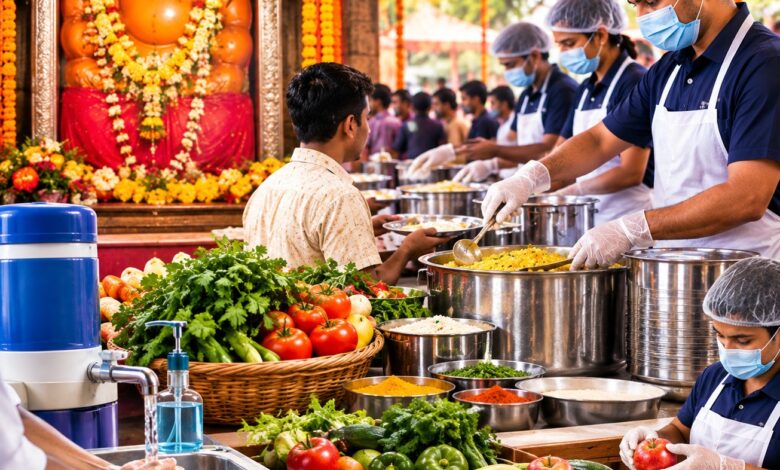
All volunteers handling food must wear aprons, gloves and headgear — the three items of basic protective gear that prevent contamination from human contact with food. Moreover, handwashing must happen frequently — not just at the beginning of the shift. As a result, mandals should have handwashing facilities with soap and clean water available and accessible at the food preparation site.
The advisory also addresses a specific health requirement. Anyone suffering from a skin infection or any other communicable disease must not be involved in cooking or serving food. Furthermore, this is not a suggestion — it is a mandatory exclusion. Therefore, mandal coordinators must check the health status of all food volunteers before assigning them to kitchen or serving duties.
What Happens During an FDA Inspection
The FDA has stated that food safety officers will be conducting inspections at Ganesh mandal premises during the festival period. Furthermore, the advisory specifies exactly what a mandal must do when an inspector arrives.
A responsible person from the mandal must be present and available to cooperate fully with the inspector. Moreover, this person must follow all instructions given by the food safety officer during the inspection. As a result, mandals should designate a specific senior volunteer as the food safety compliance point of contact throughout the festival.
The inspection may cover the cooking area, stored raw materials, utensils, refrigeration arrangements for khowa and mawa, caterer licence documents, purchase bills, volunteer hygiene and water sources. Therefore, mandals that are compliant with the advisory have nothing to fear from an inspection — and everything to gain from demonstrating their commitment to devotee health.
Why Food Safety at Ganeshotsav Matters — The Public Health Dimension
Ganeshotsav is the largest public gathering event in Nagpur every year. Furthermore, Mahaprasad and Bhandara are distributed to thousands — sometimes tens of thousands — of devotees across the city over 10 days.
A single food safety lapse at a large Bhandara can affect hundreds of people simultaneously. Moreover, during festival season, hospitals are already stretched dealing with regular patients plus the health issues that accompany large gatherings. Therefore, preventing food-borne illness through strict hygiene standards is genuinely a public health priority — not just a regulatory formality.
The FDA’s advisory, issued proactively at the start of the festival season, reflects an understanding that prevention is far better than response. Furthermore, Ganeshotsav should be a time of joy, devotion and community — not of illness caused by avoidable food safety failures.
Nagpur Updates urges all Ganesh mandals, trusts and organisers to read this advisory carefully and implement every guideline without exception.