Deekshabhoomi to Get Dedicated Budget Head in Winter Session — Bawankule Reviews 4-Phase Redevelopment Plan

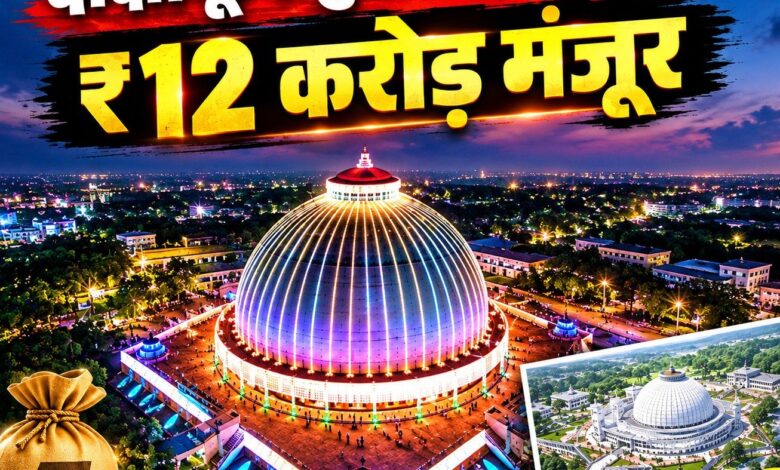

One of Nagpur’s most sacred Buddhist pilgrimage sites is getting serious government attention. Revenue Minister Chandrashekhar Bawankule has announced that a dedicated budget head will be created for the four-phase redevelopment of Deekshabhoomi during the upcoming Maharashtra Winter Assembly Session in December. Furthermore, Rs 12 crore has already been allocated for the project. As a result, Deekshabhoomi’s long-awaited redevelopment is finally moving from discussion to a structured, funded government programme.
Bawankule made this announcement on Saturday after reviewing the preliminary blueprint prepared by the Nagpur Metropolitan Region Development Authority (NMRDA). Moreover, the decision to create a dedicated budget head came on direct instructions from Chief Minister Devendra Fadnavis. Therefore, the project now has the highest level of political commitment behind it.
What Is Being Planned — The Four-Phase Blueprint
The Deekshabhoomi redevelopment is being conceived as a four-phase project. Furthermore, each phase has been planned based on the availability of land and the nature of development required.
Phases 1 and 2 will focus on works that can begin immediately on land already available with the Deekshabhoomi Trust. Furthermore, this means construction can start in these phases without waiting for additional land to be acquired or transferred. As a result, visible on-ground work can begin relatively quickly once the blueprint is finalised and funds are released.
Phases 3 and 4 are more complex. Furthermore, these phases require additional land — specifically land currently owned by the Maharashtra Health Department and the Central Government. As a result, phases 3 and 4 will require coordination between the state government, the central government and potentially the health department before construction can begin. Therefore, the overall four-phase project will unfold over a longer period, with phases 1 and 2 leading the way.

The preliminary blueprint for all four phases has been prepared by NMRDA. Moreover, NMRDA — the Nagpur Metropolitan Region Development Authority — has been the technical implementing partner for several major Nagpur infrastructure projects. As a result, the blueprint carries the weight of professional urban planning expertise.
The Consultation Process — 15 Days for Stakeholder Feedback
Before the blueprint is finalised, it will go through a formal consultation process. Furthermore, this process reflects the importance of Deekshabhoomi to multiple communities and stakeholders beyond just the government.
Bawankule confirmed that the preliminary blueprint will be circulated among Deekshabhoomi Trust members. Moreover, local public representatives will also receive the blueprint for review — including Ramtek MP Shyam Barve. As a result, both the religious and civic custodians of Deekshabhoomi’s legacy will have an opportunity to contribute to the final plan.
Stakeholders will have 15 days to submit their feedback and suggestions on the preliminary blueprint. Furthermore, this feedback period is a genuine consultation window — not a formality. The final blueprint is expected to be ready by October 5, 2026. Therefore, the 15-day feedback window means stakeholders need to submit their responses promptly.
The Timeline — What Happens Between Now and the Winter Session
Bawankule laid out a clear and specific timeline for the steps between now and the Winter Session. Furthermore, this timeline is one of the most concrete commitments made on Deekshabhoomi’s development in recent years.
October 5 — Final blueprint ready after incorporating stakeholder feedback.
October 7 or 8 — District-level committee meeting to review the finalised blueprint.
Later in October — State-level high-powered committee meeting.
After state-level committee — Proposal placed before the committee headed by Chief Minister Fadnavis for approval.
December 2026 (Winter Session) — Dedicated budget head created for Deekshabhoomi in the Maharashtra Assembly.
This is a five-step process with defined deadlines at each stage. Furthermore, the involvement of a CM-headed committee ensures that the project has oversight at the highest administrative level. As a result, delays due to departmental indifference or administrative inertia are significantly less likely than with projects that lack this level of senior attention.
The Rs 12 Crore Already Allocated — And More to Come
The Rs 12 crore that has already been allocated for Deekshabhoomi represents the first concrete financial commitment to the redevelopment. Furthermore, Bawankule confirmed that additional funds will be provided based on the project’s requirements as it progresses.
This open-ended commitment to additional funding is significant. Moreover, it signals that the state government does not intend to cap the Deekshabhoomi investment at Rs 12 crore. As a result, the scale of the eventual investment will be determined by the project’s genuine needs — not by an arbitrary budget ceiling.
The creation of a dedicated budget head in the Winter Session is critical in this context. Furthermore, a dedicated budget head means that Deekshabhoomi’s development funds are tracked separately — not buried within a general works or public works allocation. As a result, the government’s spending on Deekshabhoomi will be transparent, auditable and specifically accountable. Moreover, it makes it easier for the government to commit additional funds in future budget cycles without creating administrative ambiguity about what the money is for.
Why Deekshabhoomi Needs This Development
Deekshabhoomi — located on Ambedkar Square in Nagpur — is one of the most important Buddhist pilgrimage sites in India. Furthermore, it is the place where Dr Bhimrao Ambedkar, accompanied by approximately 6 lakh of his followers, embraced Buddhism on October 14, 1956 — Dhammachakra Pravartan Din. As a result, Deekshabhoomi is not merely a religious site — it is a historical monument of extraordinary significance to India’s Dalit and Buddhist communities.
Every year on October 14 — Dhamma Chakra Pravartan Din — lakhs of Buddhist devotees and Ambedkarites from across India and the world gather at Deekshabhoomi to mark the anniversary of this conversion. Moreover, the site also sees significant footfall during Ambedkar Jayanti on April 14. As a result, on these two days particularly, Deekshabhoomi witnesses crowds that can number in the millions.
However, the existing infrastructure at Deekshabhoomi has struggled to keep pace with this enormous footfall. Furthermore, facilities for the millions of visitors — parking, sanitation, rest areas, approach roads, accommodation for pilgrims — have long been inadequate relative to the scale of the gatherings. Therefore, the four-phase redevelopment is not just a beautification project — it is a genuine public welfare need for the communities who hold Deekshabhoomi sacred.
What This Means for Nagpur’s Buddhist Tourism
Beyond the immediate welfare of pilgrims, the Deekshabhoomi redevelopment has significant implications for Nagpur’s tourism profile. Furthermore, as Nagpur Updates has reported in the context of the city’s broader infrastructure development story, Nagpur is increasingly positioning itself as a significant heritage and cultural tourism destination.
Deekshabhoomi is one of the most powerful draws in this profile. Moreover, visitors from Maharashtra, other Indian states, Sri Lanka, Japan, Thailand, Myanmar, South Korea and other Buddhist nations come to Nagpur specifically to visit Deekshabhoomi. As a result, world-class infrastructure at the site would significantly increase both the duration of their stay and the economic benefit to the city.
The four-phase redevelopment — particularly phases 3 and 4 that require additional land from the health department and central government — has the potential to substantially expand the Deekshabhoomi complex. Furthermore, a larger, better-equipped site would be capable of handling the millions who currently crowd into limited space on Dhamma Chakra Pravartan Din.
What the Winter Session Connection Means
The commitment to create the dedicated budget head during the December 2026 Winter Session in Nagpur is itself significant. Furthermore, the Winter Session is held in Nagpur every year — in the city where Deekshabhoomi stands.
As Nagpur Updates reported earlier, the Winter Session is scheduled for December 7, 2026. Moreover, Nagpur’s MLAs, MPs and civic leaders consistently use the Winter Session to raise local development demands before the full Maharashtra Legislature. Therefore, having the Deekshabhoomi budget head creation specifically tied to the Winter Session — held in Nagpur — gives the commitment an additional layer of accountability.
If the dedicated budget head is not created during the December 2026 Winter Session, it will be visible to every MLA and civic observer who is tracking this issue. Furthermore, the October timeline for blueprint finalisation and committee approvals means everything should be in place for the Winter Session announcement well in advance.
Nagpur Updates will track every step of this timeline — from the October 5 final blueprint to the district and state committee meetings to the Winter Session budget head creation — and report on progress at each stage.