Nagpur Company Solar Defence Delivers Nagastra-2 Loitering Munition to Indian Army

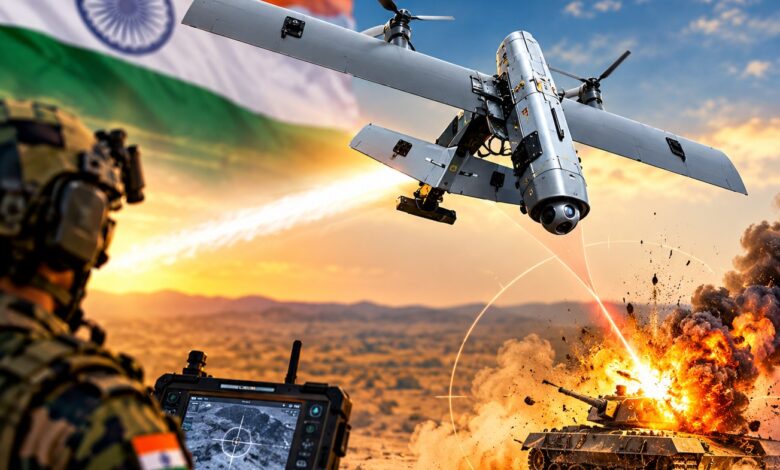

A Nagpur-based defence company has just made India’s military significantly more capable. Solar Defence and Aerospace Limited (SDAL) has completed the delivery of its Nagastra-2 loitering munition system to the Indian Army. Furthermore, the delivery follows successful trials in electronic warfare conditions at the Mahajan Field Firing Range in Bikaner, Rajasthan in August 2026. As a result, the Indian Army now has a battle-ready, indigenous precision strike weapon that can operate in the most challenging electronic warfare environments.
The Nagastra-2 is not just another drone. Furthermore, it is a loitering munition — a class of weapon that represents the cutting edge of modern battlefield technology. As a result of SDAL’s delivery, Nagpur has placed itself firmly on the map of India’s defence manufacturing ecosystem.
What Is a Loitering Munition — Explained Simply
Many readers may be unfamiliar with the term loitering munition. Furthermore, understanding what it is helps explain why the Nagastra-2 delivery is such a significant military development.
A loitering munition — also called a kamikaze drone or suicide drone — is a weapon that combines the surveillance capability of a drone with the strike capability of a missile. Furthermore, it can be launched, fly to a target area, loiter or circle above it for an extended period while identifying the precise target, and then dive into the target to destroy it.
This combination of patience and precision is what makes loitering munitions so effective in modern warfare. Moreover, unlike a conventional missile that follows a fixed trajectory after launch, a loitering munition can be redirected mid-flight, called back if the mission is aborted, or hover until the exact right moment to strike. As a result, it dramatically reduces collateral damage and increases operational flexibility.

The world saw loitering munitions dramatically demonstrate their battlefield impact in the Azerbaijan-Armenia conflict, the Russia-Ukraine war and various Middle East operations. India’s military leadership recognised this potential and has been actively building indigenous loitering munition capability — of which Nagastra-2 is the most advanced deliverable product to date.
Nagastra-2’s Key Capabilities — The Technical Details
The Nagastra-2 comes equipped with a set of capabilities specifically designed for the realities of modern electronic warfare. Furthermore, SDAL has clearly engineered this system with the lessons of recent conflicts in mind.
Range: The operational range of the Nagastra-2 is more than 25 kilometres. Furthermore, this means the operator can stand well behind the front line, safely out of most counter-fire ranges, while the weapon reaches deep into enemy territory.
Anti-Jamming and Anti-Spoofing: The Nagastra-2 features advanced Electronic Counter-Countermeasure (ECCM) capabilities — specifically anti-jamming and anti-spoofing systems. Furthermore, in modern warfare, adversaries routinely attempt to jam GPS signals or spoof drone navigation to redirect weapons away from their targets. The Nagastra-2’s ECCM systems are specifically designed to defeat these countermeasures. As a result, the weapon can operate effectively even when the adversary is actively trying to disrupt its guidance.
Vision-Based Tracking and Autonomous Guidance: Perhaps the most sophisticated feature of the Nagastra-2 is its vision-based tracking and autonomous guidance system. Furthermore, this means that even when GPS signals are completely blocked — a scenario that is increasingly common in electronic warfare environments — the Nagastra-2 can still track and engage its target using optical sensors and on-board artificial intelligence. As a result, the weapon does not rely on any single navigation technology and cannot be defeated by a single form of electronic countermeasure.
Multi-Mode Communication: The system uses multi-mode communication protocols. Furthermore, this redundancy in communication channels means that an adversary cannot simply jam one frequency to break the link between the operator and the weapon.
Electro-Optical Payload: The Nagastra-2 carries a dual-sensor electro-optical payload — day and night capable. Furthermore, this gives operators visibility of the target area in all light conditions. As a result, the weapon is as effective in pre-dawn operations as in daylight missions.
Warhead — 650mm Armour Penetration: The Nagastra-2 is equipped with an indigenously developed tandem anti-tank warhead. Furthermore, tandem warheads are specifically designed to defeat Explosive Reactive Armour (ERA) — the reactive armour panels that modern battle tanks use to protect against shaped-charge weapons. The first charge in the tandem detonates the ERA, while the second charge penetrates the underlying armour. As a result, the Nagastra-2 can penetrate up to 650mm of Rolled Homogeneous Armour (RHA) — making it effective against virtually all tanks and armoured vehicles in use globally today.
The Mahajan Trials — How the Army Validated the System
The delivery of the Nagastra-2 was preceded by rigorous testing at the Mahajan Field Firing Range in Bikaner, Rajasthan — one of India’s most demanding military test environments. Furthermore, the trials in August 2026 were conducted under the supervision of a Board of Officers from the Indian Army.
The specific focus of the Mahajan trials was to test the system’s performance in electronic warfare conditions — the very environment where loitering munitions are most challenged. Moreover, the successful completion of these trials — with the Board of Officers certifying the system’s operational standards and ECCM performance — was the green light for delivery to begin. As a result, the Indian Army has received a system that has been independently verified to perform as claimed in real-world electronic warfare conditions.
Solar Defence and Nagpur’s Defence Manufacturing Story
Solar Defence and Aerospace Limited is headquartered in Nagpur — making this delivery a significant moment for the city’s emerging role in India’s defence manufacturing ecosystem. Furthermore, SDAL has been building its track record in loitering munitions through successive product generations.
In October 2026, just weeks before this Nagastra-2 delivery, SDAL also completed the delivery of 450 Nagastra-1R loitering munitions to the Indian Army — described at the time as one of the largest single deliveries of indigenous loitering munitions in India’s defence procurement history. Moreover, the Nagastra-2 represents a significant capability jump over the Nagastra-1R. As a result, SDAL has now delivered two generations of loitering munitions to the Indian Army within a short timeframe — establishing itself as a serious, proven defence manufacturer.
This is significant in the context of Nagpur’s industrial identity. Furthermore, Nagpur is already home to MIHAN — the Multi-modal International Cargo Hub Airport at Nagpur — which was partly conceived as an aerospace and defence manufacturing zone. As a result, SDAL’s loitering munition deliveries from Nagpur represent exactly the kind of high-technology defence manufacturing that MIHAN was designed to attract and host.
Why Loitering Munitions Matter for India Right Now
The geopolitical and military context in which the Nagastra-2 is being delivered gives this event its fullest significance. Furthermore, India has active security concerns on two borders — the Line of Actual Control with China and the Line of Control with Pakistan — where adversaries possess significant armoured and mechanised forces.
Loitering munitions are precisely the type of weapon that offers a cost-effective response to armoured threats. Furthermore, a single Nagastra-2 — significantly cheaper than a helicopter-launched anti-tank guided missile — can destroy a tank worth crores of rupees. As a result, fielding large numbers of loitering munitions creates a meaningful anti-armour capability without requiring the procurement and maintenance costs of expensive manned platforms.
Moreover, the Indian government’s Atmanirbhar Bharat initiative has specifically prioritised indigenous defence manufacturing as a strategic goal. Furthermore, every Nagastra-2 delivered by SDAL is a weapon that does not need to be imported — reducing India’s defence import bill and strengthening the domestic industry. As a result, the Nagastra-2 delivery is as much an economic and strategic self-reliance story as it is a military capability story.
What This Means for Nagpur’s Industrial Future
Nagpur has long aspired to become a major node in India’s defence and aerospace manufacturing ecosystem. Furthermore, the combination of MIHAN, good road and rail connectivity, proximity to central Indian markets and the presence of companies like SDAL is gradually making this aspiration a reality.
SDAL’s delivery of both the Nagastra-1R and the Nagastra-2 within a short period demonstrates that Nagpur-based defence companies can execute complex, technology-intensive contracts for the Indian Army at scale. Moreover, each successful delivery builds SDAL’s reputation and creates the track record that attracts future contracts. As a result, the Nagastra-2 delivery is not just good news for SDAL — it is good news for Nagpur’s ambition to be taken seriously as a defence manufacturing city.