Giriraj Singh Inaugurates Nagpur Handloom Industries Building at Dhapewada

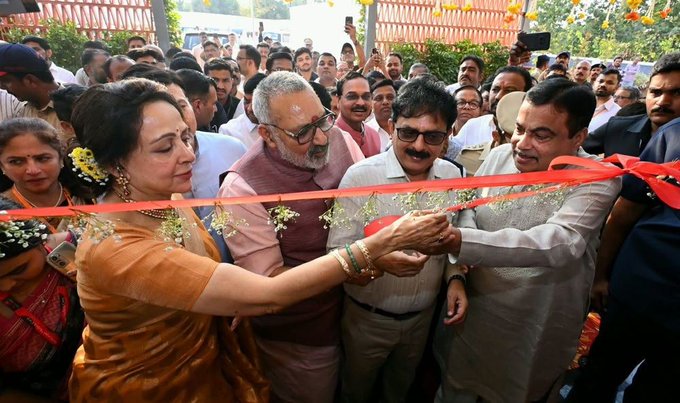

Union Textiles Minister Giriraj Singh took a significant step for Nagpur’s weaving community on October 17, 2026. He inaugurated the newly constructed Nagpur Handloom Industries building Dhapewada 2026 in the presence of Union Road Transport and Highways Minister Nitin Gadkari and BJP Lok Sabha MP Hema Malini. The new facility has been built to promote the handloom industry, give formal recognition to weaver skills, and expand local employment opportunities in one of Nagpur’s most important craft communities.
What Is the Dhapewada Handloom Industries Building?
The newly inaugurated building at Dhapewada in Nagpur is a dedicated infrastructure hub for the handloom sector. It has been designed to bring weavers, skills training, and market linkages under one roof.
The facility eliminates the fragmentation that has long been a challenge for Nagpur’s handloom artisans. Weavers working in isolation, without organised access to raw materials, training, or buyers, have struggled to compete with machine-made alternatives. The new building addresses this by providing a consolidated physical space that can support the entire handloom value chain — from yarn sourcing and weaving to finishing and marketing.
What Did Giriraj Singh Say at the Inauguration?
Minister Giriraj Singh described the building as an important step in three key directions — promoting the handloom industry, giving new recognition to the skills of weavers, and expanding local employment opportunities. His remarks reflect a consistent focus of the Ministry of Textiles under his leadership on ensuring that skilled artisans are not left behind in India’s economic growth.
Singh’s framing of the building as a platform for skills recognition is significant. India has millions of handloom weavers whose expertise is passed down through generations. However, without formal recognition, these artisans often remain outside the scope of government welfare programmes, credit access, and market linkage initiatives. The Dhapewada facility is intended to change this for Nagpur’s weaving community.

Why Was Nitin Gadkari at a Textile Event?
The presence of Union Road Transport Minister Nitin Gadkari at a textile inauguration is not incidental. Gadkari is Nagpur’s most prominent political figure and has consistently championed projects that link Nagpur’s industries to wider national and global supply chains.
His ministry governs India’s road and highway expansion. Better road connectivity directly reduces logistics costs for handloom producers who need to move finished products to retail and export markets efficiently. Nagpur’s position at the geographical centre of India makes it a natural node for this kind of supply chain thinking. Gadkari’s presence at the event signals that the textile cluster at Dhapewada is being viewed as part of Nagpur’s broader industrial and connectivity story.
What Is the National Handloom Development Programme?
The Dhapewada building has been developed within the framework of the National Handloom Development Programme. This programme has been operational since 2015 under the Ministry of Textiles. It channels central government funds into weaver welfare, cluster development, infrastructure creation, and market access initiatives.
The programme has been used to develop handloom clusters across India — from the Banarasi silk belt in Uttar Pradesh to ikat clusters in Andhra Pradesh and Telangana. The Dhapewada building in Nagpur is the latest addition to this national network of organised handloom infrastructure supported by central funding.
What Does This Mean for Nagpur’s Weavers?
Nagpur has a long-established handloom weaving community. Weavers in and around Nagpur produce traditional textiles that have local cultural significance. However, rising competition from power looms and synthetic fabrics has put significant pressure on traditional handloom artisans in the region.
The new Dhapewada facility offers these weavers a chance to modernise their operations without losing the handmade character that gives their products a competitive edge in premium domestic and export markets. Access to organised training, shared infrastructure, and market linkage support from a single dedicated building can meaningfully improve the economic viability of handloom weaving as a livelihood for Nagpur’s artisan families.
What Comes Next?
The inauguration is a first step. The real test for the Dhapewada building will be in its day-to-day utilisation over the months ahead. Whether it becomes an active hub with regular training programmes, live market linkages, and consistent weaver footfall will determine how much of an impact it actually delivers on the ground.