NMC Street Vendor, Parking Pilot on 10 Nagpur Roads: What Changes for Pedestrians, Hawkers and Drivers

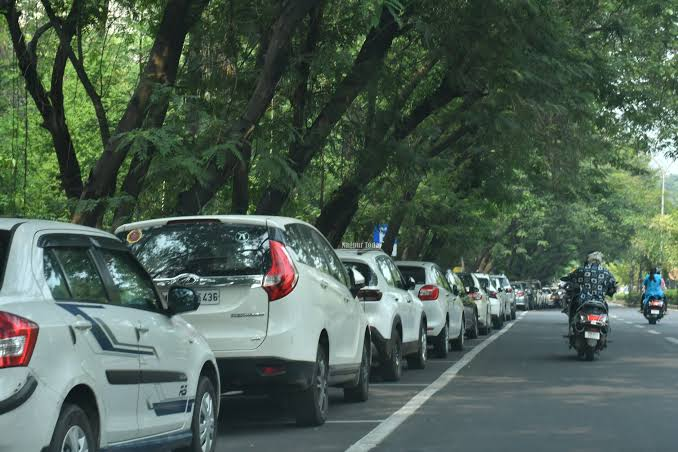

NMC on-street parking: Nagpur’s footpaths and roads are getting a scientific makeover. The Nagpur Municipal Corporation has decided to launch a pilot project for street vendor management on 10 major roads. Furthermore, the same pilot will also address on-street parking in a structured way. Municipal Commissioner Vipin Itankar chaired a high-level review meeting on Thursday where this decision was taken.
The pilot will cover roads in Dharampeth and Laxmi Nagar zones. Moreover, if successful, it will serve as a model for the entire city. This is NMC’s first structured attempt to regulate hawking while keeping roads accessible for pedestrians and motorists.
Why NMC Is Taking This Step Now
Nagpur’s footpaths have long been a battleground. Street vendors set up stalls on footpaths and road margins. As a result, pedestrians are forced onto the road. Motorists then face conflicts with both pedestrians and vendors. Traffic slows down. Safety drops.
NMC has run anti-encroachment drives in recent months. However, these drives remove vendors temporarily. Furthermore, vendors return once enforcement stops. Therefore, NMC has decided to shift from periodic eviction to planned infrastructure.
The new approach focuses on demarcated vending zones. Moreover, it aims to protect vendor livelihoods while keeping footpaths free for pedestrians. As a result, both groups benefit — vendors get secured spaces and pedestrians get accessible walkways.

Experts Who Presented at Thursday’s Meeting
Three expert organisations presented urban mobility concepts at Thursday’s meeting. First, ITDP India — the Institute for Transportation and Development Policy — presented a roadmap for scientific parking management. Second, PDA Pune showcased organised vendor management designs. Third, IRTE — the Institute of Road Traffic Education — also presented mobility improvement concepts.
Furthermore, PDA Pune’s presentation specifically covered designs for Dharampeth Zone, the Futala area and Medical College Square. These are among Nagpur’s most congested and vendor-heavy stretches. As a result, Commissioner Itankar directed officials to identify 10 key roads in Dharampeth and Laxmi Nagar for immediate pilot implementation.
What the Street Vendor Pilot Will Include
The pilot project will not be a simple eviction drive. Instead, it will create planned infrastructure for vendors. Officials have outlined the key elements.
First, demarcated vending spaces will be marked on selected roads. Vendors will be assigned specific spots. Moreover, these spots will be planned so they do not block pedestrian pathways. Second, improved pedestrian walkways will be created alongside the vending zones. Therefore, walkers will have a clear, unobstructed path. Third, conflict reduction measures between vendors, pedestrians and motorists will be built into the design.
However, detailed plans will only be finalised after road surveys. Officials said selected roads will be surveyed before implementation begins. As a result, the pilot design will be based on actual ground conditions rather than assumptions.
On-Street Parking — What Is Changing
Alongside vendor management, Thursday’s meeting also reviewed Nagpur’s on-street parking strategy. Currently, NMC and Nagpur Traffic Police have declared on-street parking on 51 stretches across the city. However, this existing parking infrastructure lacks scientific management.
ITDP India’s parking roadmap presented at the meeting addresses this gap. As a result, Commissioner Itankar directed NMC’s project department to appoint consultants for detailed road surveys. These surveys will map available parking space, current usage patterns and problem areas.
Furthermore, a joint workshop is being organised. It will bring together NMC, Nagpur Traffic Police, Nagpur Improvement Trust (NIT), Public Works Department (PWD) and MahaMetro. Moreover, all five agencies will work together to prepare an integrated parking plan. Therefore, parking management will be coordinated across all relevant bodies — not handled in silos.
Why an Integrated Approach Matters for Nagpur
Nagpur’s parking and vending problems cannot be solved by one agency alone. Roads belong to PWD or NMC. Traffic management belongs to Nagpur Traffic Police. Metro-adjacent roads involve MahaMetro. Furthermore, NIT manages several key urban areas.
Therefore, a plan made by any single agency will always have gaps. The joint workshop approach directly addresses this. Moreover, having ITDP India — a globally respected urban mobility organisation — involved gives the plan credibility and technical depth.
In addition, the Dharampeth and Laxmi Nagar zones are ideal for a pilot. Dharampeth is Nagpur’s most upmarket commercial and residential zone. Furthermore, it has wide roads that can accommodate vendor zones without major disruption. Laxmi Nagar is a busy mixed-use zone with significant pedestrian and vendor activity.
What This Means for Nagpur’s Streets
If the pilot succeeds, Nagpur’s approach to street management will change fundamentally. Currently, enforcement drives chase vendors off footpaths. However, vendors return within days. As a result, the cycle never ends and footpaths remain chaotic.
A planned vending zone system breaks this cycle. Vendors get legal, designated spots. Moreover, they no longer fear eviction from those spots. As a result, they have an incentive to maintain their areas well. Furthermore, pedestrians get clear walkways. Motorists get roads with less conflict and congestion.
The pilot’s results will provide valuable inputs for a citywide street vending and parking policy. Moreover, the 10-road pilot gives NMC real data before scaling across all of Nagpur’s hundreds of commercial roads.
What Happens Next
Road surveys on the 10 selected roads will happen first. Furthermore, consultants for the parking management study will be appointed shortly. The joint NMC-Traffic Police-NIT-PWD-MahaMetro workshop will follow.
Nagpur Updates will track the progress of this pilot and report on which 10 roads are selected, the survey findings and the implementation timeline.